

You’ve been lied to about motivation.
Most people think motivation is something you either have or you don’t.
But motivation doesn’t work like that.
I’ve had periods where I could work all day and had to force myself to stop, and others where I could barely get myself to work. I didn’t suddenly become a different person. But when I compared those periods in my life, there were clearly a few things I did differently.
I’ve read a lot about the neuroscience and psychology of motivation, and I’ve also tested a lot of habits and strategies in the 10+ years I’ve been “self-improving.” That made me realize something:
Motivation is something you can engineer.
When we look at it from a first-principles point of view, motivation is basically wanting to do something. There are 5 principles that can help you create a life where the things you should do become the things you want to do. That’s what I’ll break down in this article.
I’ll make it as concise as possible, but you still need to motivate yourself to read for a few minutes instead of scrolling.
Let’s begin.
1. Know Your Why
He who has a why to live can bear almost any how.
– Friedrich Nietzsche
The periods in my life when I’ve been the most motivated were when I had a clear vision of what I wanted to achieve.
As Arnold Schwarzenegger says, the vision needs to come first because it creates the “want power”. We’re programmed to survive and to reproduce, so this means that we tend to be lazy because laziness helps us to preserve energy. So to get around this, we need to have a clear vision of something that’s good enough to justify spending energy on.
In other words, you need a goal. I know, boring advice. But it’s crucial. Without a goal, you don’t have anything to move towards. And since most motivation comes from moving towards a desirable goal, you’ll miss out on a lot of motivation.
So you need to get clear on what you want. I recommend picking something that you truly want to achieve (your Heaven) and something that you truly want to avoid (your Hell).
Your Heaven pulls you forward. Your Hell pushes you from behind.
Together, they use your two strongest motivators: desire and fear.
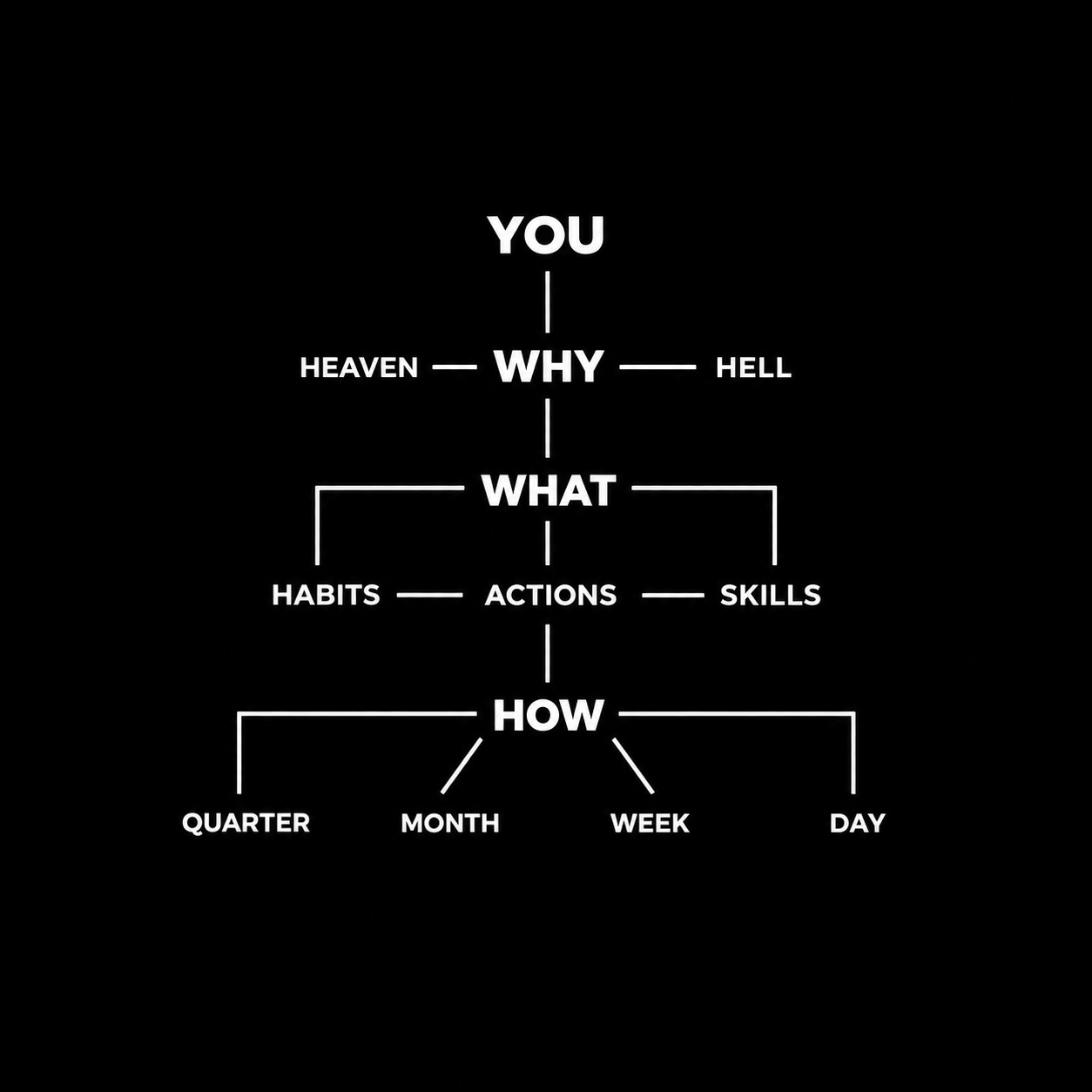
For now, the combination of your Heaven and Hell becomes your Why.
It will evolve over time. That’s normal. So don’t get hung up on trying to make it perfect. It’ll never be perfect, so just make it good enough and improve it as you get clearer on what you want and don’t want by taking action.
When you have a clear vision, break it down to make it practical.
Reverse-engineer your Heaven into goals, milestones, and actions until you know exactly what you need to do today.
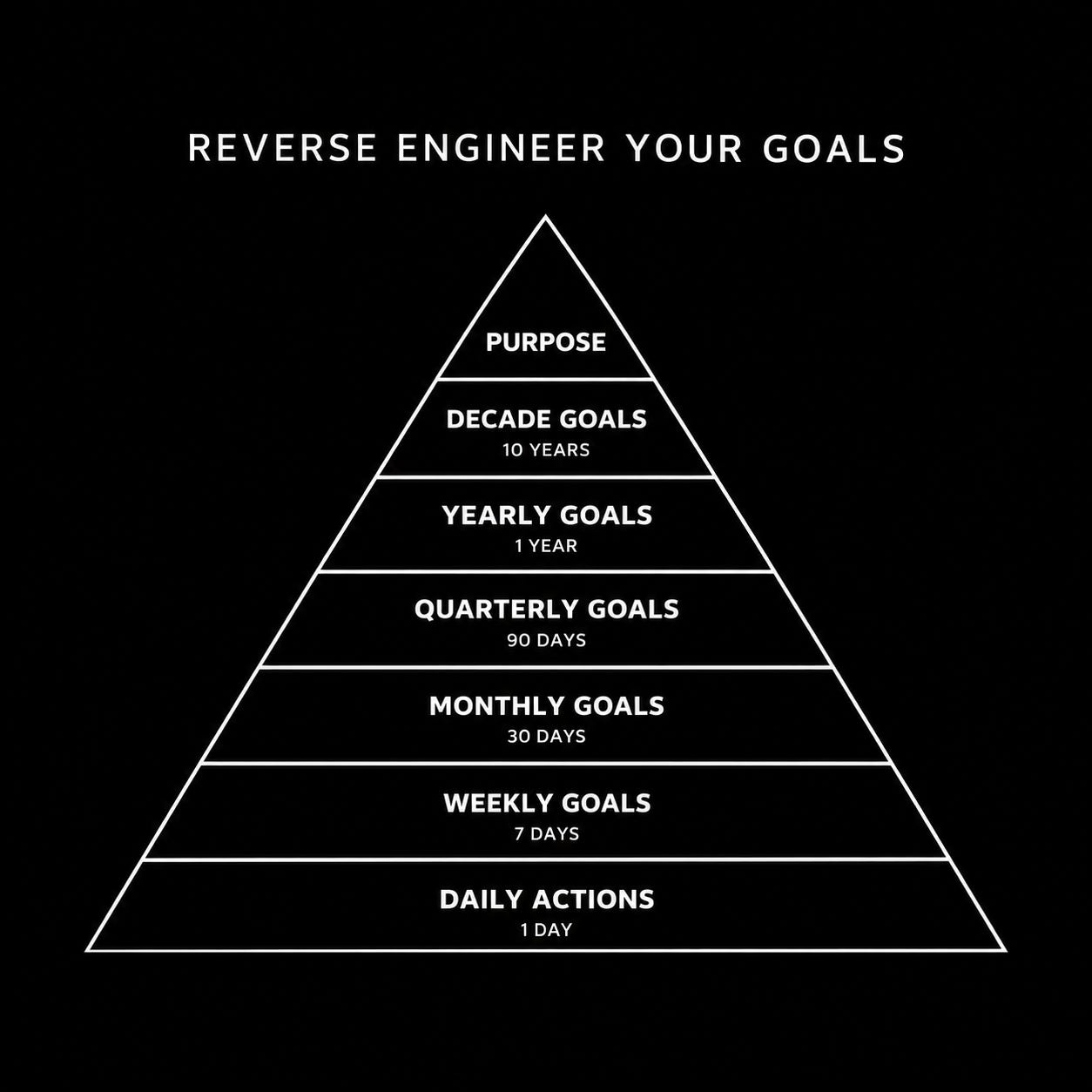
This will make you more motivated because it connects your daily actions to your long-term vision. Every action becomes a step you take that brings you closer to your desired future. This can release dopamine in your brain, which makes you feel more motivated.
Then there’s one more thing that you need to do. You need to make your future feel real.
In the book Psycho-Cybernetics, Maxwell Maltz argues that imagined experiences can influence us in ways similar to real experiences. This is because an experience creates thoughts, emotions, and physical responses that can gradually change you.
Visualization can create some of those responses without the experience actually happening. The key is to try to feel the emotions that you would feel if you achieved your goal.
Don’t just think about your future intellectually. Close your eyes and imagine yourself already living it. See what you would see. Feel what you would feel. Make it as clear and emotional as possible.
This is also an idea Joe Dispenza emphasizes: combine a clear intention of the future you want with the elevated emotions you would feel if that future were already real.
The point isn’t to magically attract your future without doing the work. It’s to repeatedly experience the thoughts and emotions associated with that future. You are shaped by your experiences and the emotions they create.
Over time, this can affect your self-image, expectations, and behavior. Instead of your desired future being something you only want, you’re mentally and emotionally rehearsing the person you need to become to create it.
Instead of letting your past determine how you feel and act in the present, you start using your desired future to shape how you feel and act now.
Visualization won’t achieve the goal for you. But it can change the state you’re acting from, which can change the actions you take.
This is it for the vision part, but this is only one piece of the puzzle.
2. Turn Work Into a Game
The best moments usually occur when a person’s body or mind is stretched to its limits in a voluntary effort to accomplish something difficult and worthwhile.
– Mihaly Csikszentmihalyi
I recently made a counterintuitive observation about people who say that they lack motivation:
They don’t lack motivation.
This sounds weird but let me explain what I mean. The people who complain about a lack of motivation usually aren’t lacking motivation. They have no problem playing video games for hours. That requires serious effort, but it feels effortless for them.
This is because of how the games are designed. Video games leverage certain inner motivators and because of this, they make it almost effortless for us to take action.
The main intrinsic motivators games leverage are:
Progress: you constantly see yourself moving forward.
Mastery: you get better at something through practice.
Challenge: there’s always a difficult but achievable next step.
Autonomy: you choose what to do and how to do it.
Curiosity: you want to discover what happens next.
Competence: you receive constant evidence that you’re improving.
Feedback: actions produce immediate, clear results.
Achievement: goals, levels, milestones, and wins give you something to pursue.
These are the things that make games addictive and fun. So the key is to recreate these things in your work to make it more fun.
Start by making progress visible. Games constantly show you points, levels, streaks, and completed missions. Do the same with your goals. You don’t have a level up bar in real life, but you can track the actions that move you forward so you can see yourself making progress.
I made a Habit Tracker to help you do this. It’s part of my Purpose Planner and you can get it here for free.
You also need to find the right challenge level. Think about it like a game.
If you’re a level 50 character that’s slaying level 5 monsters, then you barely get exp. It’ll also be boring. The opposite is true if you try to slay level 50 monsters as a level 5 character. It’ll be too stressful because your current skill level isn’t high enough. That’s why you need to pick a challenge that’s a little bit above your current skill level.
According to Steven Kotler, it’s ideal to pick a challenge that’s just 4% above your current skill level. If something is too easy, you get bored. If it’s too difficult, you get overwhelmed. But when the challenge is slightly above your current skill level, you’re more likely to become fully engaged and enter a state of flow.
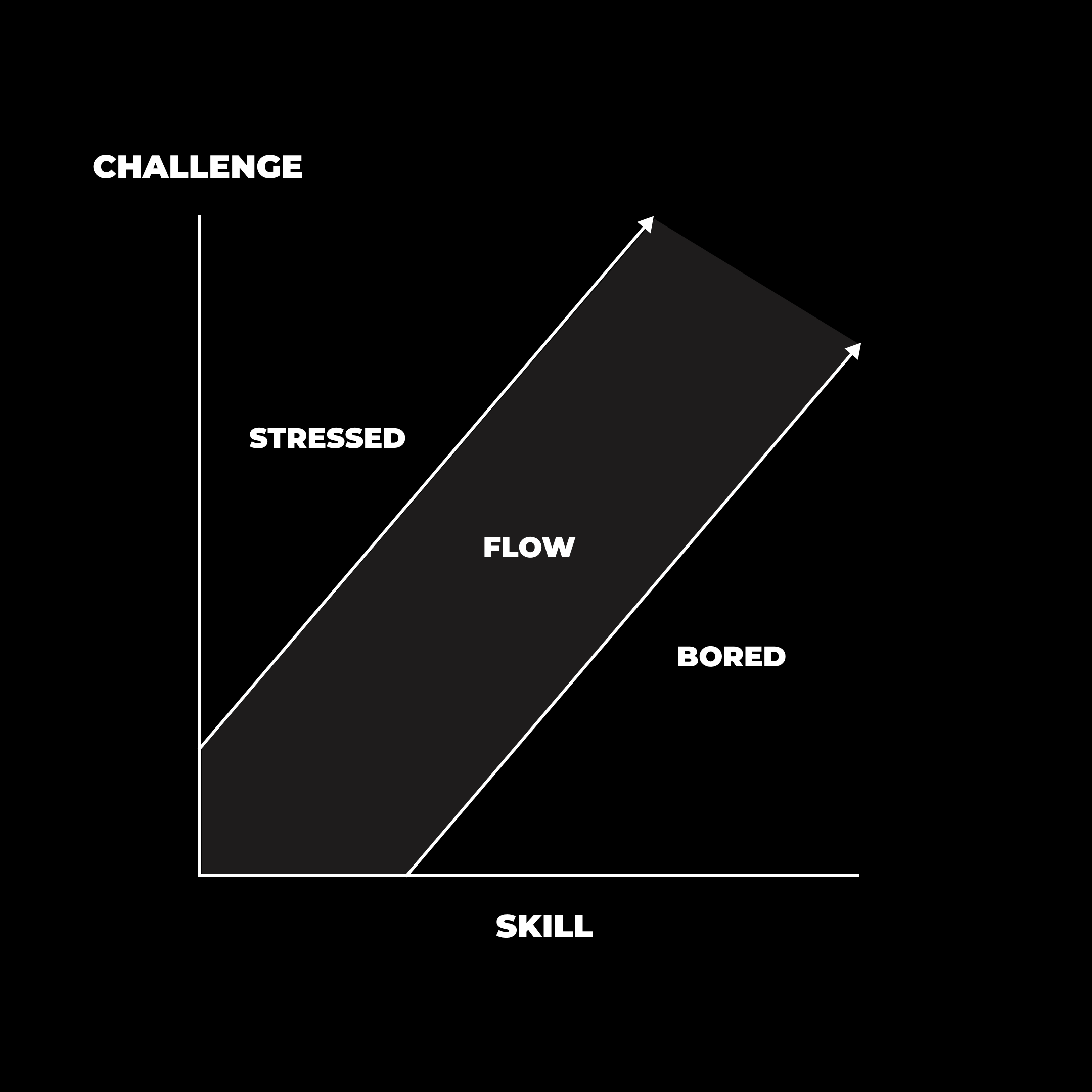
This stretches your ability and this gets you into a flow state.
Finally, create your own game loop:
Goal → Challenge → Action → Feedback → Progress → Reward → Next Level
Set a clear goal. Give yourself a challenge. Take action. Get feedback. Track your progress. Reward yourself for winning. Then make the challenge slightly harder and repeat.
Instead of relying on motivation to do boring work, design the work so that you want to keep playing. When you turn your work into a game, it starts to feel like play and you’ll be naturally motivated to do it.
3. The Pain Pleasure Principle
With prolonged and repeated exposure to pleasurable stimuli, our capacity to tolerate pain decreases, and our threshold for experiencing pleasure increases.
– Dr. Anna Lembke
One of the best ways to increase your motivation is to limit your consumption of instant gratification activities.
We briefly talked about how dopamine plays a role in motivation. We get dopamine when we see ourselves move closer towards a goal. However, if you constantly expose your brain to highly stimulating rewards, then the ordinary, slower rewards feel less motivating by comparison.
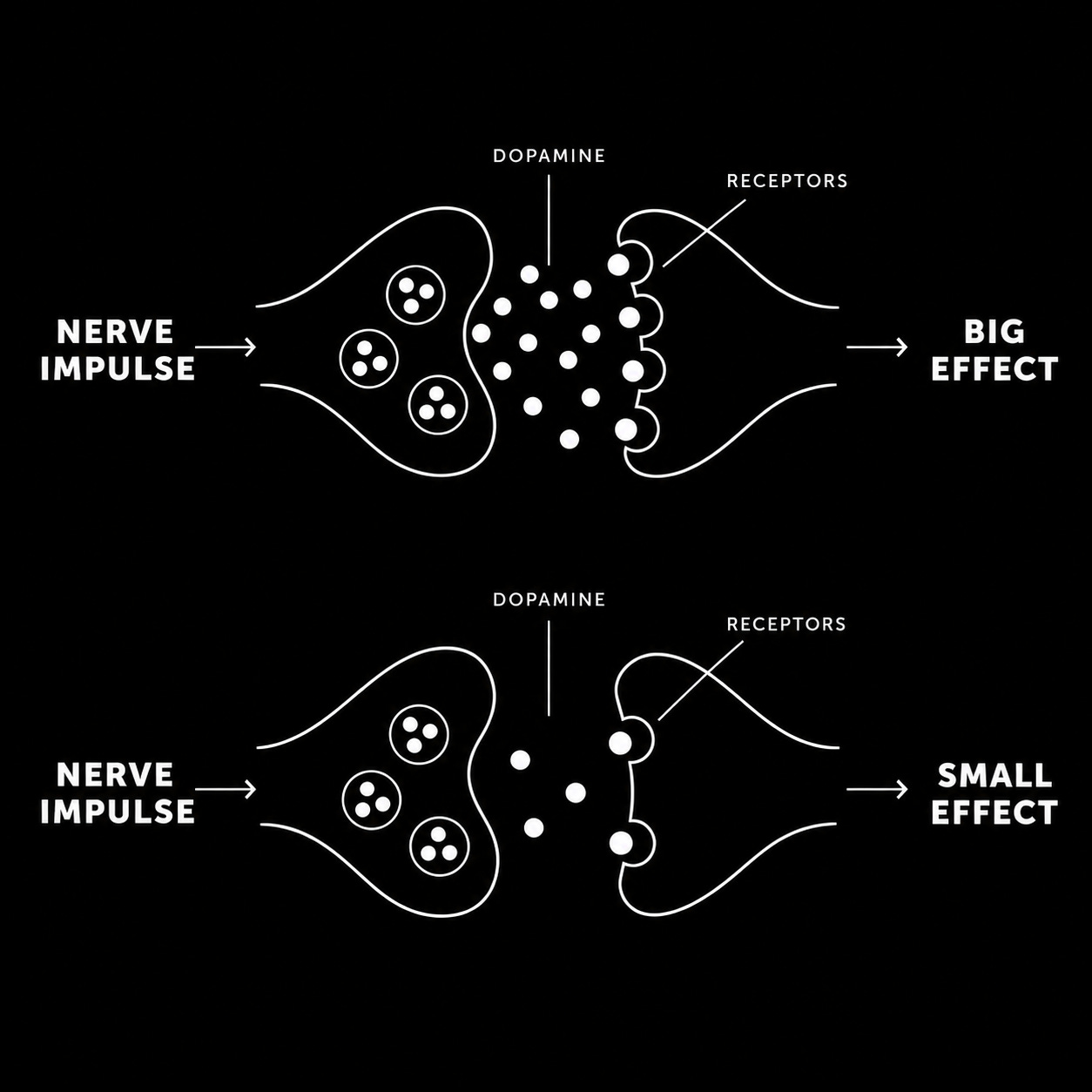
Think about it like this (these numbers aren’t scientific, I’m just using them as an example to illustrate my point):
Moving towards your goal may give you 10 units of dopamine. This isn’t a lot or a little. It depends on how much dopamine you get from other activities. If you doomscroll for 30 minutes, this may give you 50 units of dopamine. And if you watch p*rn, smoke a few cigarettes, or drink a six-pack of beer, then this may give you 100 units of dopamine.
So to your brain, the dopamine from working towards your goals seems like a bad trade-off. It costs a lot of energy and it gives you significantly less dopamine than the other activities (that are also much lower effort).
The high-dopamine activities raise the bar for what’s stimulating to you.
This is one reason why reading a book, going to the gym, or working on your goals can feel difficult. When your brain gets used to highly stimulating rewards, lower-stimulation activities can feel boring and harder to do by comparison.
So if you want to become dangerously self-motivated, one of the most powerful things you can do is remove high-stimulation activities. When you do this, other activities become more fun by comparison because your brain lowers the threshold for what’s considered to be fun and stimulating.
I like how this graph from After Skool illustrates this:
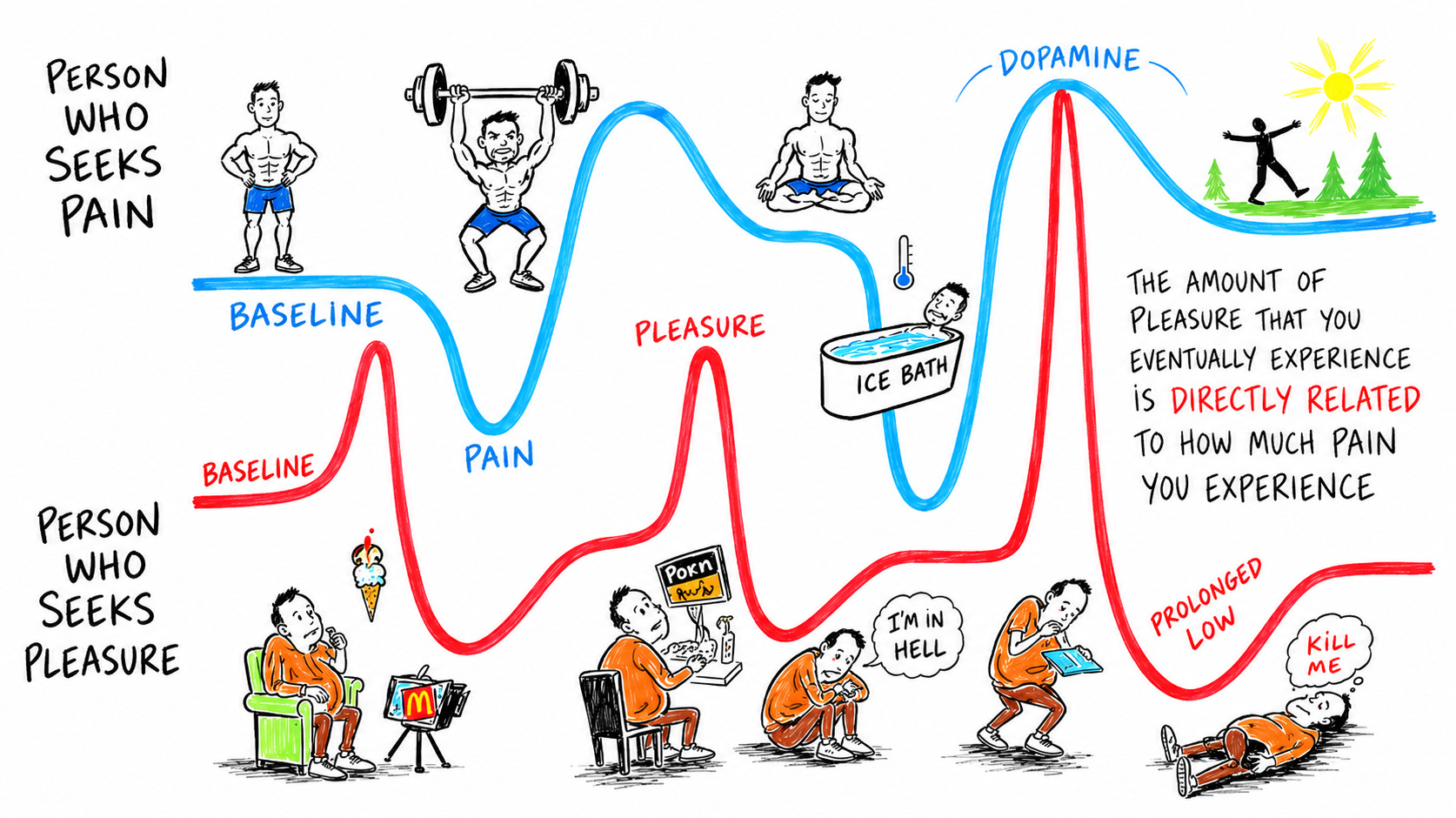
More useful pain leads to more pleasure later. More meaningless cheap pleasure now leads to more pain later.
Again, it isn’t perfectly scientifically accurate, but that doesn’t mean that it’s not a useful way to think about it.
Generally speaking, the more meaningless pleasure you remove, the better off you’ll be long-term. You don’t need to quit everything, but the more you get rid of, the better you’ll start to feel. It’s not easy, but that’s why most won’t do it. If you want to get better results than 99% of people, you need to do the things that 99% of people are not willing to do. And getting rid of instant gratification activities is one of those things.
Nobody is forcing you to do this. But if you want to become dangerously self-motivated, this is one of the things you have to do. Stop wasting your dopamine on cheap stimulation. Get comfortable with boredom so the work that actually matters becomes rewarding again.
I find it useful to think of dopamine as a currency. If you spend it, you get pleasure now. If you invest it, you get motivation later.
4. Make Your Biology Work For You
To keep the body in good health is a duty, otherwise we shall not be able to keep our mind strong and clear.
– Buddha
On most days, my motivation is pretty high.
But if I don’t sleep enough, my motivation instantly drops a lot. That’s because the body and the mind are linked. You can’t outthink or outwork poor sleep, a lack of exercise, and a bad diet. You can be the most motivated person in the world. But if you sleep 3 hours, eat like shit, drink alcohol, and don’t exercise, your motivation will fade away fast.
That’s why you need to fix the biological foundations. It’s not fun or cool advice, but it’s extremely important.
The most important habits are:
Sleep 8 hours
Eat healthy food
Exercise almost daily
Limit cheap dopamine
Meditate and take short breaks
Don’t sit too much and stretch daily
There’s more, but this is the most important stuff. I recommend making a habit tracker because it shows you exactly when you are not doing what you should be doing so this makes it easier to stay on track. Again, you can get my habit tracker here.
It’s also important to do your most important work when you are at your best. We all have a sleep chronotype. This basically means that you naturally tend to be more alert and productive at certain times of the day.
The most important thing is finding the most important thing to do and then doing it when you’re at your best. If that’s 4am, great. If it’s 1pm or 10pm, great. Just get clear on when it is and get it done. If you do that, and if you make sure that you fix the foundational habits, then you’ll be much more motivated and you’ll get much more done.
5. Make It Easy To Do The Work
Environment is the invisible hand that shapes human behavior.
– James Clear
No matter how locked in we are, our motivation and willpower still have a limit. It can be extremely high, but it’s not unlimited. So we also need to get rid of the things that might potentially drain it.
In other words, we want to design our environment so that it makes it easy to do what we set out to do. We need to add friction to our environment to make bad behavior harder and we need to remove friction to make good behavior easier.
This is true for both our physical and digital environments.
The fewer distractions and temptations you have, the easier it becomes to do the work.
You can do many different things for this. Here’s a list of everything that works for me:
Plan tomorrow today
Turn off all notifications
Isolate during the morning
Hide bookmarks and minimize tabs
Use a standing desk to switch posture
Don’t multitask or switch between tasks
Focus on one big action step per work block
No phone, email, or social media before noon
Stay fasted and caffeinated during deep work
Use earplugs or noise-cancelling headphones
Keep your desk empty (just your PC and water/coffee)
Work in 90-minute blocks (then recover for 10 minutes)
Batch-produce shallow tasks into one time block later in the day
Do your most important work when your energy peaks (usually morning)
Reduce decision fatigue by eating mostly the same meals, wearing simple clothes, and automating small decisions
You don’t need to do all of this. But the more of these you apply, the easier it becomes to focus. And the easier it is to focus, the less motivation you’ll waste on the wrong things.
This is how you become dangerously self-motivated. It’s not easy. That’s why most people won’t do it. But if you’re able to do this, you’ll blow past the competition.
Stijn
How I Can Help
1. Thread Mastery. Learn how to write viral threads for X and Threads.
2. X Growth System. Learn how to grow an audience on X and Threads with writing.
3. More Content. I backlog my best newsletters and articles on my website. I also turn them into videos. Click here to subscribe. You can also follow me on LinkedIn, 𝕏/Twitter, Instagram, and Threads for short daily lessons.
I can but what about misleaders of mind thinks