

Some people achieve in months what takes others years.
People usually think this is because of a difference in work ethic, but while hard work is important, it doesn’t fully explain the massive differences in results.
Plenty of people work incredibly hard and still struggle to achieve their goals. And there are also plenty of successful people who don’t seem to work that hard.
The difference often comes down to what they work on.
That’s where strategic thinking comes in.
Strategic thinking is the ability to make decisions that maximize your chances of achieving a desired outcome. It’s about knowing what you want, finding the most effective path to get there, and making the right moves along the way. A strategic genius is someone who executes this process flawlessly to achieve their goals.
In this article, I’ll explain the 5 Pillars of Strategic Thinking, and I’ll turn them into a simple 5-step process that will help you think like a strategic genius so you can make better decisions and achieve your goals faster.
Before we dive in:
I’m running a special final sale for the 𝕏 Growth System.
Inside, you’ll learn the strategies I used to grow to 74,000+ followers on 𝕏 and generate 100M+ yearly views. These strategies also work on other writing platforms.
This is your last chance to get it before it closes at the end of this week.
» Click here to get the X Growth System.
With that out of the way, let’s dive into it.
How to Think Like a Chess Grandmaster
I was a chess prodigy when I was younger.
By the time I was 11, I had won more than 10 trophies and was competing against the best adult players in my area. When I was 8, I even made a 16-year-old club champion cry after beating him in front of his entire club (yes, really, here’s the full story).
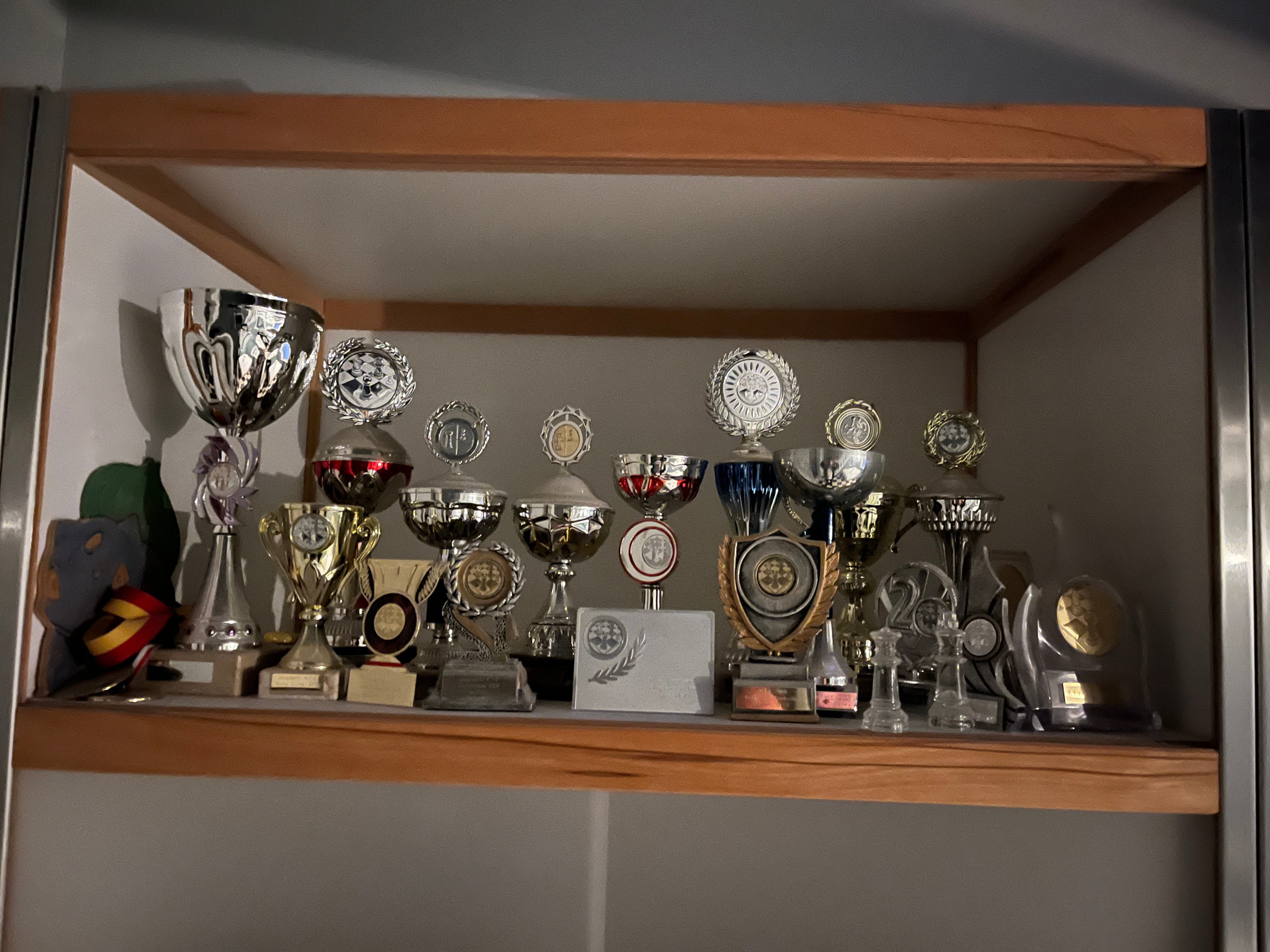
Sadly, I peaked when I was 11 because I quit when I went to high school.
But my interest in strategy never went away. I kept reading and learning about it.
To me, a chess grandmaster is a perfect example of a strategic genius.
They know what they’re trying to achieve, assess their current position, calculate different moves, develop a plan, and adapt as the game unfolds.
I’ve spent a lot of time thinking about what makes chess grandmasters and other great strategists so effective. I’ve identified 5 pillars of strategic thinking that you can apply to your own life. Let’s go through them.
I. Vision — Start With The End in Mind
If a man knows not to which port he sails, no wind is favorable.
— Seneca
Strategy is about achieving what you want in the most effective way.
But if you don’t know what you’re trying to achieve, you can’t determine whether your decisions are moving you in the right direction.
That’s why every great strategy starts with a clear vision.
The grandmaster thinks about the position he wants to create on the board. Then he works backward to determine which moves could get him there and in what order.
This is called reverse-engineering.
It means starting with your desired outcome and working backward to identify what needs to happen to make it a reality. This helps you make decisions that bring you closer to your desired goal.
You can apply this principle to your own life by choosing a long-term goal and breaking it down into yearly, quarterly, monthly, and weekly milestones.
From there, you can identify the daily actions you need to take to get there.
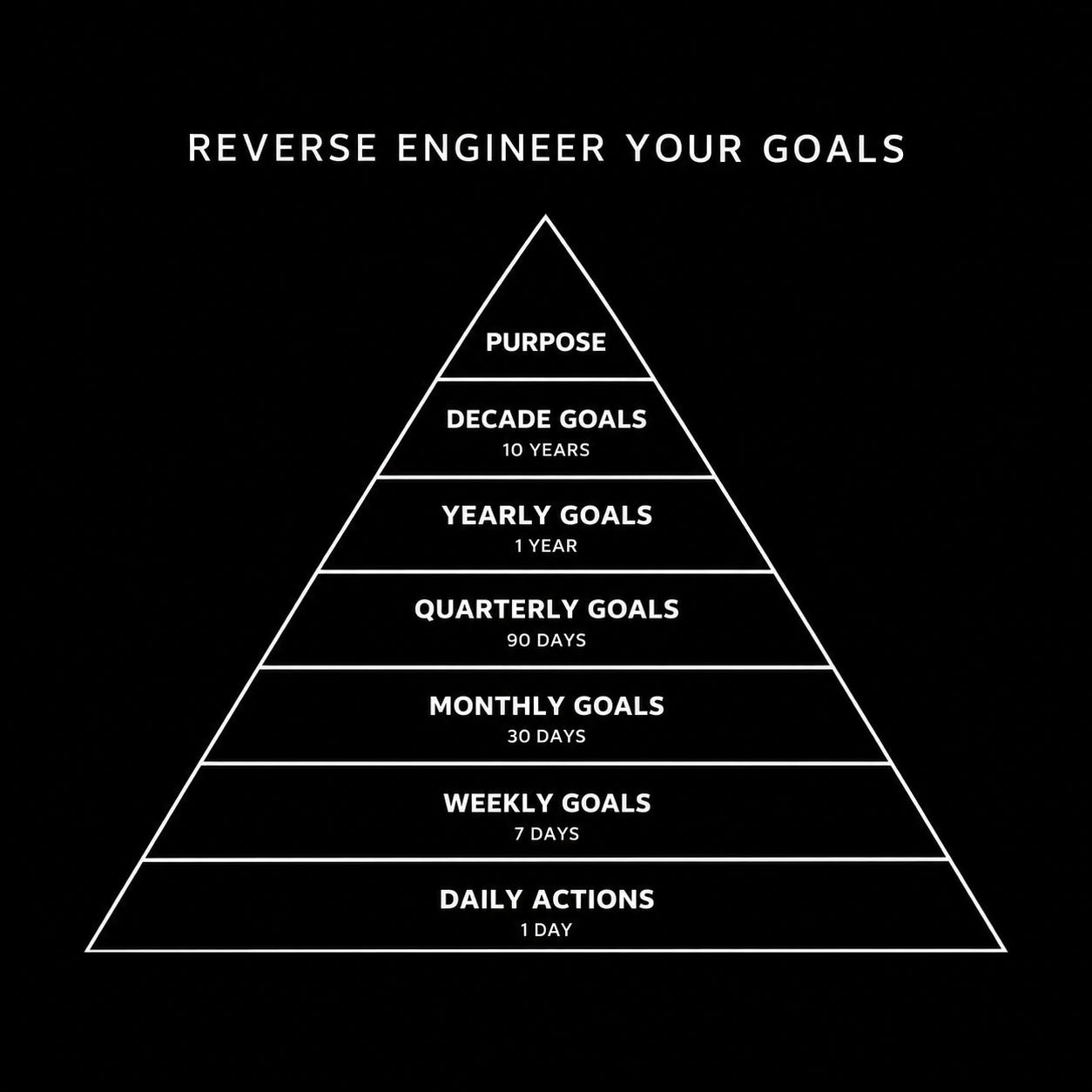
Let’s say your goal is to build a creator business that makes $10,000 per month.
Instead of immediately asking yourself what you should work on, start by figuring out what achieving that goal would require.
In this case, you might decide to sell a $500 product.
This means you need 20 sales per month. If your offer converts at 2%, you would need 1,000 people to see it to get 20 sales. And if 1% of your content views turn into offer views, you would need approximately 100,000 views to get those 20 sales.
These numbers are hypothetical, but they illustrate the principle. When you do this, you have a clear picture of what it takes to achieve your ideal position.
Then you can look at what you actually need to achieve this:
Something valuable to sell (product)
People who want to buy it (audience)
A way to reach those people (content)
A way to convince them to buy (offer)
You can then break these requirements down into smaller milestones until you have a clear picture of what needs to happen.
This is the power of reverse engineering.
Instead of randomly taking action and hoping it leads somewhere, you start with your desired outcome and work backward to understand what it takes to get there.
That’s why vision is the first pillar of strategic thinking. Even the greatest strategist can’t create a good plan without knowing where he wants to go.
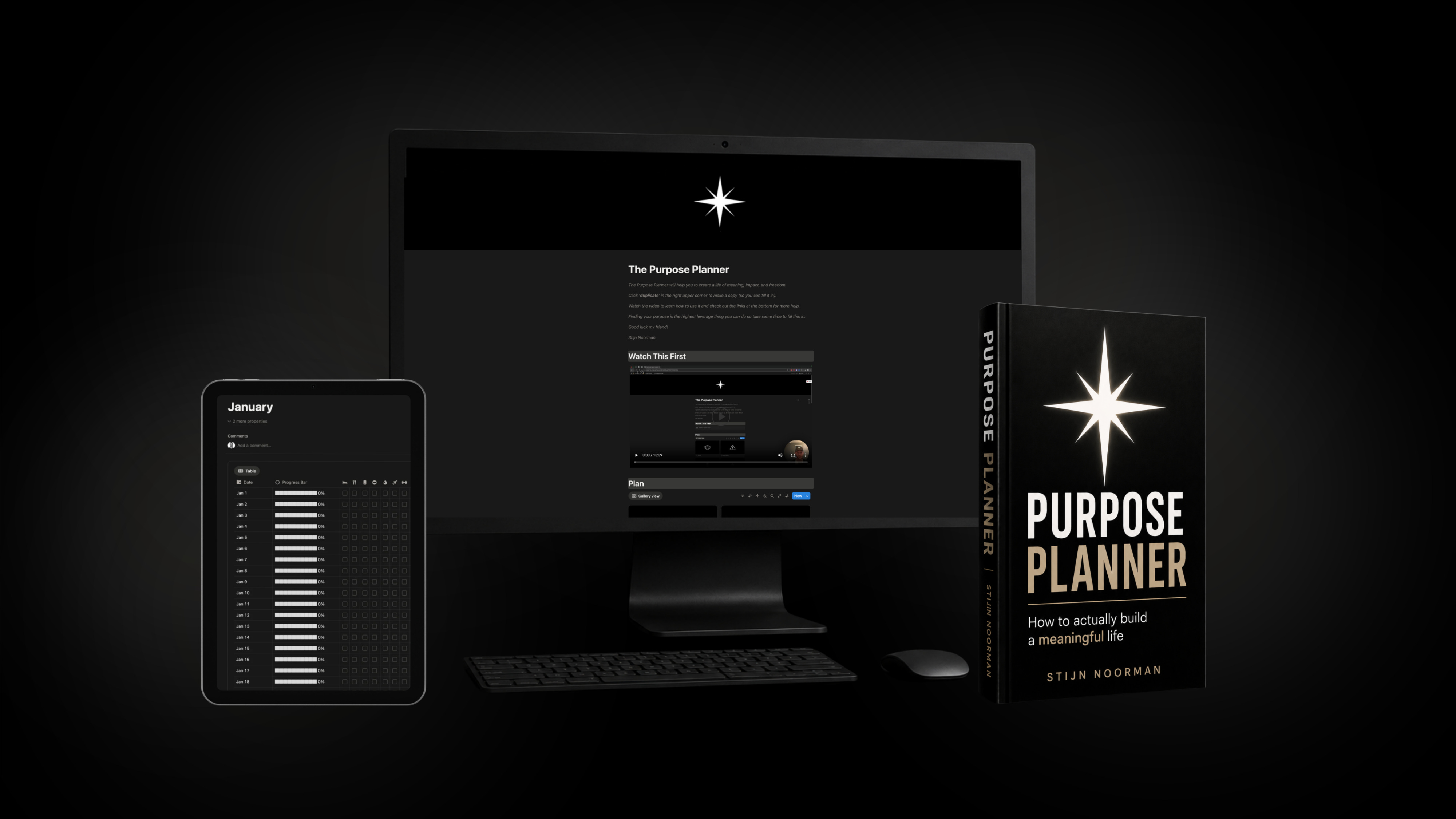
If you struggle with this, you can get my Purpose Planner for free. It will help you find your purpose and develop a clear vision for your life. I believe this is one of the most important things you can do, which is why I made it free. Click the button below to subscribe, or reply to this email if you’re already subscribed and I’ll send it to you.
II. Analysis — Understand Your Current Position
If you know the enemy and know yourself, you need not fear the result of a hundred battles.
— Sun Tzu
Once you know where you want to go, you need to understand where you are.
Think about chess again.
Before you make a move, you need to understand your current position. You need to understand which pieces you have, what threats your opponent poses, and what opportunities could improve your position.
The same principle applies to achieving your goals.
Let’s continue with the example of building a business that makes $10,000 per month.
We already identified the main requirements: something to sell, people to sell it to, a way to reach those people, and a way to convince them to buy.
Now you need to analyze your position to see what you have and what you lack.
Maybe you have a valuable skill but no audience. Maybe you have an audience but no product. Or maybe you have both, but you don’t have an offer that sells.
Each of these situations requires a different strategy. That’s why you need to properly analyze your current position first.
To do this, ask yourself:
Resources: What do I have at my disposal? (time, energy, money)
Strengths: What advantages can I use? (skills, experience, connections)
Weaknesses: What are my disadvantages? (skill gaps, bad habits, blind spots)
Environment: What obstacles and opportunities exist? (trends, threats, demand)
The important thing is to be objective.
If your current position is bad, you need to admit that to yourself. You can’t improve if you don’t do this. A strategy based on incorrect assumptions can send you in the wrong direction, no matter how well you execute it.
The better you understand your current position, the easier it becomes to identify the smartest path toward your goal.
That’s why analysis is the second pillar of strategic thinking. There’s a section in the Purpose Planner that helps you with this as well.
III. Judgment — Find the Smartest Path
Give me a lever long enough and a place to stand, and I shall move the world.
— Archimedes
Now that you know where you want to go and where you currently stand, it’s time to figure out the smartest way to get there.
This is where judgment comes in.
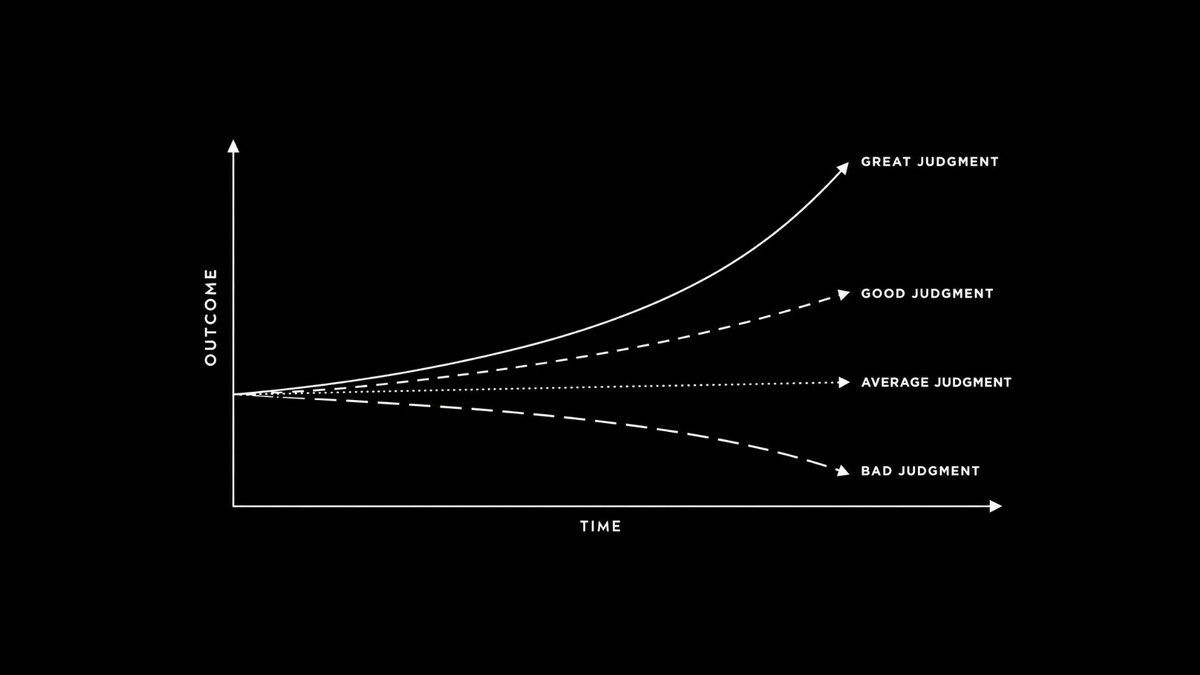
Judgment is your ability to evaluate different options and make decisions that maximize your chances of achieving your goals. Developing this skill is incredibly valuable because not all paths are equally effective, and choosing the right one can make an enormous difference in your results.
Let’s continue with our business example. Imagine you want to make $10,000 per month and you’ve already built an audience. You could sell a service, create a digital product, or promote someone else’s product. All three approaches could work, but each one has different advantages and disadvantages.
Selling a service might generate income faster, but it also requires your time to deliver. Creating a digital product allows you to sell the same product repeatedly, but it will take more work upfront and you need more volume to make it work. Promoting someone else’s product eliminates the need to create your own, but it gives you less control over the offer and you’re now dependent on someone else.
None of these approaches is ‘the best way’. Judgment is about evaluating the trade-offs and determining which path makes the most sense for your situation and goals.
Once you’ve identified the most promising path for you, look for the highest-leverage moves you can make. These are the actions that generate the greatest results relative to the time, effort, and resources they require. One high-leverage move can give you better results than 10 low-leverage moves combined.
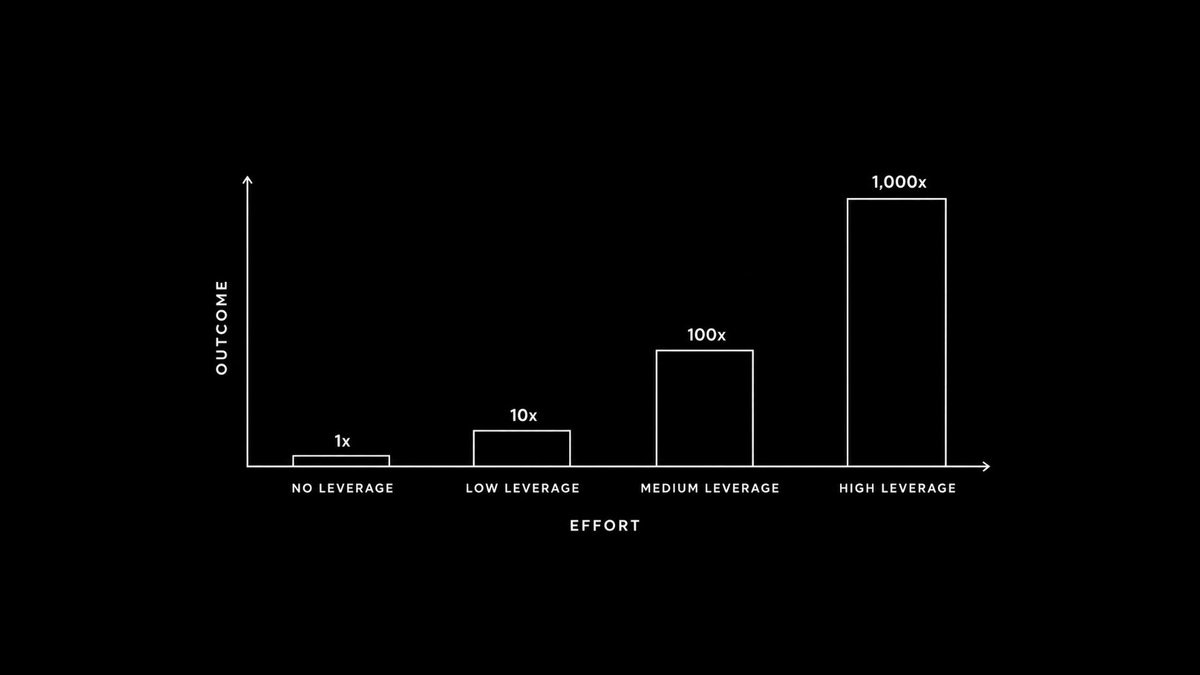
Once you’ve identified these moves, create a plan. Determine what needs to happen, in what order, and how the different actions fit together.
Strategic judgment is about choosing the most promising path and developing a plan that maximizes your chances of achieving your goal.
Once you have that strategy, it’s time to execute it.
IV. Execution — Concentrate Your Forces
The secret of great battles consists in knowing how to deploy and concentrate at the right time.
— Napoleon Bonaparte
A great strategy is worthless if you don’t execute it.
Execution isn’t just about working hard. It’s about concentrating your efforts where they can make the greatest difference.
Napoleon understood the importance of concentrating your forces better than almost anyone. He knew that you didn’t need to have the largest army to win a battle. What mattered was having superior strength at the decisive point.
By concentrating his forces at the right place and time, he could win battles and force a breakthrough even when he was facing a larger opponent.
The same principle applies to executing your strategy.
Your resources are limited, but how you use them determines how effective they become. When you spread your resources too thin, you risk making progress everywhere without achieving anything decisive. But when you concentrate your resources, you can achieve breakthroughs that would otherwise be out of reach.
In short, you concentrate your forces where they can make the greatest impact.
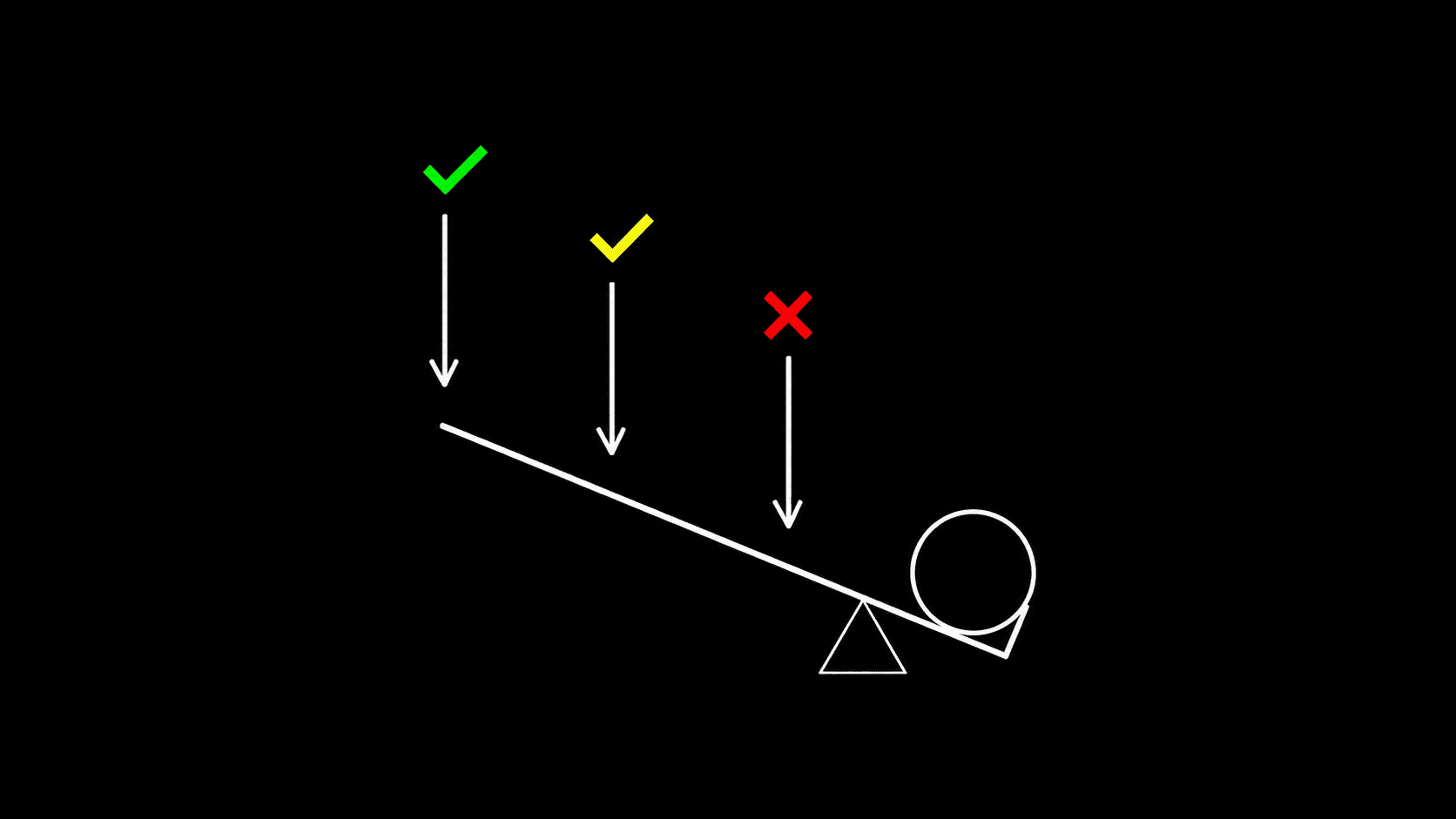
This is why your resourcefulness is often more important than the resources you have available. Strategic geniuses are extremely resourceful even with limited resources.
Strategic execution is about concentrating your forces at the decisive point and following through until you’ve achieved your objective. Once you’ve accomplished that, you can redirect your forces toward the next objective.
V. Adaptation — Learn, Adapt, and Iterate
No plan survives contact with the enemy.
— Helmuth von Moltke
No matter how good your strategy is, things rarely go exactly according to plan.
You will encounter unexpected obstacles, discover new opportunities, or realize that some of your assumptions were wrong.
That's why the final pillar of strategic thinking is adaptation.
Think about chess again.
You can have a brilliant strategy, but your opponent isn’t going to follow your plan. Every move they make changes the position on the board. Even if you’ve thought 10 moves ahead and considered several possible responses, they can still make a move you didn’t expect. That’s why you need to constantly evaluate the situation and adjust your strategy accordingly.
This is also true for your goals.
Let’s say you’ve launched your digital product, but you’re not generating the sales you expected. Maybe your product isn’t as appealing as you thought. Maybe you’re targeting the wrong audience. Or maybe you’re reaching the right people, but your sales page isn’t convincing them to buy.
Each problem requires a different solution.
That’s why you need to create a feedback loop:
Observe: Measure your results
Analyze: Identify what’s working, what’s failing, and why
Adjust: Change your strategy based on what you’ve learned
Repeat: Continue improving as new information becomes available
You want to stay committed to your vision, but you want to be flexible with your plans.
You don’t want to abandon your strategy every time something goes wrong. But you also don’t want to stubbornly stick to a plan that clearly isn’t working. Make changes based on what you learn, rather than reacting emotionally to every result.
Treat the process like a scientist. Make a hypothesis based on research, experiment to test it, analyze the results, and make changes accordingly.
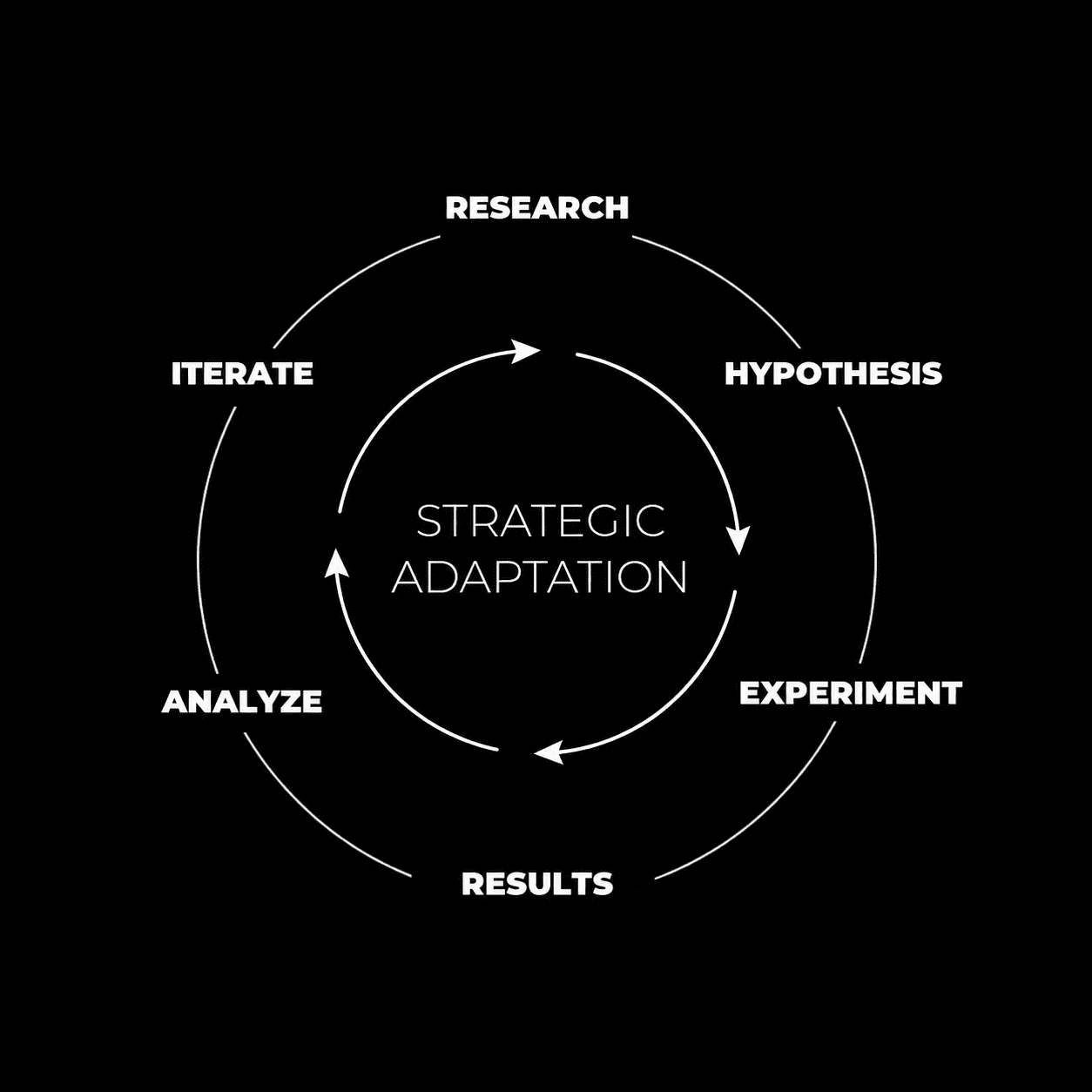
A great strategist doesn’t just create a good plan. They continuously improve it as they learn more about reality.
The Art of Strategic Thinking
Strategic thinking is one of the most valuable skills you can develop because it influences almost everything you do. The better your strategy, the more you can achieve with the time, energy, and resources available to you.
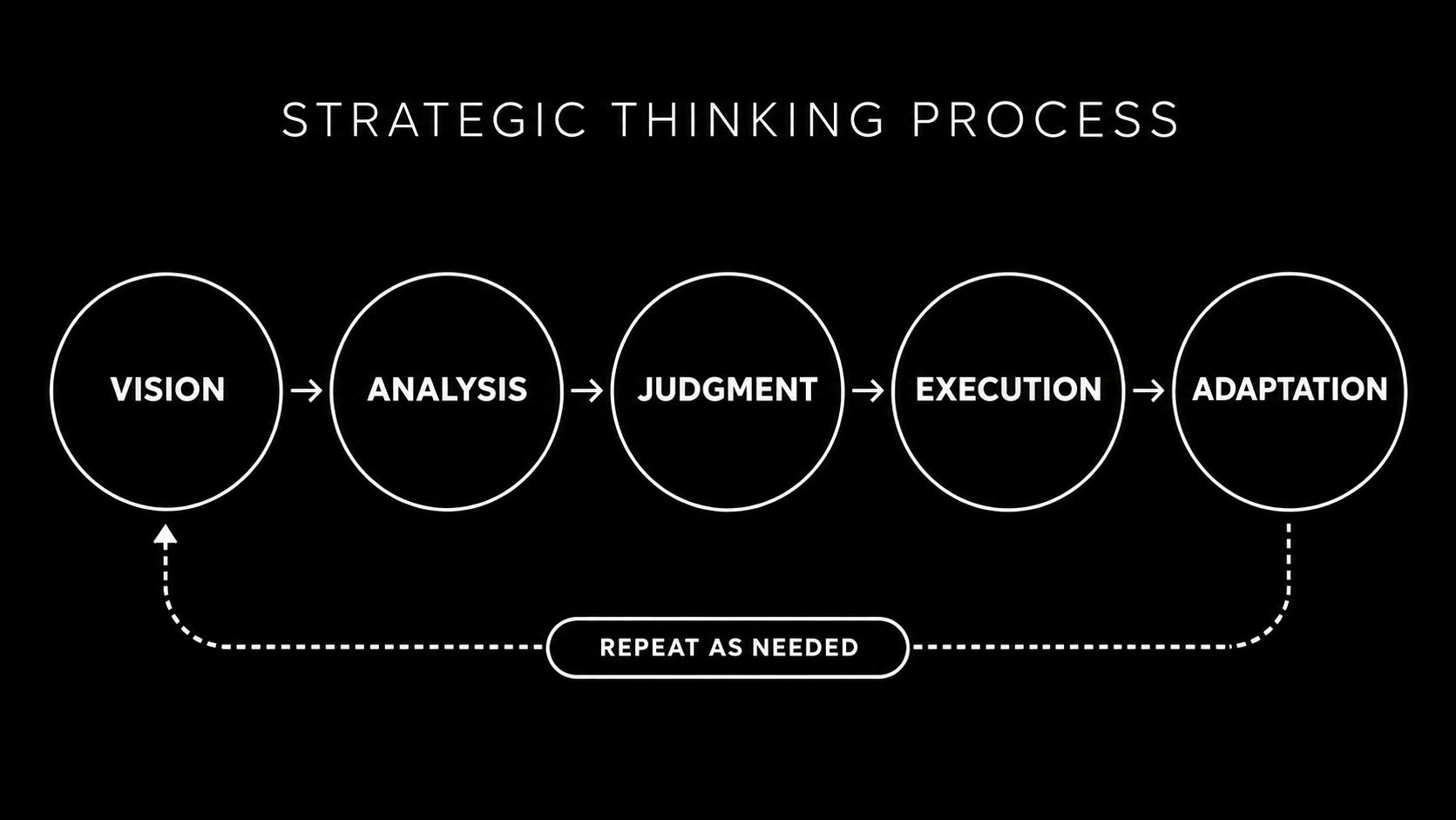
There are 5 Pillars of Strategic Thinking:
Vision: Know exactly what you want to achieve
Analysis: Understand your current position
Judgment: Find the smartest path toward your goal
Execution: Concentrate your resources and take action
Adaptation: Learn from your results and continuously improve
The important thing to remember is that strategic thinking isn’t something you do once. It’s a continuous process of making decisions, observing the results, learning from your experiences, and adjusting your approach.
Strategic geniuses don’t necessarily work harder than others. They make better moves. That’s how they win.
Don’t work like a hustle guru. Work like a chess grandmaster.
That’s it. Thanks for reading!
Stijn
PS: I write 2 newsletters like this every week. Click the button to subscribe for free:
How I Can Help
1. X Growth System. Learn how to grow your audience on X with the strategies that helped me reach 74,000+ followers and 100M+ yearly views. It closes this week.
2. YouTube videos. I turn my articles into videos in case you prefer to watch or listen.
“Treat the process like a scientist ✨️” thanks for this article 🙏
Great article Stijn!