

Ideas are the raw material for your content.
Without good ideas, people won’t click, read, or watch your content.
But most people struggle with coming up with ideas.
So in this newsletter I’m going to share how I never run out of content ideas.
It’s basically a mini course and I created a worksheet for you here.
We’ll cover:
What your audience actually wants to read
The only 3 core content pillars every creator needs
14 idea generation methods to get unlimited content ideas
In case you prefer watching/listening:
Click here to watch the video version of this newsletter (most recent upload).
Let’s begin.
‘Niche’ Simplified
Before we can create content, we need to know who we are creating content for.
In other words, what’s your niche?
I used to get paralyzed by this question.
But it’s actually a lot simpler than you might think.
Niche = a group of people with the same problems who want the same outcome.
So it has 3 core parts:
People
Problems
Outcome
So your niche is simply:
Who you help (people)
What they need help with (problems)
What they want to achieve (outcome)
That’s all.
You can still talk about almost anything.
You just need to make it relevant for the person who has these goals and problems.
So get clear on who you help and then make a list of:
The goals this person has
The problems this person has
The other interests this person has
This is important to know because it makes idea generation much easier.
I recommend creating a simple worksheet like this:
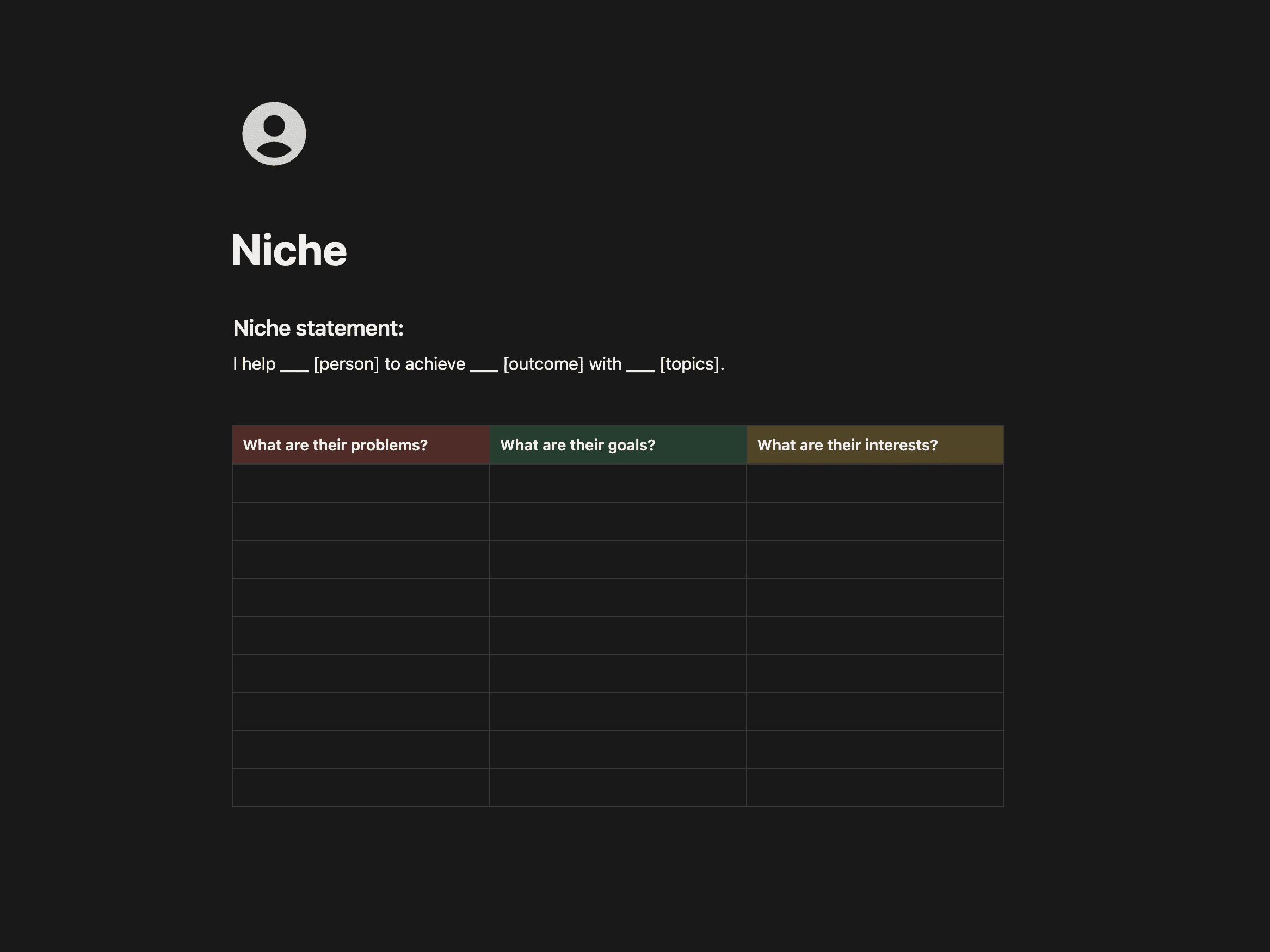
This is part of my Infinite Ideas Worksheet (click here to get it for free today).
With that out of the way, let’s move on to what you can actually talk about.
Content Pillars
When you know the goal of your audience, it becomes much easier to know what to write about.
You simply write content that helps them solve their problems so they can achieve the goal.
But unlike what gurus tell you, you don’t need to stick to a few narrow topics.
Because your audience doesn’t care about your content pillars.
They care about achieving their goals.
So if your content helps them with this, they will read it.
You simply need to show them how it benefits them.
To do this, I like to break it down into 3 parts:
Primary topics
Secondary topics
Other topics and interests
Understanding the difference is important, so let’s quickly talk about this.
Primary Topics
Primary topics are necessary to achieve the outcome.
You can’t get to the outcome with them.
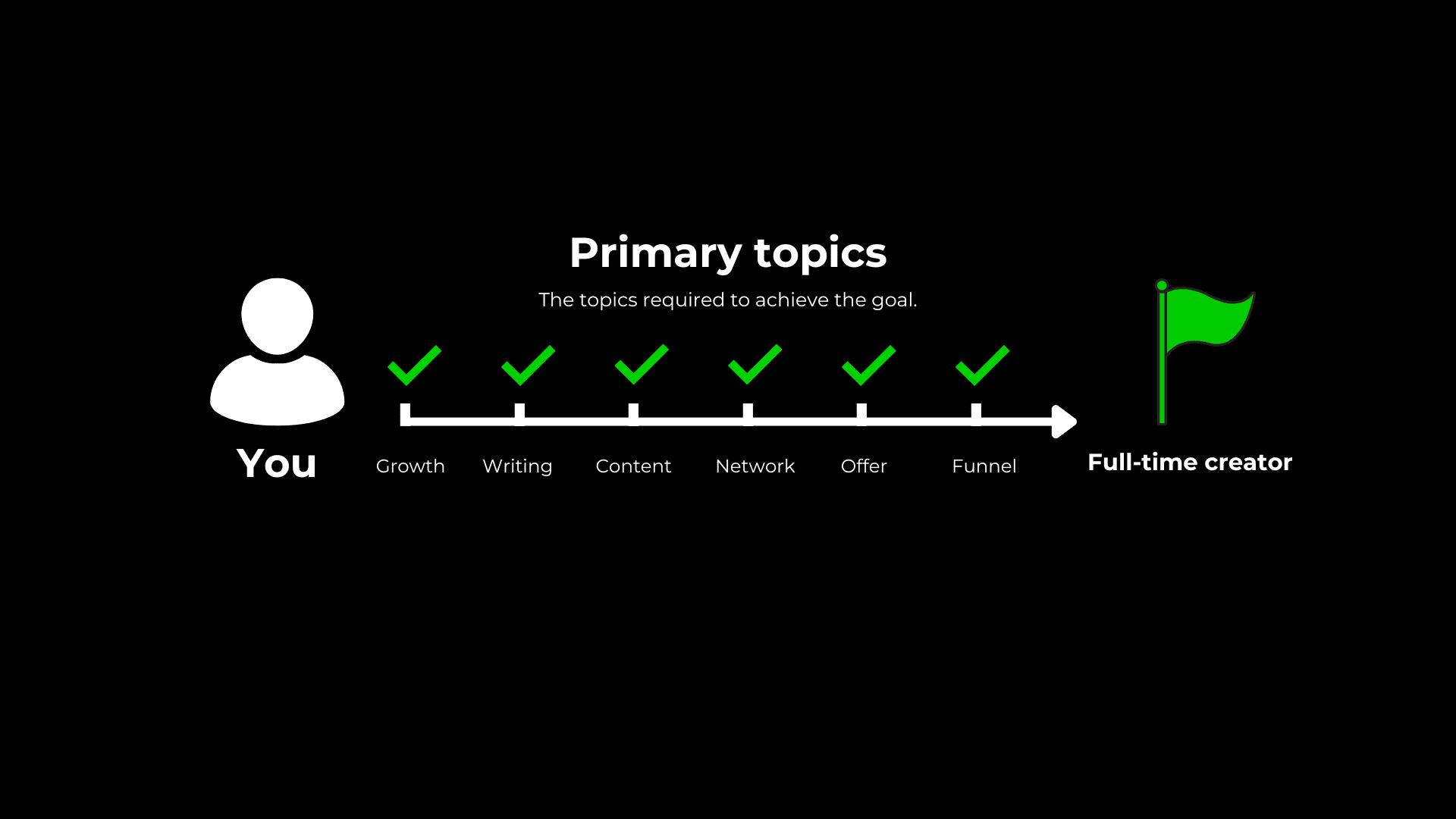
If you’re in the creator business niche, content creation is a primary topic.
And if you’re in the dating niche, communicating is a primary topic.
You need these topics and skills to get to the outcome.
There’s no way around it.
But here’s where a lot of people go wrong:
Just because you need these things doesn’t mean that you can only talk about this.
You can still talk about almost everything else.
And this is where the secondary topics come into play.
Secondary Topics
Secondary topics are useful to achieve the outcome.
They aren’t required like primary topics, but they make it easier to achieve the outcome.
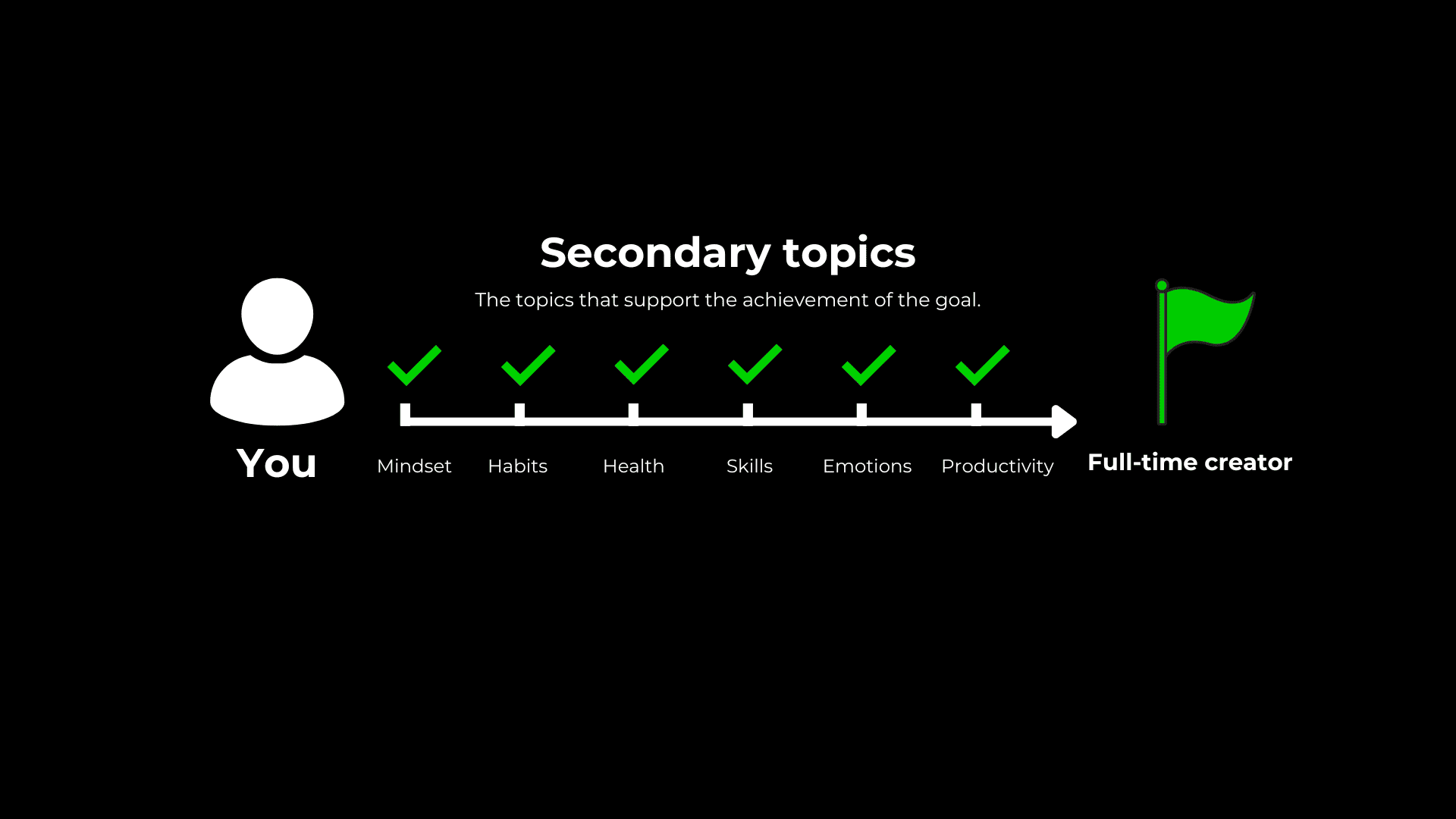
Topics like mindset, time management, and habit-building are secondary topics.
You can get to the outcome without them, but it will be much harder.
They basically make it easier to get the result.
Secondary topics tend to be foundational.
A good mindset makes it easier to get fit
A good mindset makes it easier to get rich
A good mindset makes it easier to get a relationship
You can technically become rich or fit without a good mindset, but it will be much harder.
That’s why these topics are very useful as well.
You just need to show your audience how the topics are relevant for them.
Let’s take a quick example.
I help people grow and monetize their audience.
So if I write:
“Here are 8 dieting tips to eat clean.”
Then the post will flop.
Because most people in my audience won’t see how this is relevant for their goals.
So they won’t care.
But if I write:
“You’re struggling to write because you can’t think clearly.
Here’s a simple diet that will give you a clear mind so you can write better content:”
Then more people will be interested.
The funny part is that I can still talk about the same 8 dieting tips after this.
But I positioned it in a way that my ideal reader cares about.
Because I showed them that the dieting tips will help them with their goals.
So that’s why they are more likely to read it.
And this is how you can talk about almost anything you want.
Everything is interconnected.
You just need to show people how it connects to something that they care about.
When you do that, they will care.
And that brings me to the third pillar: other topics and interests.
Other Topics
Based on the above you should already understand why you can use other topics and interests.
Because it doesn’t matter what the topic or interest is.
It matters that you make it interesting to your ideal reader.
If I want to talk about chess, I can.
But I need to it in a specific way.
Because my audience won’t care if I randomly start talking about chess.
But they will care if I show how it’s relevant for them.
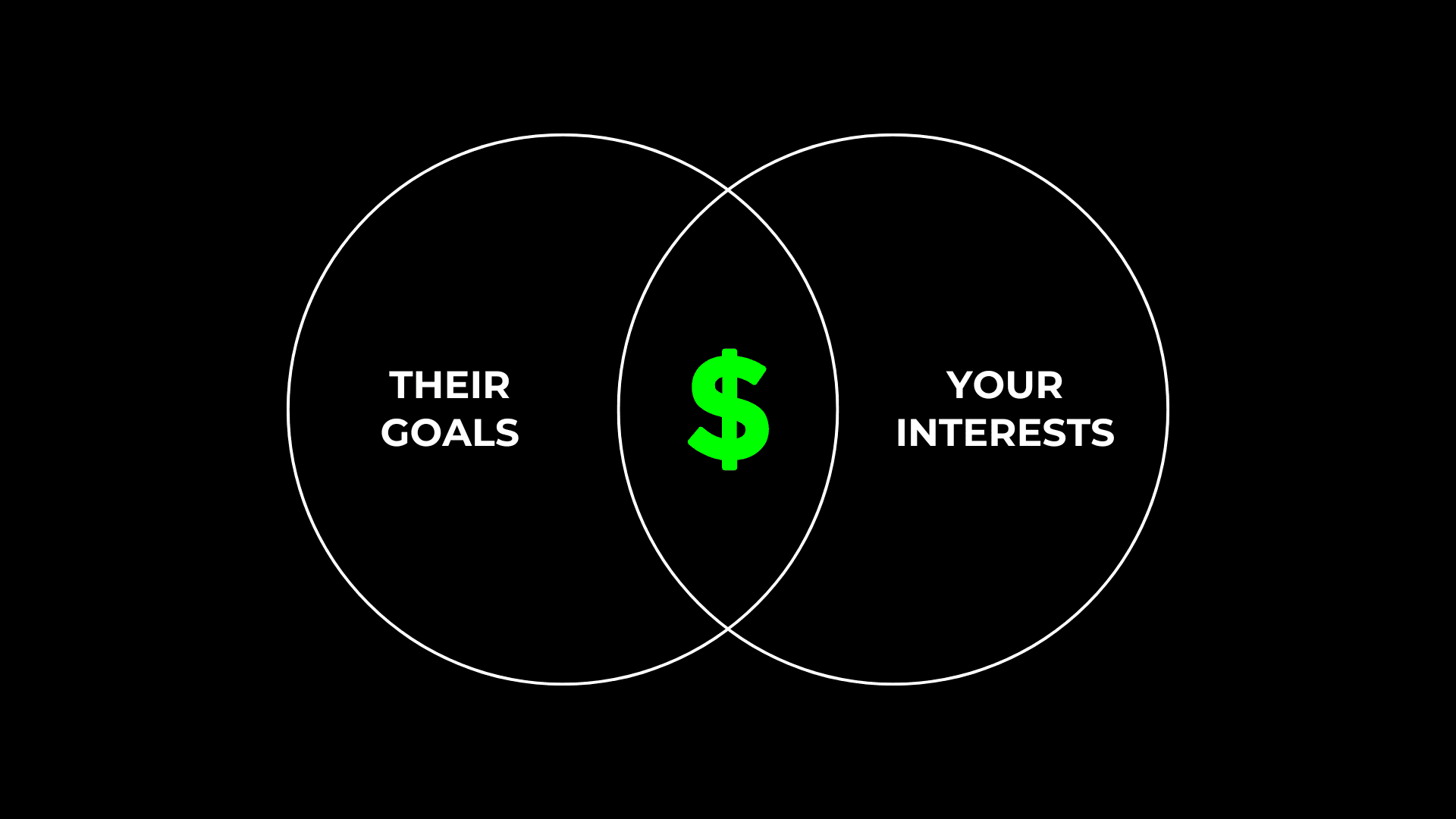
I can for example do this with a metaphor:
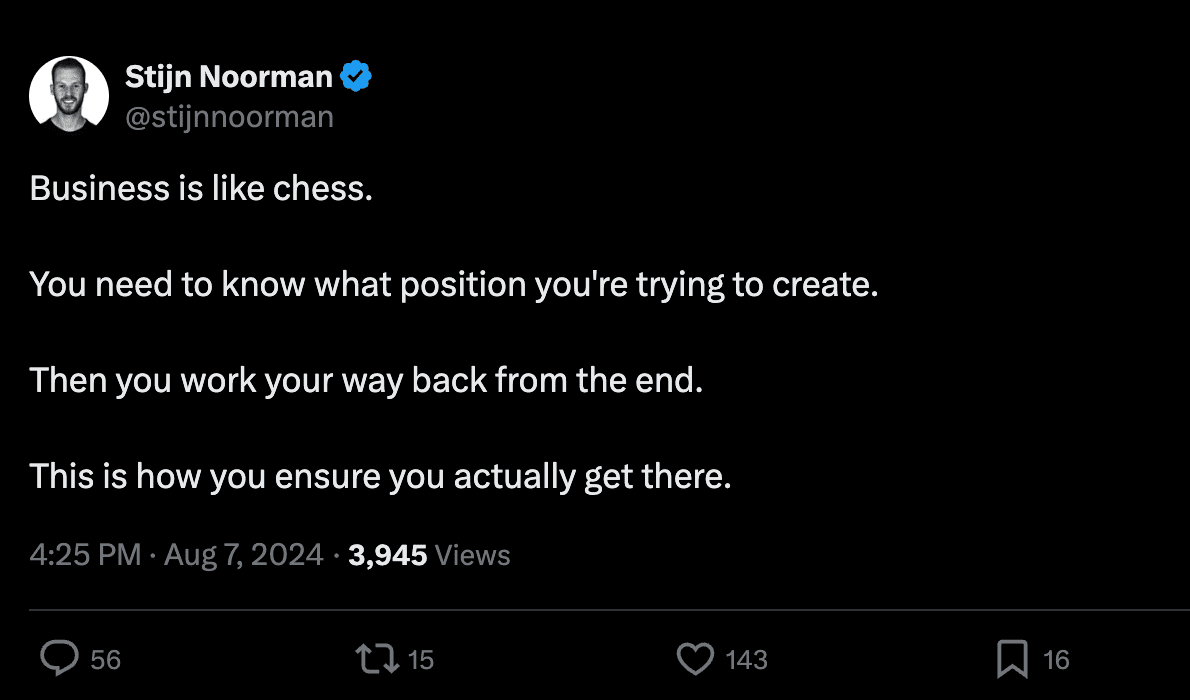
The metaphor shows how chess is like something they care about.
And that’s why they read it (and care about it).
You can do this with literally anything.
You simply take:
1 ) A topic you want to talk about
2 ) A topic your audience cares about
And then you explain how they are alike or similar.
Good metaphors also make it easier for your audience to remember the lesson.
They’re a powerful tool.
If you link their goals to your interests, they will care about your interests.
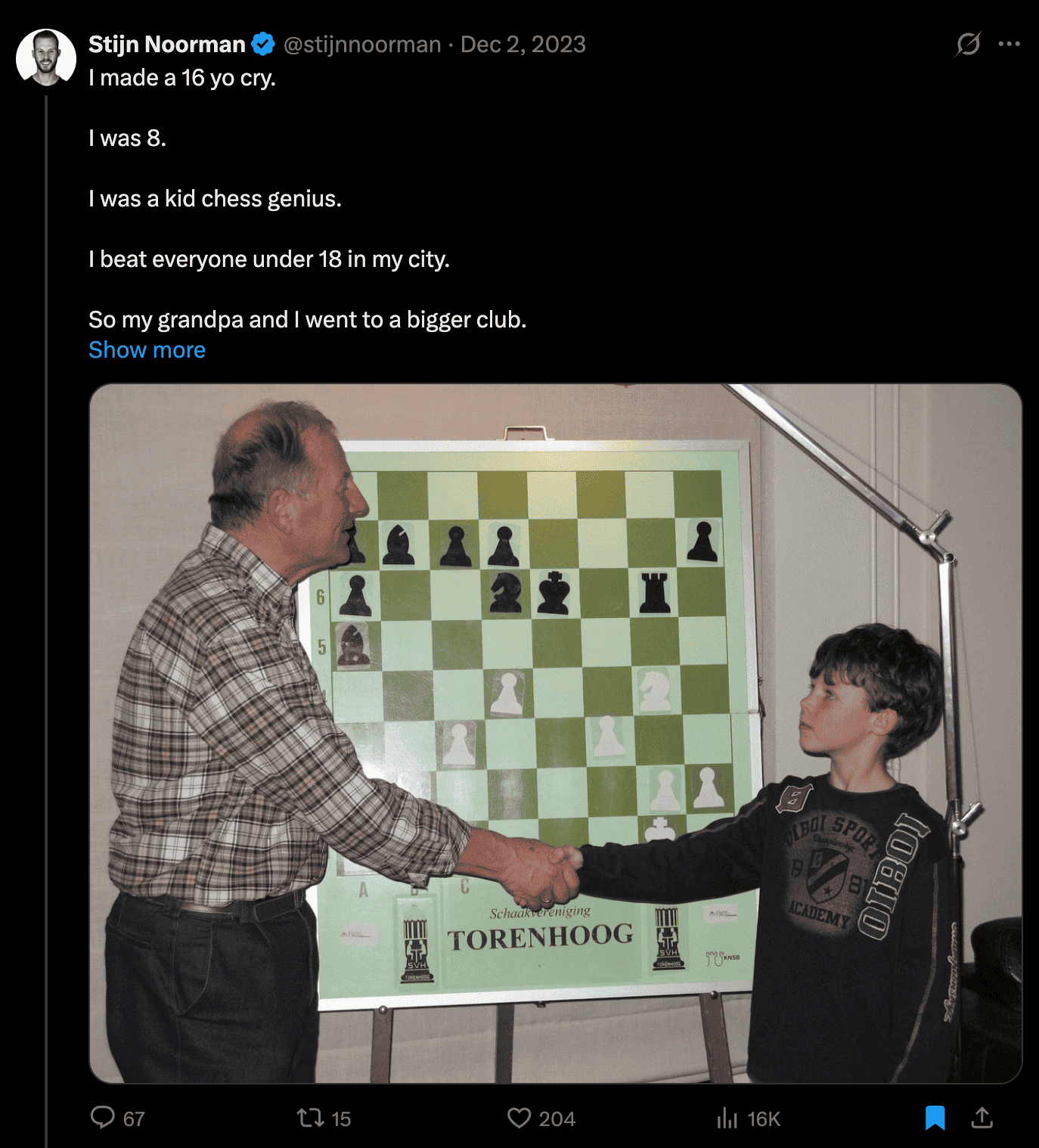
Another way to talk about whatever you want is with storytelling.
I can tell a story about an experience I had with chess:
And then I can connect the story to a lesson that’s relevant for my audience:
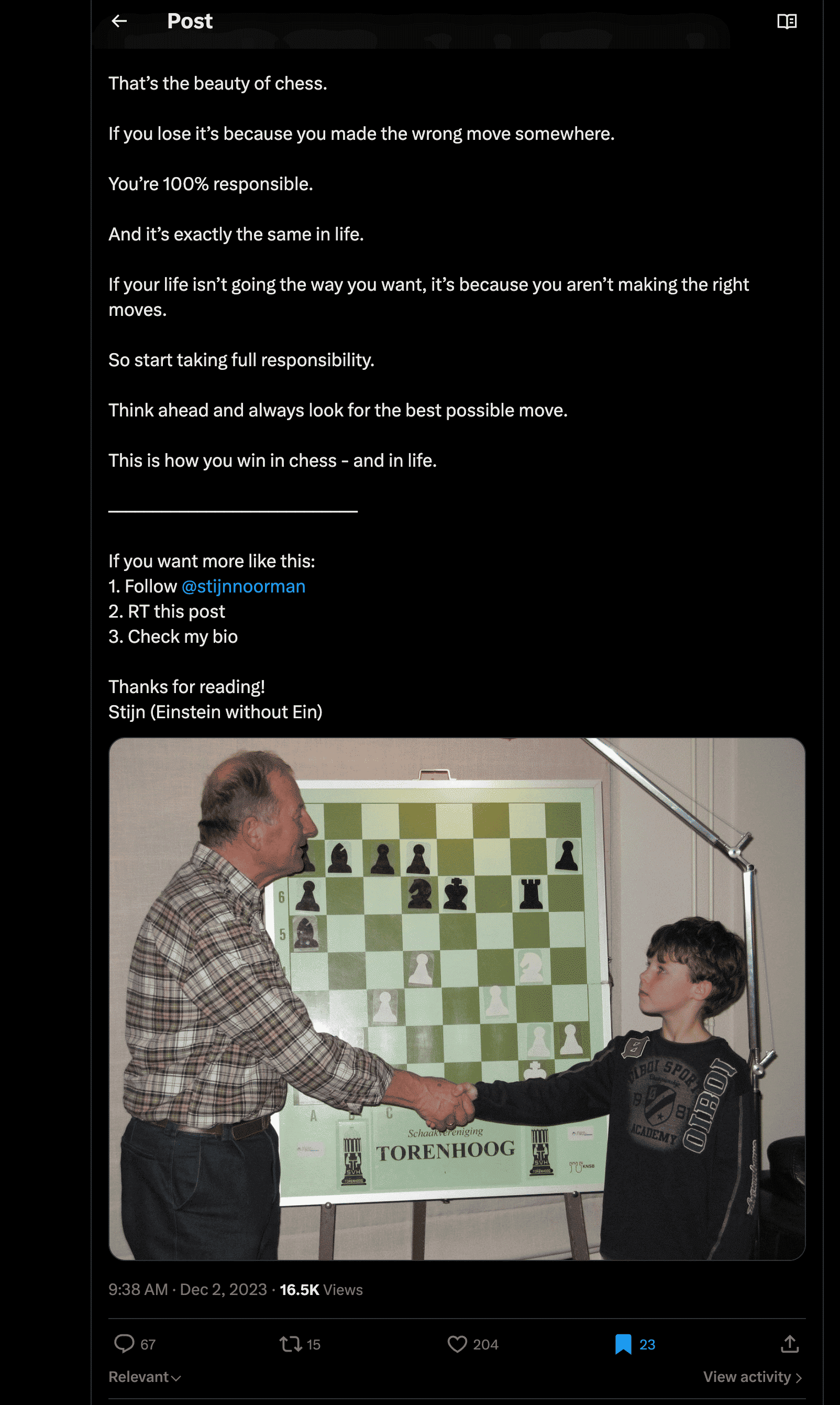
(Here’s the story in case you want to read it).
Do you see what I did there?
I start the story with a hook that makes people curious.
Then I share a short chess story.
And then I connect the ending of the story with a lesson that’s useful for my audience.
The hook grabs attention
The story holds attention
The lesson gives a payoff
In this way, you can talk about basically anything you want.
You just need to connect your story to a lesson that benefits your audience.
Because again: it’s not about the topic.
It’s about how you talk about the topic.
That will determine whether people care or not.
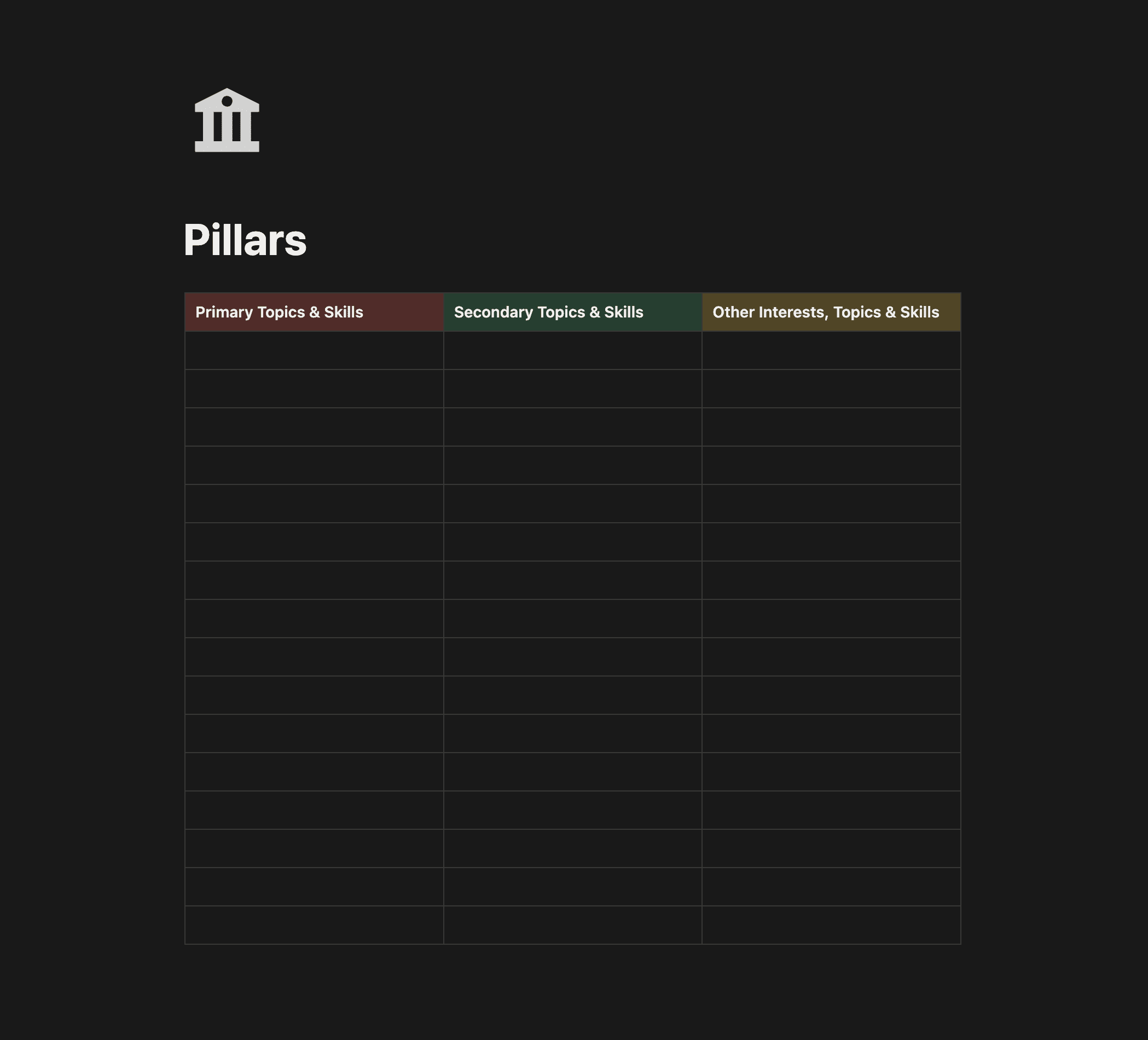
So now that you understand this, I want you to make a second list with:
Primary topics and skills
Secondary topics and skills
Other topics, skills, and interests
Again, you can get my Infinite Ideas Worksheet here so you can just fill it in.
After you’ve done this, you know:
The goals of your audience
The problems of your audience
The interests of your audience
The primary topics and skills
The secondary topics and skills
The other topics, skills, and interests
So you now know what to create content about.
But now, we’re going to talk about where you can find high-quality content ideas.
I’m going give you 14 different ways to generate high-quality content ideas.
When you combine this with the above, you will never run out of content ideas again.
14 Idea Generation Methods
I want to start this chapter with an important insight.
Because in my experience, most people think they can’t use other people’s ideas.
And this couldn’t be more wrong.
Don’t get me wrong.
I don’t mean literally copying people word for word.
That’s obviously wrong.
But I mean taking inspiration from ideas you like.
Because here’s what most people don’t realize:
Even if you try to think of something by yourself without looking at any content, you will still come up with something that has already been written about.
So you might as well look at what’s performing and what resonates with you, and then try to improve upon that by writing about it from your unique perspective.
Because that’s what makes it valuable.
The value comes from connecting proven old ideas and presenting them in a new way.
Almost everything you read online is an old idea.
But the ones that perform well are presented in a new, interesting way.
Creativity is the process of combining old ideas in new ways.
– James Clear
I know many creators with 50K-5M followers and none of them create from scratch.
They have a small list of a few people they aspire to be like.
And they have a large list of cool ideas they encounter.
They just combine those ideas with their own personality, stories, worldview, and perspective to create something new.
Plagiarism is copying from one source. Research is copying from many.
– Austin Kleon
So you don’t need to start from scratch.
You need to make a list of people you like.
And you need to write down all the ideas you like.
Your brand becomes the combination of this.
There are so many amazing people you can learn from.
So take this opportunity.
Save the best ideas you like and try to improve them.
That’s what the best creators do.
If I have seen further it is by standing on the shoulders of giants.
– Isaac Newton
The Infinite Ideas Worksheet will help you to collect all of this in one place.
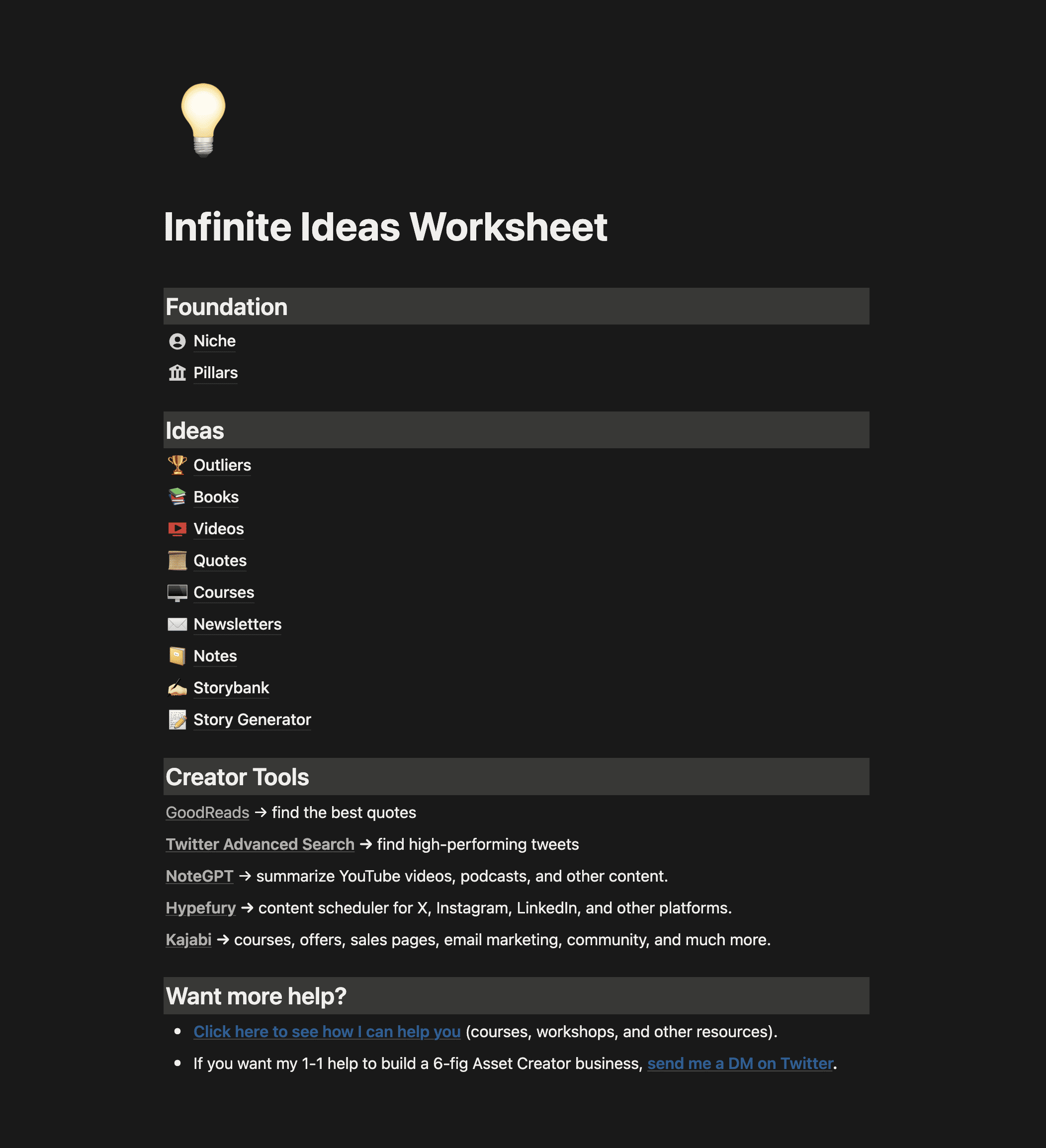
So with that out of the way, let’s go over the 14 places where you can find high-quality content ideas.
X Advanced Search
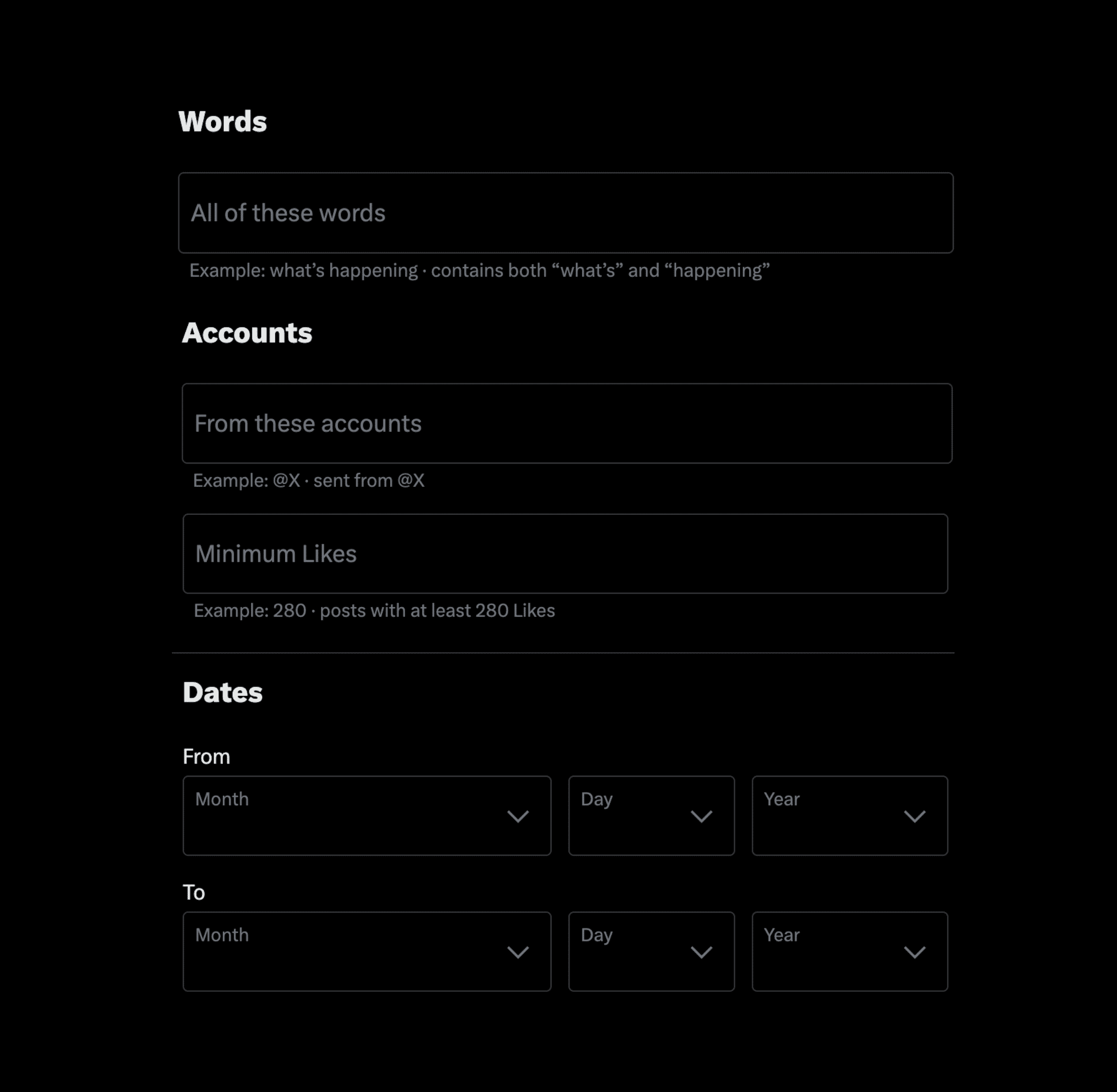
X Advanced Search is one of the best ways to find proven ideas.
It lets you filter someone’s tweets by keywords or performance.
You can use it to:
Search for high-performing tweets
Analyze the best tweets from a certain creator
Search for specific topics from a certain creator
Then you can save the ones that resonate in the Infinite Ideas Worksheet.
Books
Books contain compressed knowledge.
You can get the best ideas from a smart person in a few hours.
One good book can give you dozens of good content ideas.
Highlight interesting concepts, frameworks, and examples.
Then add all your notes to Notion (or connect Readwise with Notion).
Ebooks
Ebooks are usually more practical and niche-specific.
This makes them perfect for idea generation.
Pay attention to checklists, frameworks, and step-by-step processes.
Each one can become multiple posts.
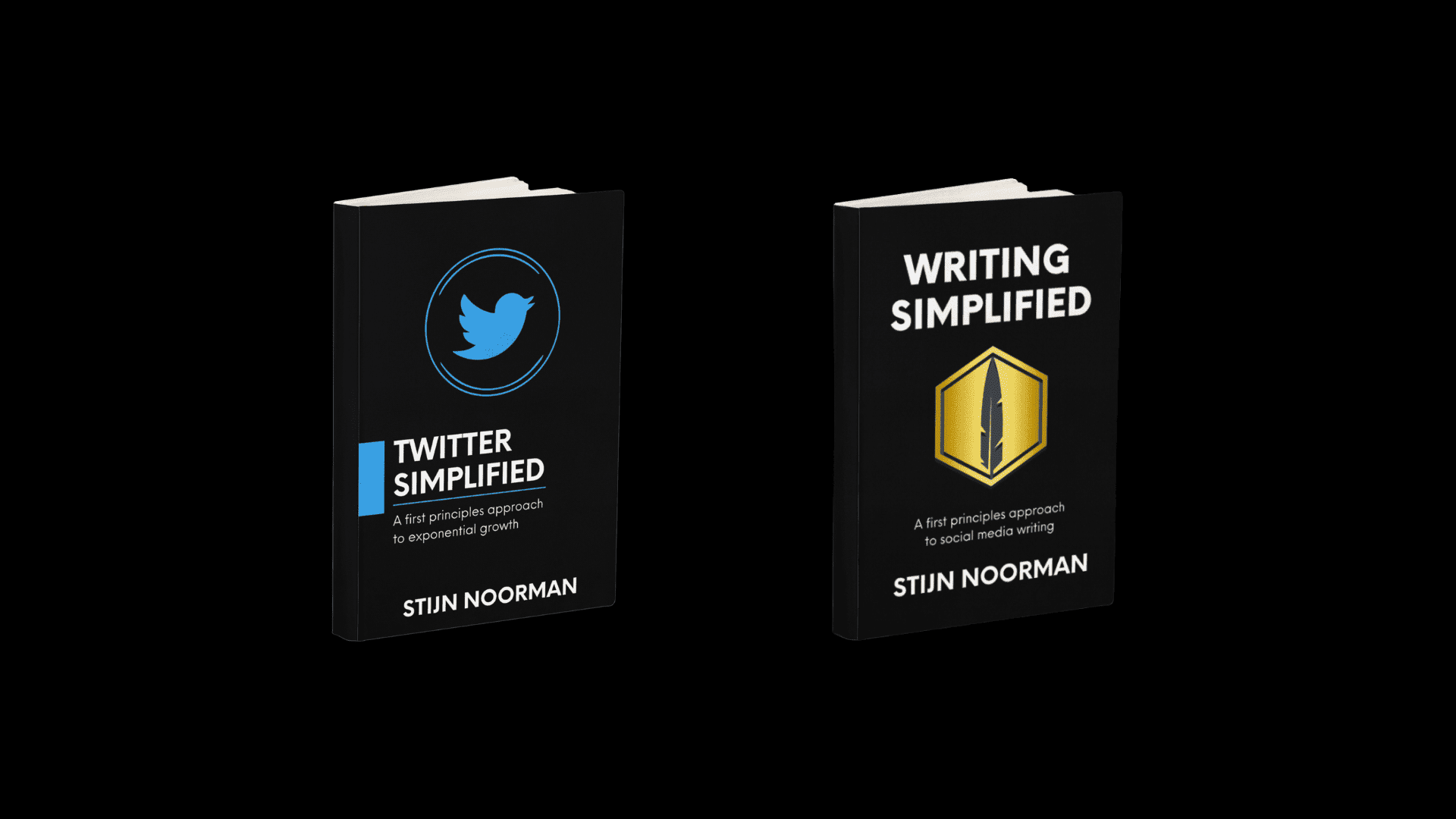
If you want these 2 ebooks on writing and growing an audience, click here or sign up to my newsletter on this page.
Quotes
Quotes are compressed wisdom.
You can find the best quotes on Goodreads:
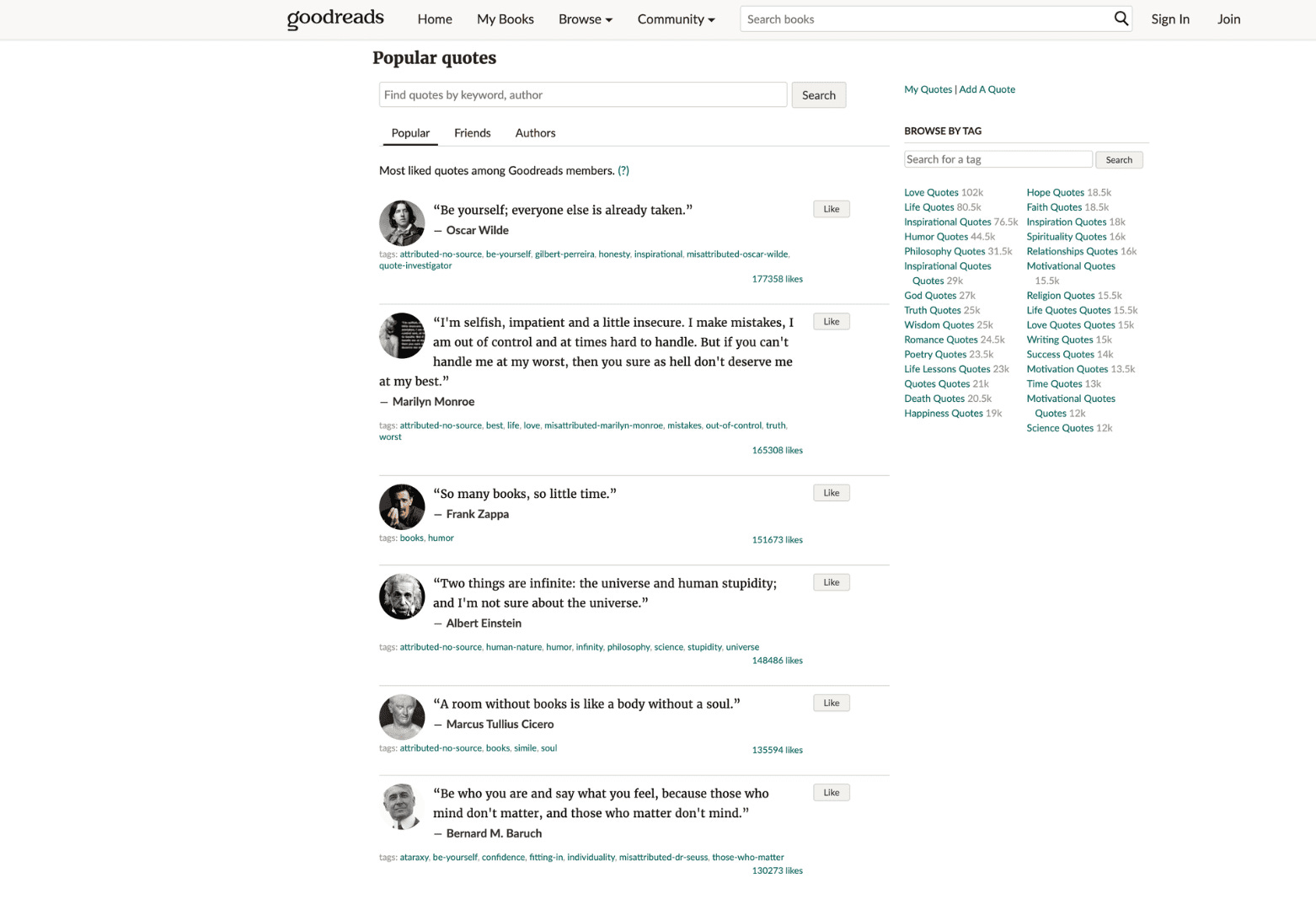
You can filter on a topic, person, or book.
Then you can read all the best quotes and save the ones you like.
This is great to find the best ideas from famous people.
Threads
Threads (or carousels) are a collection of tweets (or short posts).
Good threads are deep dives into a specific topic.
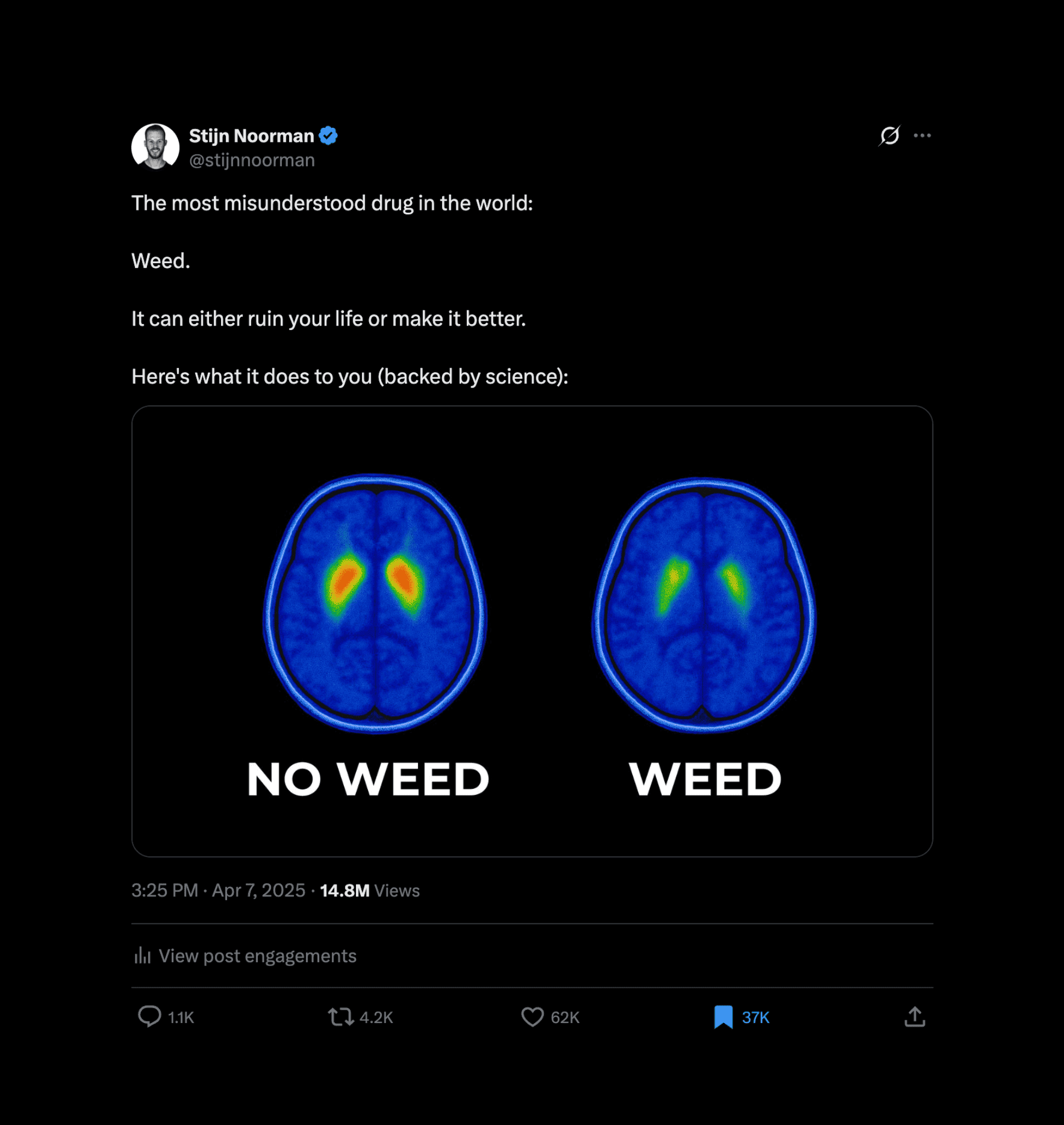
Each tweet in the thread contains one core idea.
And every idea is a potential content idea.
Articles
Articles are similar to threads, but the form is different.
Good articles can contain dozens of potential content ideas.
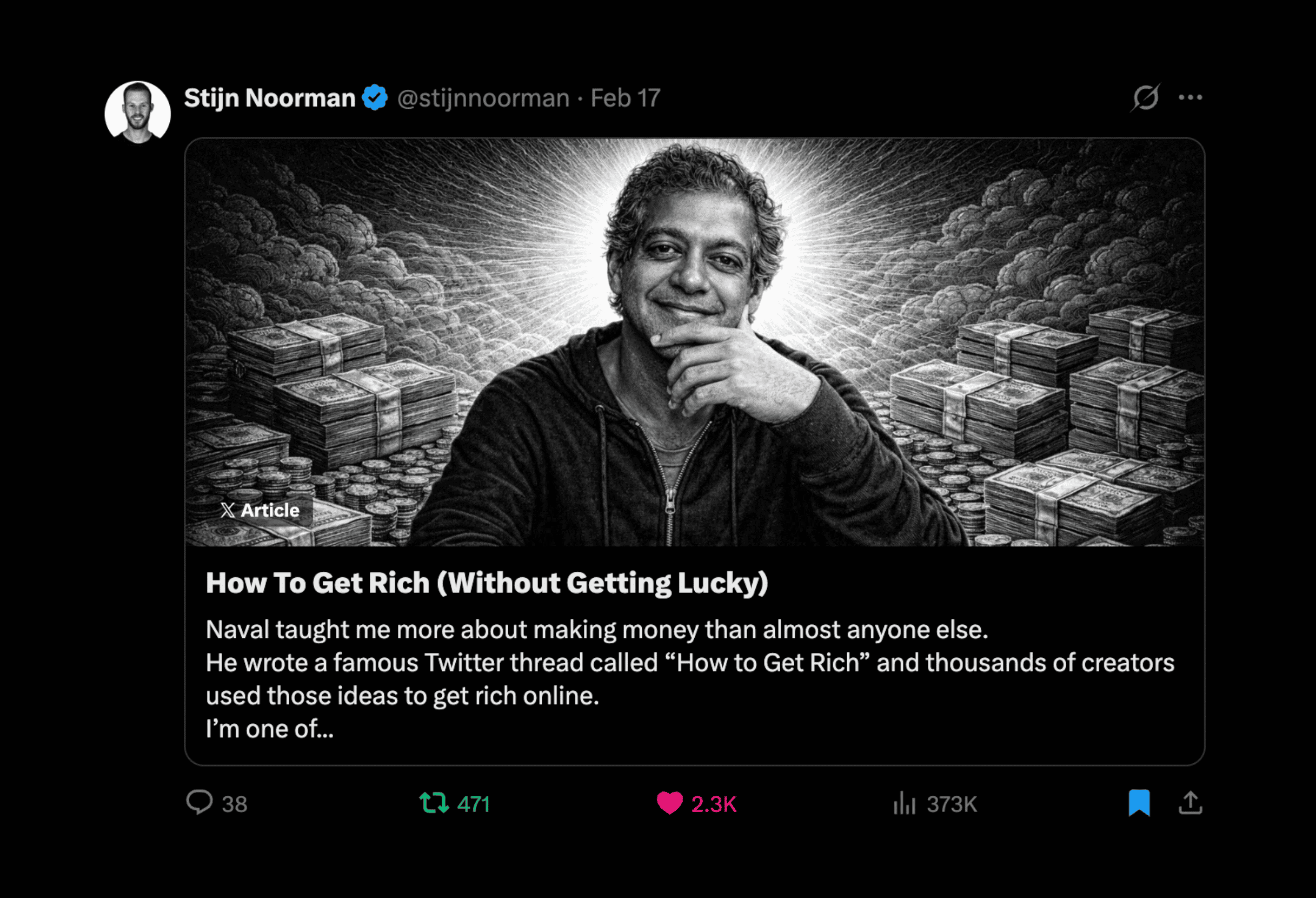
Save interesting ideas in the Infinite Ideas Worksheet.
Then write about these ideas in your own words.
Newsletters
Newsletters are idea goldmines.
Many great creators share their best thinking there.
They are similar to articles but the difference is that you can get them in your inbox.
Videos
YouTube videos are a great way to get ideas.
Make a list of the 10 channels you like the most.
Then make a folder for each channel inside the Infinite Ideas Worksheet.
Now you can create a new folder for every video you watch.
And you can just add your notes here.
This keeps everything organized and it will give you lots of content ideas.
Podcasts
Podcasts reveal how people think.
You hear stories, mental models, and lessons.
The process here is the same as for videos.
Make a list of podcasts and take notes every time you listen.
You can also use NoteGPT to summarize videos and podcasts for you.
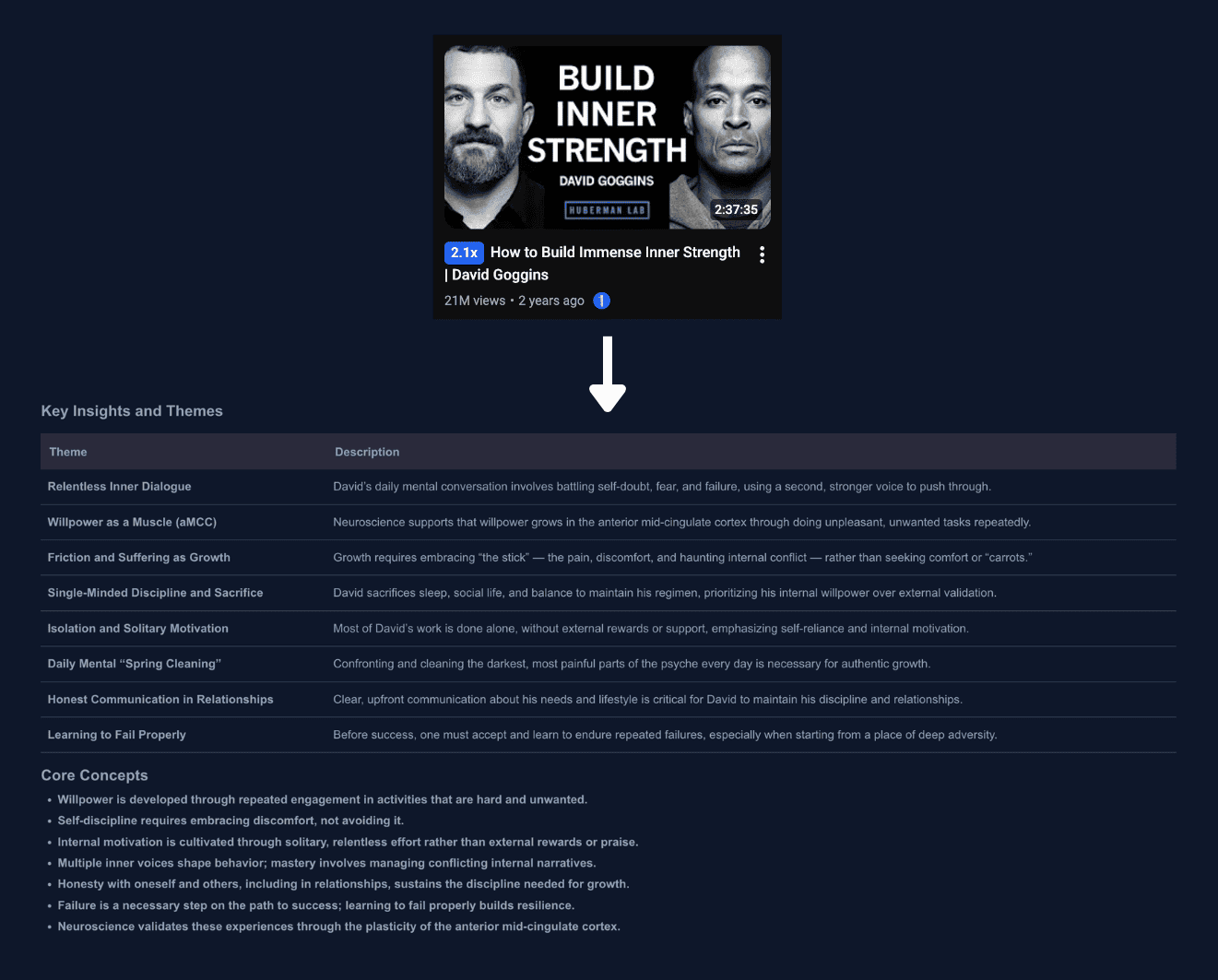
This helps to get the core ideas and to determine if the podcast is worth listening to.
Courses
Courses are structured knowledge.
It helps you get from point A to point B.
“Buttttt….. all information is free online! Courses are a scam!”
You can find the law online.
But you still get a lawyer for legal problems.
Because it saves you a lot of time, effort, and headaches.
So yes, you could find all information online.
But the problem is that your time is limited.
And you don’t know what the right information looks like.
A good course saves you time by showing you what information does and doesn’t matter, and how to apply it in the right order.
When you do everything yourself, you save money but pay with your time.
When you invest in a good course, you save time but pay with your money.
It’s up to you which one you prefer.
A good course can save you thousands of dollars in opportunity costs and it’s also a great way to generate ideas.
So when you’re going through a course, make sure you add notes to the worksheet.
AI
You can use AI to quickly understand topics and skills.
I usually ask it about the first principles, mental models, and most common ideas.
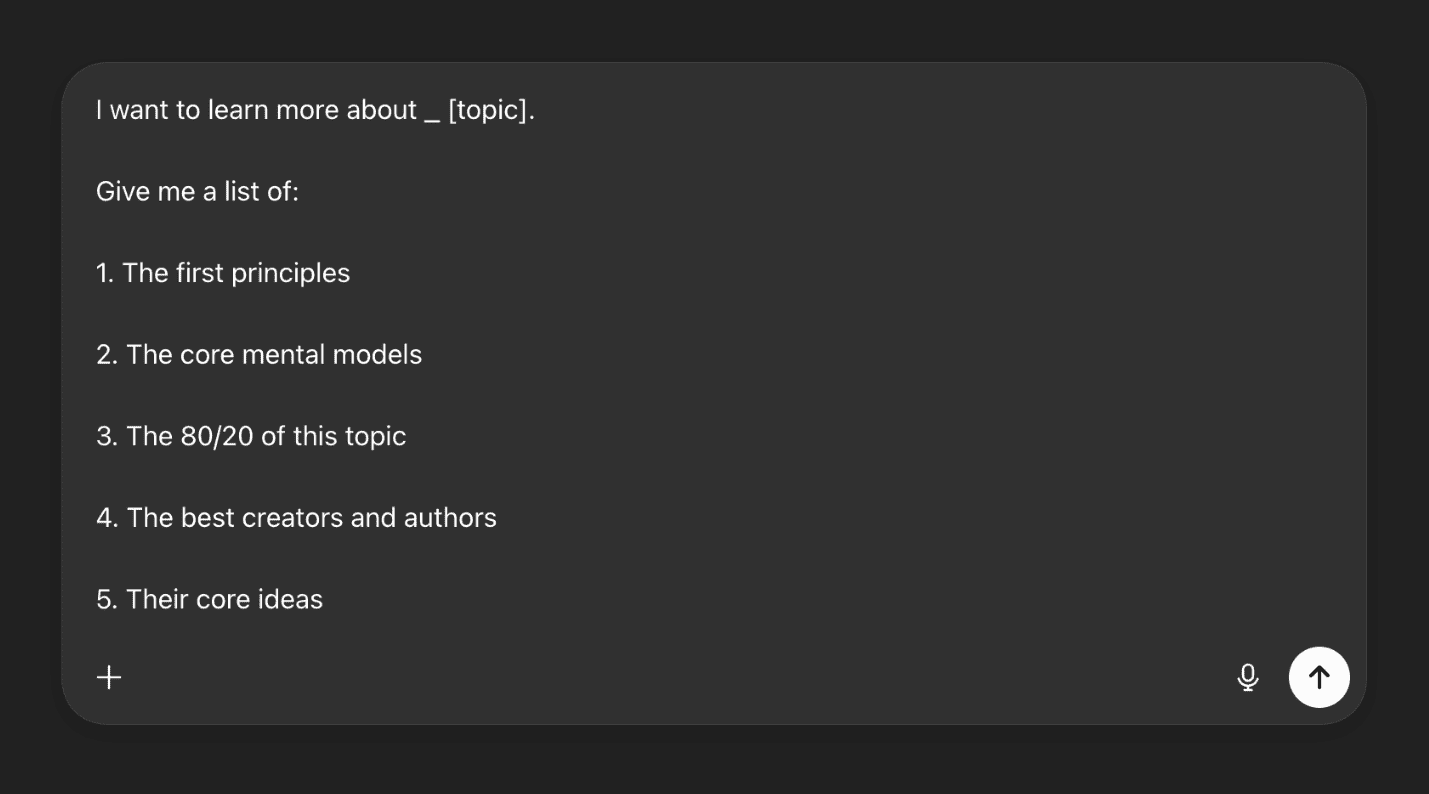
When you understand that, you understand the foundation of the topic.
And based on this, you can dive deeper into the ideas that interest you.
Walks
Walking helps you think more clearly.
According to science, it literally makes your brain more active:

You can either listen to a podcast or just walk in silence.
Make sure that you have your phone with you to take notes.
In my experience, the best ideas come when you’re walking.
Storybank
You experience things every day.
So at the end of each day, you can write down the most interesting thing that happened in a storybank.
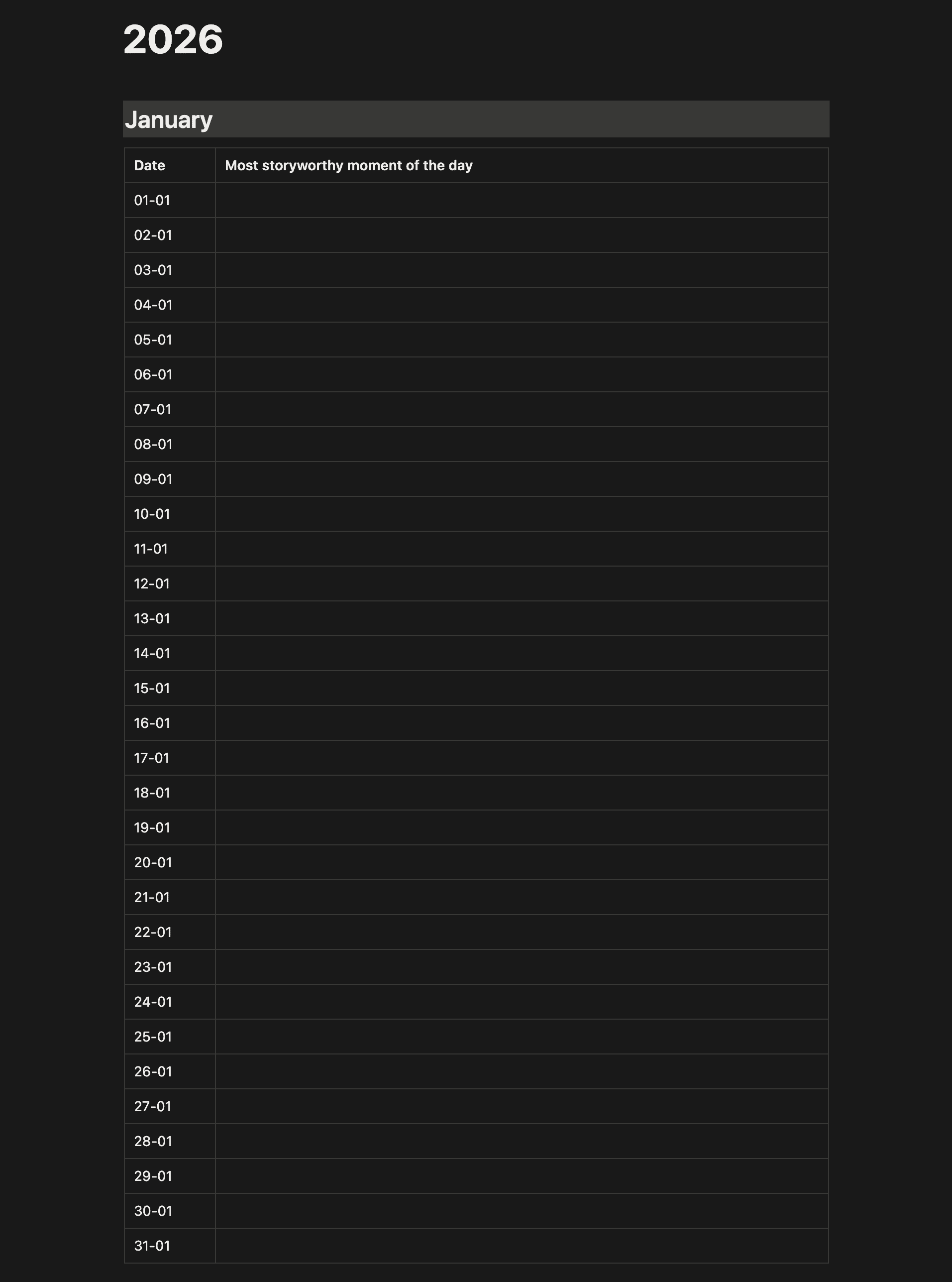
Write down lessons, mistakes, wins, and moments.
You can use everything that happened as a story.
These stories make your content unique because nobody else lived your experience.
And a second benefit is that you have a bank of all your coolest experiences.
This is a goldmine for content and something to look back on as you get older.
Story Generator
You use a storybank to keep track of stories as they happen.
But you can use the story generator to create stories based on past events.
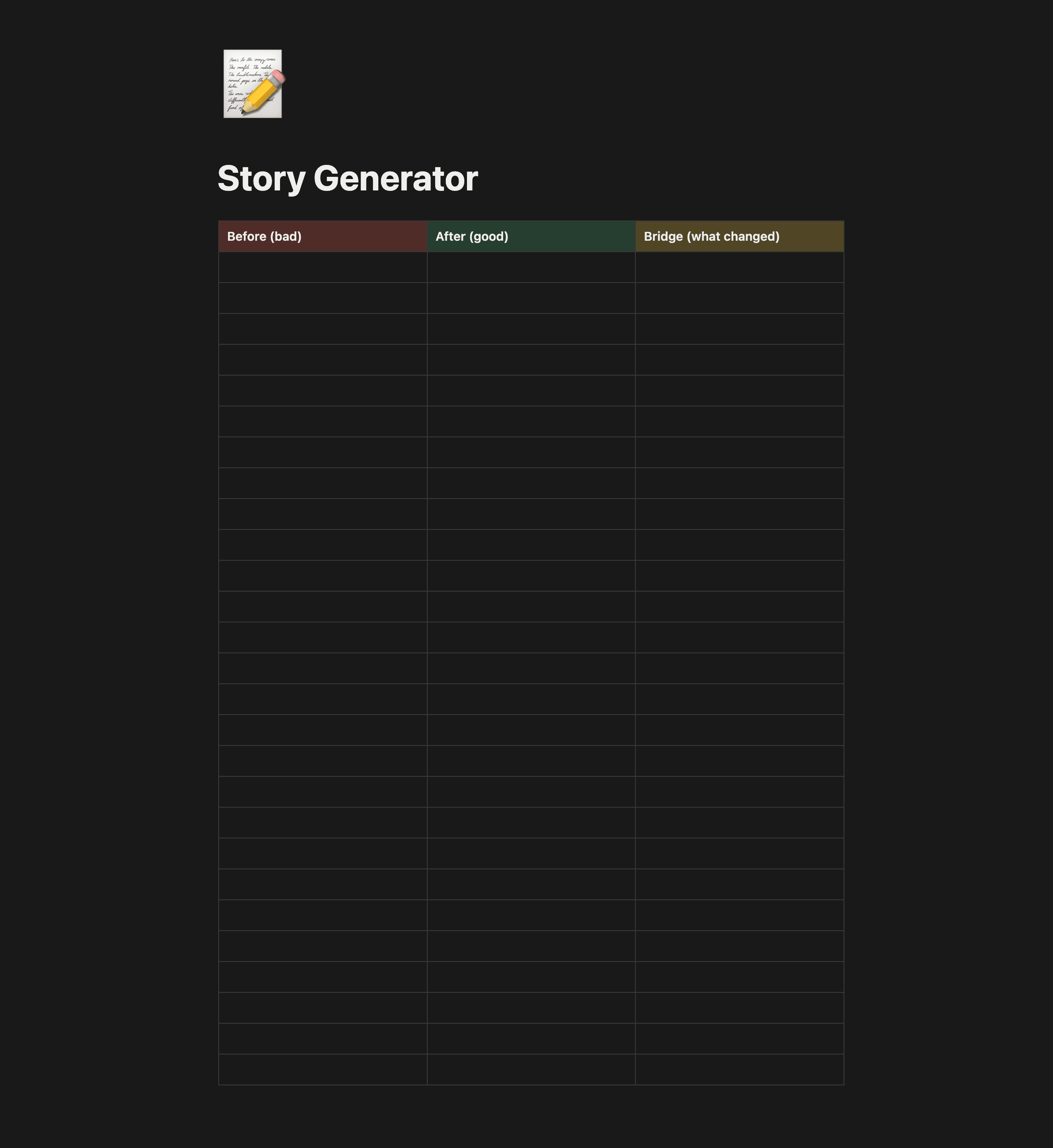
A story is basically a transformation.
You went from point A (bad place) to point B (good place).
It becomes a story when you share how you went from A to B.
So use the story generator in the worksheet for this:
When you combine all of this, you will never run out of content ideas.
Don’t forget to get the Infinite Ideas worksheet here.
If you want more like this, subscribe to my free newsletter.
Also like, restack, and share this if you found it useful so that I know whether or not to create more newsletters (and worksheets) like this.
Talk to you soon,
- Stijn Noorman
PS: if you want my 1-1 help to build a 6-fig business in 2026, reply AC to this email or DM me AC on Twitter. If you want my system but prefer to do it yourself, check out the X Growth System (price increases soon after I finish the big update).
How I Can Help You
1. X Growth System: How I grew from 0 to 59K 𝕏 followers, +102M organic views in a year, and built a 6-fig creator business without sales calls, ads, and cold outreach.
2. Aesthetic Writing: Learn the best writing strategies I used to gain 70M organic impressions and 18,100 X followers in only 90 days.
3. All Resources: Get all my best workshops, courses, and other resources.
4. Work with me 1-1. DM me ‘AC’ (or reply via email) if you want my help to build a 6-fig Asset Creator business with +50K followers and 10M-100M organic views per year. The Asset Creator model only requires 2-4 hours per day and we focus only on content, emails, and digital assets (no cold outreach, sales calls, or sleazy tactics).
Excellent article