

Everyone talks about Monk Mode, which is great and has its place, but Lion Mode is actually much more efficient and sustainable.
Lion Mode will help you to achieve your goals faster by doing less.
This sounds counterintuitive, but at the end of this newsletter it’ll make sense.
So in this newsletter, I’ll explain the 3 phases of Lion Mode and how you can use it to get ahead of 99% of people by doing less.
Lion Mode Simplified
Work like a lion. Sprint, rest, and reassess. Then attack again. You’re not a cow, grazing all day. You’re a lion, waiting, preparing, then going in for the kill.
– Naval
Lion Mode is about working like a lion.
It has 3 phases:
Plan. Hunt. Rest.
In the planning phase, you select your target (goal)
In the hunting phase, you attack with full intensity (work)
In the resting phase, you recharge completely (active recovery)
The idea is that you either work or rest with 100% intensity.
Most people waste their time in the middle. They’re always half-working and half-resting. They stay semi-stimulated, like grazing cows. They’re always busy, but never fully on and never fully off.
High performers are different. They work like lions. They plan and wait, then they strike with full force, then they rest deeply.
Average people are always 30% on. High performs switch between 0% and 100%.
This helps them to get more done even though they work fewer hours:
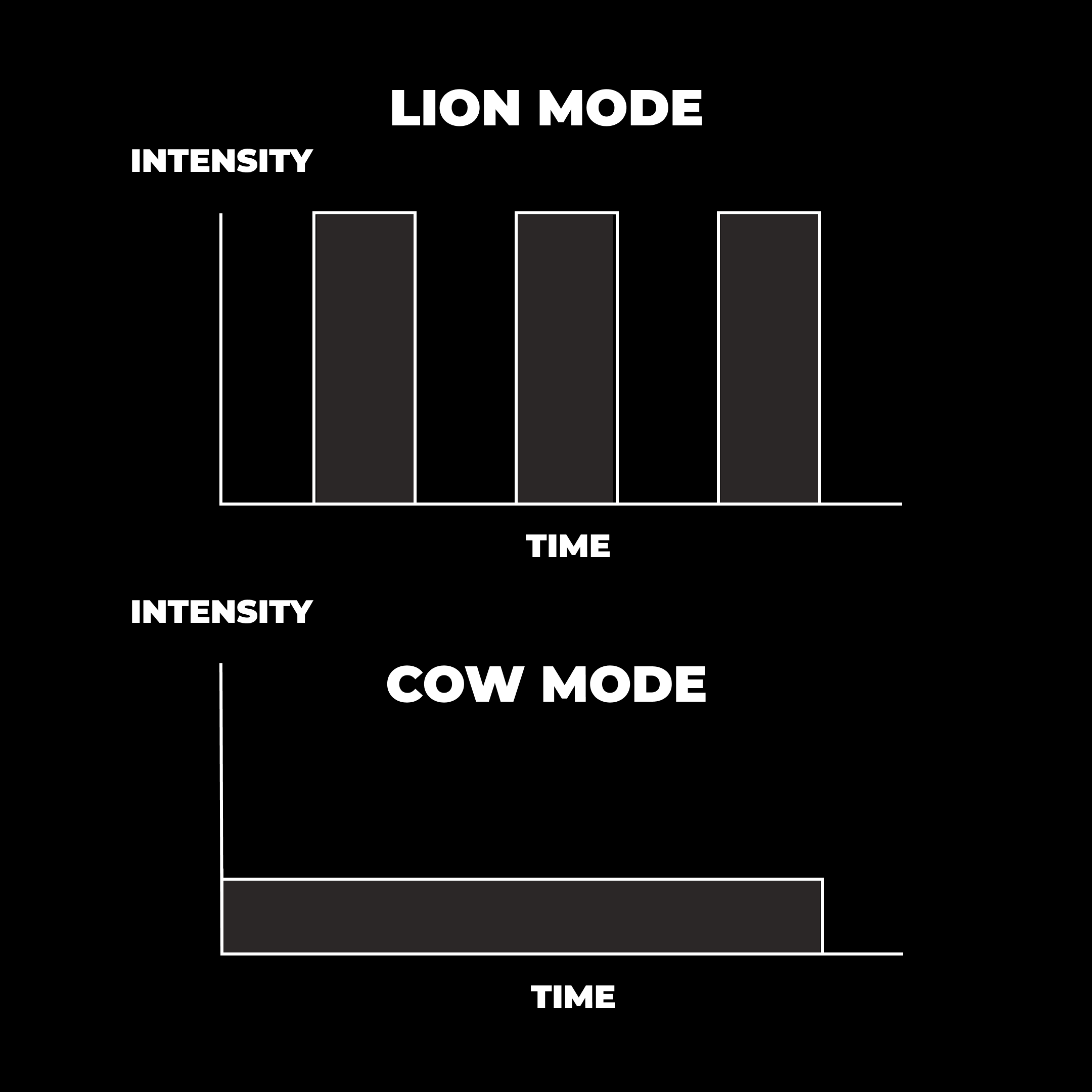
When they work, they really work.
When they rest, they actually rest.
This is what Lion Mode will help you to do.
You make a plan. You work as hard as possible. And then you rest to recover.
The way people tend to work most effectively, especially in knowledge work, is to sprint as hard as they can while they feel inspired to work, and then rest. They take long breaks.
It’s more like a lion hunting and less like a marathoner running. You sprint and then you rest. You reassess and then you try again. You end up building a marathon of sprints.
– Naval
And this is how you blow past the competition by working less.
But to make Lion Mode work, you must master all 3 phases.
Let’s start with the first one: the planning phase.
Phase 1: Planning
If you do not know to which port you are sailing, no wind is favorable.
– Seneca
Progress implies that you progress towards something. Without a goal, there’s nothing to move toward. It’s like running a race without a finish line.
You move without getting anywhere.
Humans need an aim to function. We’re literally built for it:
We’re the only primates with universally visible whites in our eyes. That’s because we’re aiming creatures. We have evolved to cooperate toward shared goals, and it’s important that we can see what others are aiming at.
– Jordan Peterson
We need goals so we know what to focus on. Without them, we’re distracted.
Your goals literally change what you see. They become your filter for reality. Your goals shape what you focus and what you notice.
Your brain is actively looking for information that will help you to achieve your goal. It filters the information that’s relevant for your goal.
That’s why two people can consume the same content and see different things.
If you have no fitness goals, a podcast on testosterone feels irrelevant. But if you’re training to be a bodybuilder, it suddenly matters.
Your goals determine what you see as valuable.
They change the lens through which you view the world.
When you know what you’re looking for, the world becomes your library.
– Kobe Bryant
The world shifts itself around your aim.
Your goals change what you see, but they also change how you feel. Progress makes us feels good. Not because of achievement, but because of movement.
Almost all of the positive emotion that you will experience in your life will not be from attaining things but from seeing yourself move closer toward a goal you value.
When you move closer toward a goal, dopamine gets released. This dopamine makes you feel good, and this good feeling motivates you to keep pursuing the goal.
Unlike what most people think, dopamine isn’t about having stuff, it’s about getting stuff. It’s not about achieving goals, it’s about pursuing goals. That’s what gives you the most dopamine.
Dopamine is not about the pursuit of happiness, it is about the happiness of pursuit.
– Dr. Robert Sapolsky
So it’s not about goal attainment — it’s about the pursuit.
If you don’t believe me, think back to when you graduated. Each exam you passed felt great. But when you finally got the degree, it probably felt empty.
When I finally got degree in criminology after 4 years of studying, they shook my hand, said “congratulations”, gave me a piece of paper, and that was it.
It was extremely underwhelming and I didn’t feel anything. I was happy for a day when I passed my final exam, but after that, I was back to baseline. This is because dopamine is not about having things, it’s about getting and wanting things.
Now that you understand why and how goals motivate us, let’s talk about how you can set goals in the right way to leverage this dopamine system.
Aim At A Star
We get most of our positive emotions from seeing ourselves move closer toward a goal. The more meaningful the goal, the more motivated we’ll be.
– Jordan Peterson
If we want to feel good and motivated, we need clear goals that we can move towards. But not all goals are equal. The more meaningful the goal, the stronger the motivation.
The best goal is the highest possible good you can currently imagine.
Jordan Peterson calls this aiming at a star. It’s a metaphor from the movie Pinocchio. In the movie, the character Geppetto wishes upon a star for his puppet to become real. For him, this was the highest possible aim he could imagine.
This aim is different for everyone, and it takes time to find it.
Don’t worry about picking the wrong star.
Because you will.
And that’s actually a good thing.
Because here’s how progress actually works:
You aim at a star (you set a goal)
You move toward it (you make progress)
You realize it’s not the right one (you gain clarity)
You re-aim at a better one (with more wisdom and skill)
You learn what’s right for you by experiencing what’s not right for you.
It’s impossible to know what you want without trial and error. So don’t worry about getting this right in your first try. Aim badly, give it your all, learn a lot, and then re-aim.
You aim at what you can see, and as you move toward it, new things come into view that you couldn’t see before. Then you aim higher.
You might start with a foolish aim. But it’s by aiming that you learn to aim better. As you develop, the thing you’re aiming at transforms, because you transform.
You aim at something and as you move toward it, you get wiser. And as you get wiser, you see a better goal in the distance. So you reorient yourself toward that. And that’s how you progress.– Jordan Peterson
If you’re anything like me, you’ll miss often — and that’s fine.
Every missed attempt gives you more clarity on what you actually want. Every star brings you closer to your real north star.
My first aims were terrible. They weren’t even close to what I ended up doing. But it was needed to gain clarity.
Here are my previous ‘stars’:
Applied Math in college → dropped out after 3 weeks.
Nutrition & Dietetics in college → dropped out after 1 year.
Criminology in university → I liked it at first and after 1 year, I even started doing a second study simultanously (Law) because I wanted to become a judge
Criminology + Law → I realized I wanted to become a creator/writer so I dropped Law (but I continued studying criminology) to start creating online.
Finished Criminology → didn’t do anything with it and went all-in on my personal brand instead.
Quit YouTube → focused on my Twitter personal brand instead and became a full-time creator (check out the X Growth System to learn how).
Quit client work → realized I wanted to focus fully on creating content, books, and digital products instead.
In hindsight, it can seem like a waste on time. But every step mattered. Each aim revealed the next. I wouldn’t have been able to see star number 7 without first pursuing star 1-6.
You can only connect the dots looking backward, you need to collect them first by moving forward. So pursue a goal to collect the dots. Then reflect to connect them.
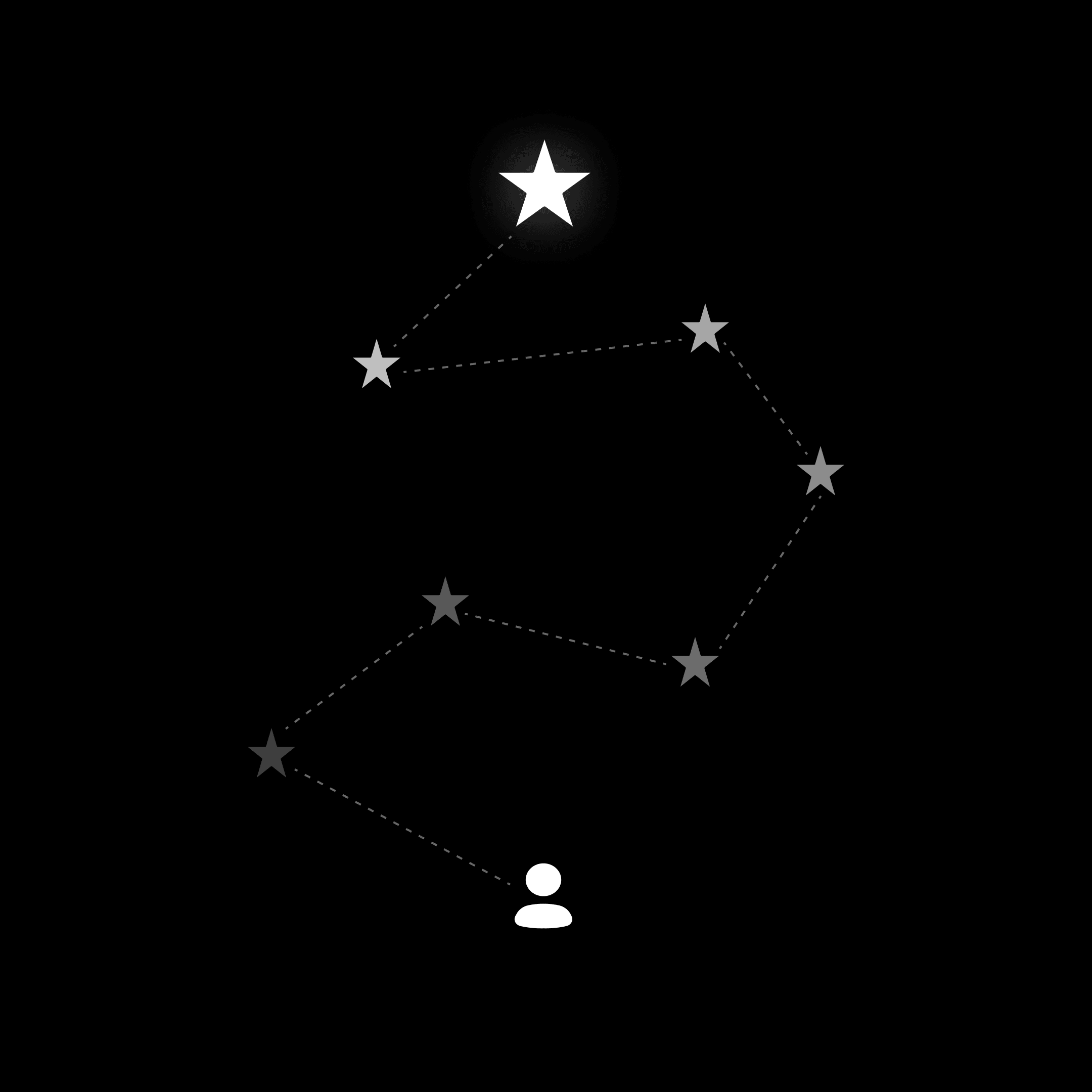
It doesn’t matter if you don’t know where to start. Just pick what you think is best and begin. You have to shoot to see how far you’re off. Take your best shot, pursue it, and iterate as you go. The more you aim, the better your aim will get.
Before we get to phase 2, there’s one more interesting concept I want to share that will make it clearer for you what goals to pursue. It’s called the Layers Of Purpose.
Layers Of Purpose
A man must align himself with his deepest purpose and then live it fully. Once that purpose has been lived, a deeper layer will be revealed. When a man is living one layer of his purpose completely, he will feel the next layer beginning to emerge.
– David Deida
Instead of stars, Deida talks about Layers Of Purpose.
To reach your core purpose, you must complete the outer layers first. Just like you need the early stars to reach the higher stars.
The idea here is that you have a core purpose and that you find it by completing the outer layers of purpose:
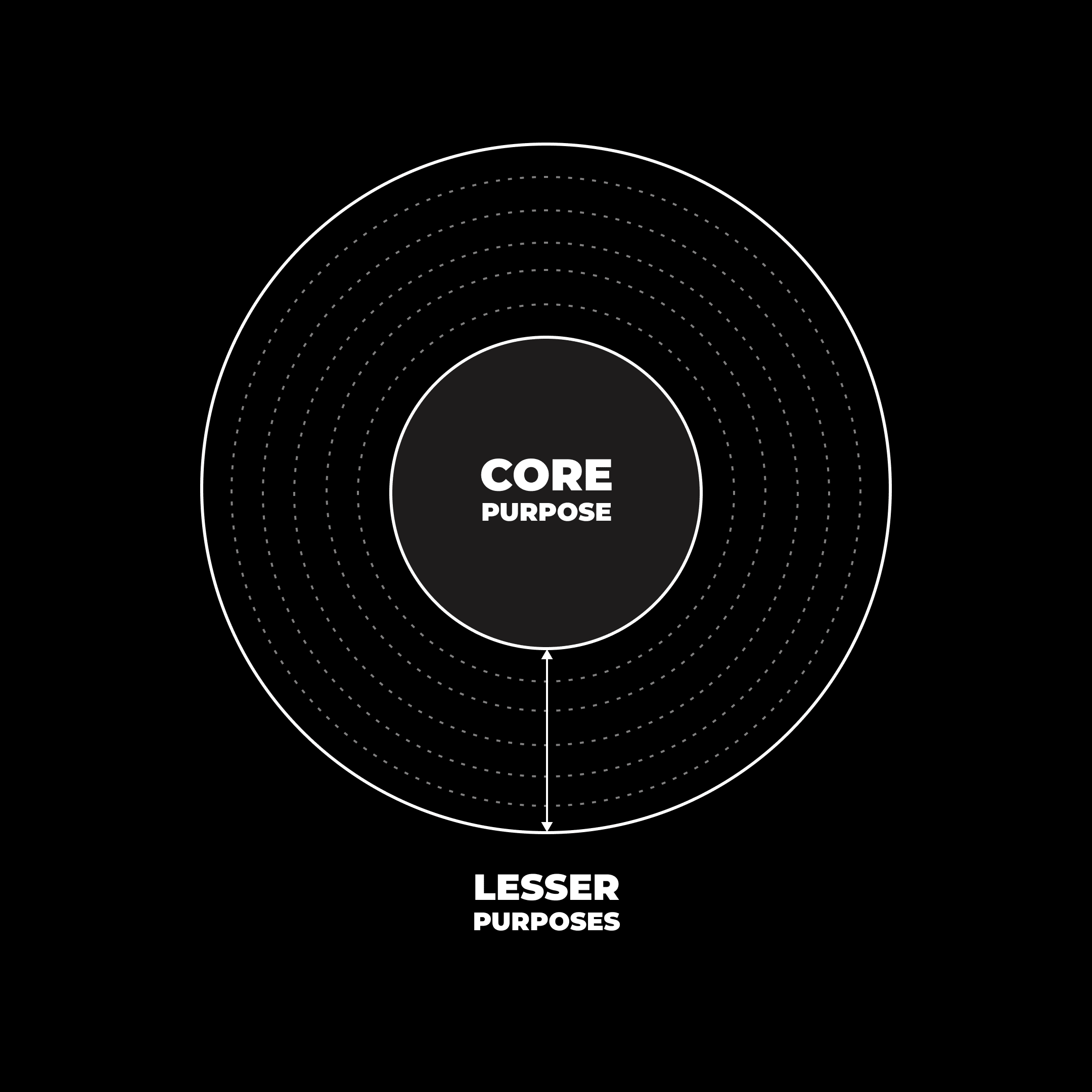
You reach your higher purposes by completing your lesser purposes. Each layer lived fully reveals the next. So the lesser purposes (or stars) aren’t ‘failures’ or ‘detours’, they’re needed to get to your core purpose (or goals).
You reach the higher goals by pursuing the lesser ones first.
So all of this is great, but how do we make this practical?
By reverse engineering your goals.
Reverse-Engineer Your Goals
Begin with the end in mind.
– Stephen Covey
When an engineer wants to recreate something, he takes it apart to understand how it works. This is called reverse-engineering, and it’s extremely effective for goal-setting.
Here’s how you can use it:
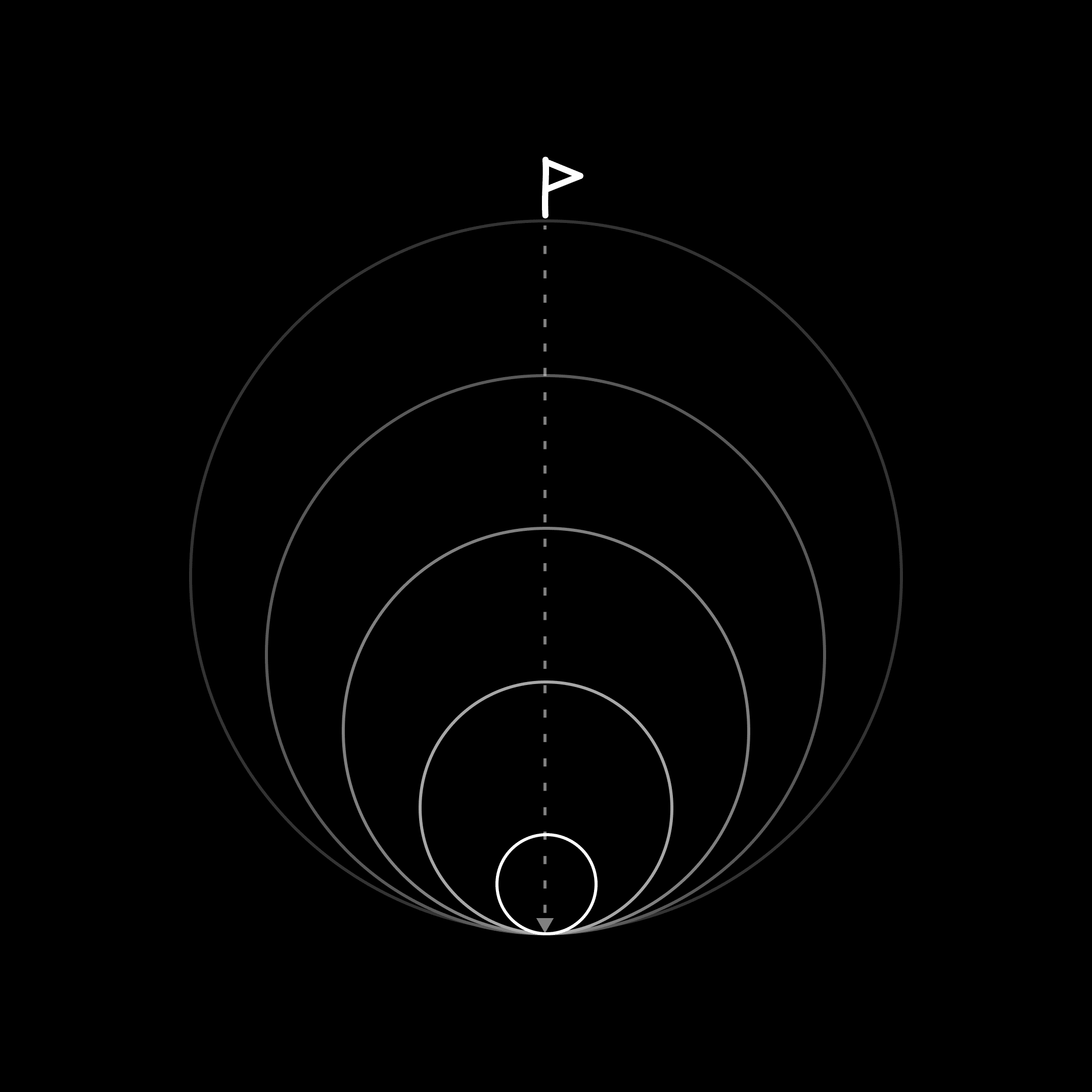
Aim at the highest possible good you can imagine
Turn this into a practical long-term goal (10 years)
Break it down into smaller goals (3y, 1y, 1q, 1m, 1w, 1d)
Define clear daily, weekly, monthly, and quarterly actions
Execute three key actions every single day
This aligns your daily actions with your long-term goal.
And because that goal represents the highest good you can imagine, it aligns your actions with what you value most.
This gives you the strongest motivation and dopamine while you pursue it.
Now you know what to aim for. That brings us to the second phase: the hunt.
Phase 2: Hunting
It is not that we have a short time to live, but that we waste much of it.
– Seneca
Everyone gets the same 24 hours. Yet some achieve far more. Even if they have the same goals and resources.
Why?
Because they actually do what matters. They strike like lions with precision and intensity. And they do it through something called Flow.
Flow is a state in which people are so involved in an activity that nothing else seems to matter; the experience is so enjoyable that people will continue to do it even at great cost, for the sheer sake of doing it.
– Mihaly Csikszentmihalyi
Flow is a mental state where work feels effortless. You’re fully focused on one task and you become extremely productive. To access it, you need 3 key things:
1. Challenge vs Skill level
The best moments usually occur when a person’s body or mind is stretched to its limits in a voluntary effort to accomplish something difficult and worthwhile.
– Mihaly Csikszentmihalyi
The first step is matching the challenge to your skill.
Video games are addictive because they master this balance.
We’ll dive deeper into this in a later newsletter, but for now it’s enough to understand that they always give you a challenge that’s just beyond your current skill level.
If it’s too hard, you feel anxious or stressed. If it’s too easy, you feel bored.
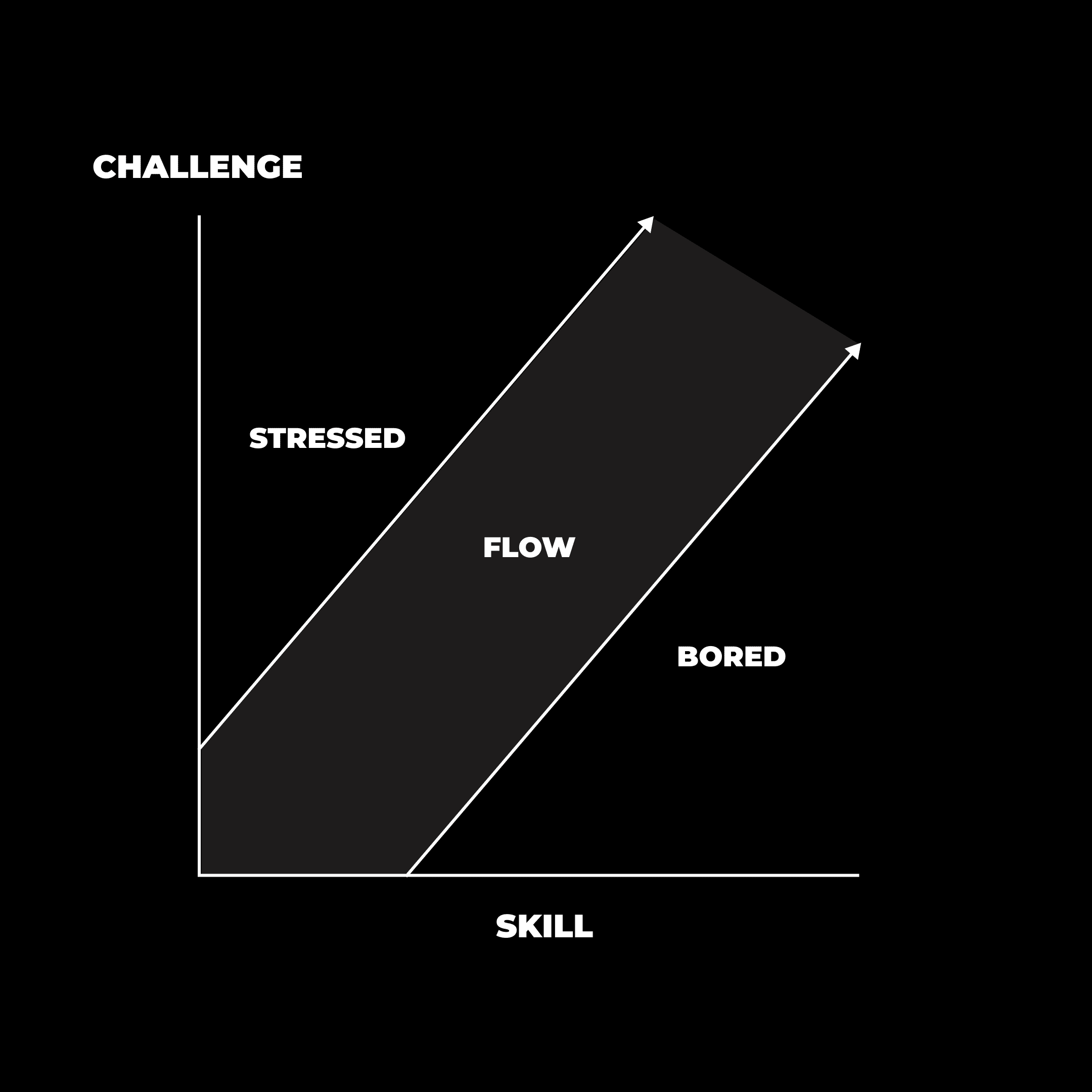
In the gym, you add a few pounds to get stronger. You don’t lift 300 pounds on your first day because you can’t handle it yet.
Work and skills should be treated the same. You add a bit of difficulty to get more skilled. Think about it as progressively overloading your skill level.
If you’re at level 5, take on a level 6 challenge. It’s high enough to motivate you but low enough to achieve (so you don’t feel overwhelmed). That balance triggers flow.
If you want to trigger flow, the challenge level should be about 4% greater than your current skill level. This matters because when the challenge is too low or too high, flow breaks.
A level 100 player won’t enjoy a level 1 challenge, so he feels bored. A level 1 player can’t handle a level 100 challenge, so he feels stressed and overwhelmed.
So pick a challenge just above your current level. That’s where growth happens.
2. Attention Design
The successful warrior is the average man, with laser-like focus.
– Bruce Lee
The next step is what I call Attention Design.
This is about designing your work environment for maximum focus.
It comes down to two rules:
Remove everything that distracts you
Add everything that helps you focus
I don’t know what your room looks like, but here’s what works for me:
Plan tomorrow today
Turn off all notifications
Isolate during the morning
Hide bookmarks and minimize tabs
Use a standing desk to switch posture
Exercise daily, sleep 8 hours, eat clean
Don’t multitask or switch between tasks
Focus on one big action step per work block
No phone, email, or social media before noon
Stay fasted and caffeinated during deep work
Use earplugs or noise-cancelling headphones
Keep your desk empty (just your PC and water/coffee)
Work in 90 minute blocks (then recover for 10 minutes)
Batch-produce shallow tasks into one time block later in the day
Do your most important work when your energy peaks (usually morning)
Reduce decision fatigue by eating mostly the same meals, wearing simple clothes, and automate small choices
The more of these you apply, the easier it becomes to focus.
It works well for me so I can highly recommend trying it out.
At this point, you know your goal, you picked the right challenge level, and you created the right work environment.
Now comes the hard part — actually sitting down to do the work.
And for that, there’s one key concept you need to understand.
3. Activation Energy
It is not always easy to enter flow. Most enjoyable activities require an initial investment of attention before they begin to be enjoyable.
– Mihaly Csikszentmihalyi
Once you’re in flow, work feels effortless. But getting into flow takes effort. You need to push through the resistance first. And to do this, you need Activation Energy.
Activation Energy is the effort it takes to start before the work becomes easier or enjoyable. It’s the spark that starts the fire. Most people avoid this spark, which is why they stay in shallow work.
They get distracted, multitask, or quit too early. And every time they switch tasks, they reset their flow.
According to Dr. Gloria Mark, it takes an average of 23 minutes and 15 seconds to return to the original task after an interruption.
This is why Attention Design matters. It helps you to focus long enough on one thing to overcome the struggle so that you get into flow state.
Just like everything else, it’s a skill you can train.
At first, it’s hard to push through the struggle phase. But the more you practice, the easier it becomes. It also becomes easier if you actually care about what you do.
To build activation energy and move through struggle:
Make the task clear and meaningful
Remove distractions (Attention Design)
Start — even when it feels hard
Focus deeply for 15–20 minutes
Let go and trust your brain to take over
Repeat this process, and you’ll enter flow more often.
That’s how you hunt like a lion. Flow is powerful, but it comes at a cost. Without proper recovery, it will drain you over time. So that brings us to the third phase: Rest.
Phase 3: Resting
After flow, you have to recover. Flow is a high-energy state — it’s neurochemically expensive. Without recovery, you build allostatic load — the body’s stress systems stay activated, performance drops, and burnout follows.
– Steven Kotler
You need to take time to recover after flow. But recovery often gets misunderstood. Most people think recovery means relaxing. But relaxing ≠ recovering.
Relaxation is passive — it feels good but doesn’t fully recharge you.
Recovery is active — it can feel hard but it actually recharges your body and brain.
That’s why you can “rest” all weekend and still feel drained. It’s simply not enough.
You need something called Active Recovery.
Active recovery is any deliberate, low-intensity activity that helps the body and brain return to baseline after high performance.
– Steven Kotler
Active recovery doesn’t always feel good during, but it makes you feel much better after. It clears stress, recharges your nervous system, and prevents burnout.
Here’s a list of the most important (active) recovery habits:
Sauna
Walking
Massages
Journaling
Breathwork
Light exercise
Social interaction
Yoga or stretching
Practicing gratitude
Spending time in nature
Cold showers & ice baths
Meditation & mindfulness
Sleep & NSDR (non-sleep deep rest)
Also eat healthy and work out regularly.
If you do these habits, you’ll actually recover mentally (instead of just relaxing).
You don’t need to do them all, but the more you do, the better you’ll recover.
Pick the ones you enjoy most and make them part of your routine.
It can also help to batch them together. For example:
Walk in nature
Focus on your breathing during meditation
Exercise in the gym and then go in the sauna or take a cold shower afterwards
This tactic is called Habit Stacking. It’s useful to add new good habits to something you’re already doing. In this way, you get positively triggered to do the new habit while you’re doing the old one (f.e., you start stretching after your workout).
For optimal recovery:
10 minutes per task
1 hour per day
1 day per week
1 weekend per month
1 week per quarter
This keeps your body and mind in balance. These are guidelines though, you don’t need to obsess over it. I usually try to stick to 1 hour per day and 1 day per week.
In short:
Plan. Work. Recover. Repeat.
Work with 100% intensity. Rest with 100% intensity.
Don’t half-work like a cow. Work and rest with full intensity like a lion.
This is how you use Lion Mode to get ahead of 99% by working less.
That’s it for this letter. It took a lot of mental energy to write this one. If you enjoyed it, please like it, share/restack it, and subscribe to this free newsletter for more.
Talk to you soon my friend,
Stijn Noorman
PS: I turn my newsletters into videos in case you prefer watching/listening over reading. Click here to watch the latest ones (free).
How I Can Help You
1. X Growth System: How I grew from 0 to 55K 𝕏 followers, +100M organic views in a year, and built a 6-fig creator business without sales calls, ads, and cold outreach.
2. Aesthetic Writing: Learn the best writing strategies I used to gain 70M organic impressions and 18,100 followers in only 90 days.
3. All Resources: Click here to see all my workshops, courses, and other resources (discounts ending soon).
4. Work with me 1-1. DM me ‘AC’ (or reply via email) if you want my help to build a 6-fig Asset Creator business with +50K followers and +100M organic views per year. The Asset Creator model only requires 2-4 hours per day and we focus only on content, emails, and digital assets (no cold outreach, sales calls, or sleazy tactics).
5. Free eBooks. Get my Writing and Twitter Simplified eBooks for free by subscribing to my free newsletter (you also get a bonus worksheet that will help you to build a unique personal brand on social media). If you’re already a subscriber and haven’t received these yet, reply ‘ebooks’ to this email and I’ll send them to you: