

Today we’re going to talk about how you can fix your focus in 1 day.
We need a few things to make this work:
Simplifying how focus actually works
The 3 foundational pillars of focus
8 practical steps to fix your focus
Let’s begin.
Before we dive in:
I have a special offer for you that will help you to start gaining 1,000+ X followers and 1M followers per month. The strategies inside are made for X but they also work on other writing platforms like Substack, LinkedIn, and Threads.
I used to sell this for a lot of money, but you can get it for only $29 today. It helped me get 100,000 followers across platforms which helped me to make over $100K in a year.
It’s a limited offer though so it will be gone very soon and I won’t sell it again for this cheap after that. Click here to get it. (if the page says ‘offer expired, you’re too late).
With that out of the way, let’s begin.
Focus Simplified
The man who chases two rabbits, catches neither.
– Confucius
To fix our focus, we first need to take a look at what it actually is.
There are many definitions of focus.
To me, focus is doing the one thing you set out to do.
It’s using your limited mental resources on one thing and ignoring everything else.
Our attention, energy, and time are limited. So to make progress, we need to decide how to use them. This is what focus helps up to do.
You need to:
Decide what matters
Actually do that thing
Don’t get pulled away
That’s the core of focus.
Most people think focus is trying harder. But it’s actually about elimination.
You improve your focus by eliminating options and distractions.
When there’s only one real thing to do, focus becomes easier.
Because focus is like taking pictures.
Only one object can be sharp at a time. Switching takes time to refocus. But you can take two clear pictures. Just one at a time.
Your brain works the same way.
It performs best with one target and loses sharpness when you switch tasks. But if you give it one clear goal, and if you remove your distractions, it will become much easier to focus.
In short:
Focus is doing one thing and not doing all other things.
It’s not forcing yourself to work harder, but it’s removing what doesn’t matter so you can give your limited attention, time, and energy to the one thing that matters most.
If we want to fix our focus, we need to understand the 3 Pillars Of Focus.
The 3 Pillars Of Focus
As every divided kingdom falls, so every mind divided between many studies confounds itself.
– Leonardo da Vinci
In order to focus, there are 3 things you need.
I call these the 3 Pillars Of Focus:
Clarity. So you know what to focus on.
Self-discipline. So you can focus on this thing.
Self-control. So you don’t get distracted by other things.
Clarity tells you what to focus on. Self-discipline ensures you actually do this thing. And self-control ensures that you don’t get distracted by the wrong things.
Each of these topics deserves its own newsletter but I don’t want this newsletter to become too long.
So let’s break down the most impactful stuff you can do to build these 3 Focus Pillars.
Pillar I - Clarity
If a man knows not to which port he sails, no wind is favorable.
– Seneca
Clarity means knowing what you’re trying to achieve and what to do next.
Your brain needs a target.
If there’s no clear goal, your brain can’t prioritize.
Everything feels equally important, so nothing gets your full attention.
When the goal is clear, many decisions disappear automatically. You don’t waste energy wondering what to do. You already know. And this makes it easier to focus.
That’s why you need to:
Get clear on what you want
Break it down into smaller steps
Make a list of practical action steps
That’s how you make it crystal clear what you need to do.
We’ll come back to this later. But first, we need to talk about the second pillar:
Discipline.
Pillar II - Discipline
Discipline is choosing between what you want now and what you want most.
– Abraham Lincoln
Knowing what to do isn’t enough.
You still need to do it.
That’s why you need discipline. Unlike what most people think, discipline isn’t something you ‘have’ or ‘are born with’.
It’s actually a decision you make.
You choose to do the thing.
That’s all it is.
You need to make that decision for yourself. I can’t do it for you. But what I can do, is make it easier for you to make that decision.
And there are 3 important things that will help you with this.
1. Work when it’s easiest to work.
I’m at my best in the morning. Some people are at their best in the evening.
Get clear on when your energy levels are at their highest. This is the best time to do focused work. I can recommend tracking your energy levels for a week:
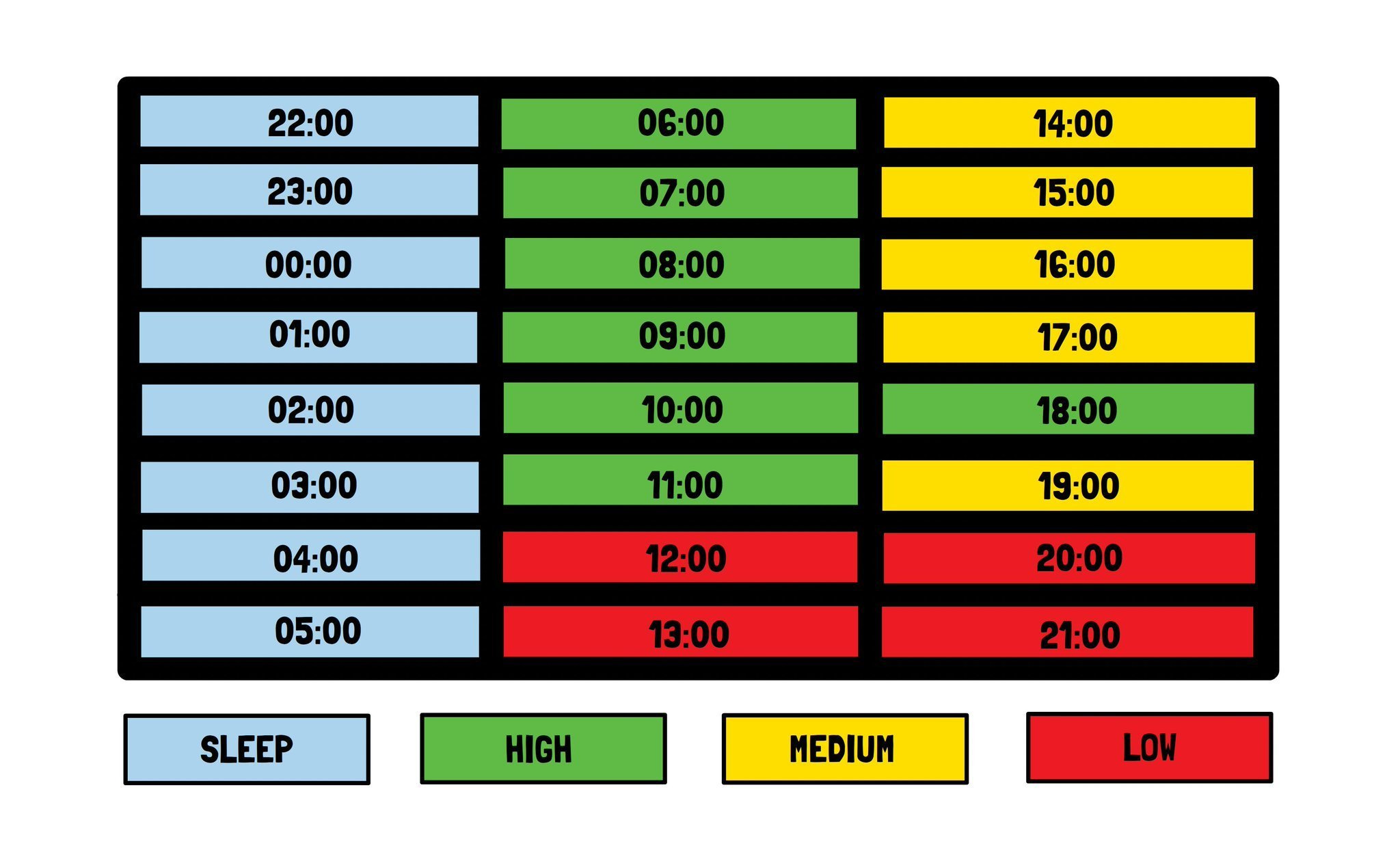
When you do, you will know when you’re at your best. And when you know this, you know when your focus as at its peak.
Do your most important work when you’re at your best.
That’s how you make it easier to choose to be disciplined.
2. Pick the right challenge for your skill level.
Flow follows focus, and focus follows challenge. The ideal challenge point is about 4 percent greater than the skills we bring to the task.
– Steven Kotler
We are at our best when we stretch our limits. So we need to do stuff that’s a little harder than what we feel comfortable doing. When we do, this triggers a flow state.
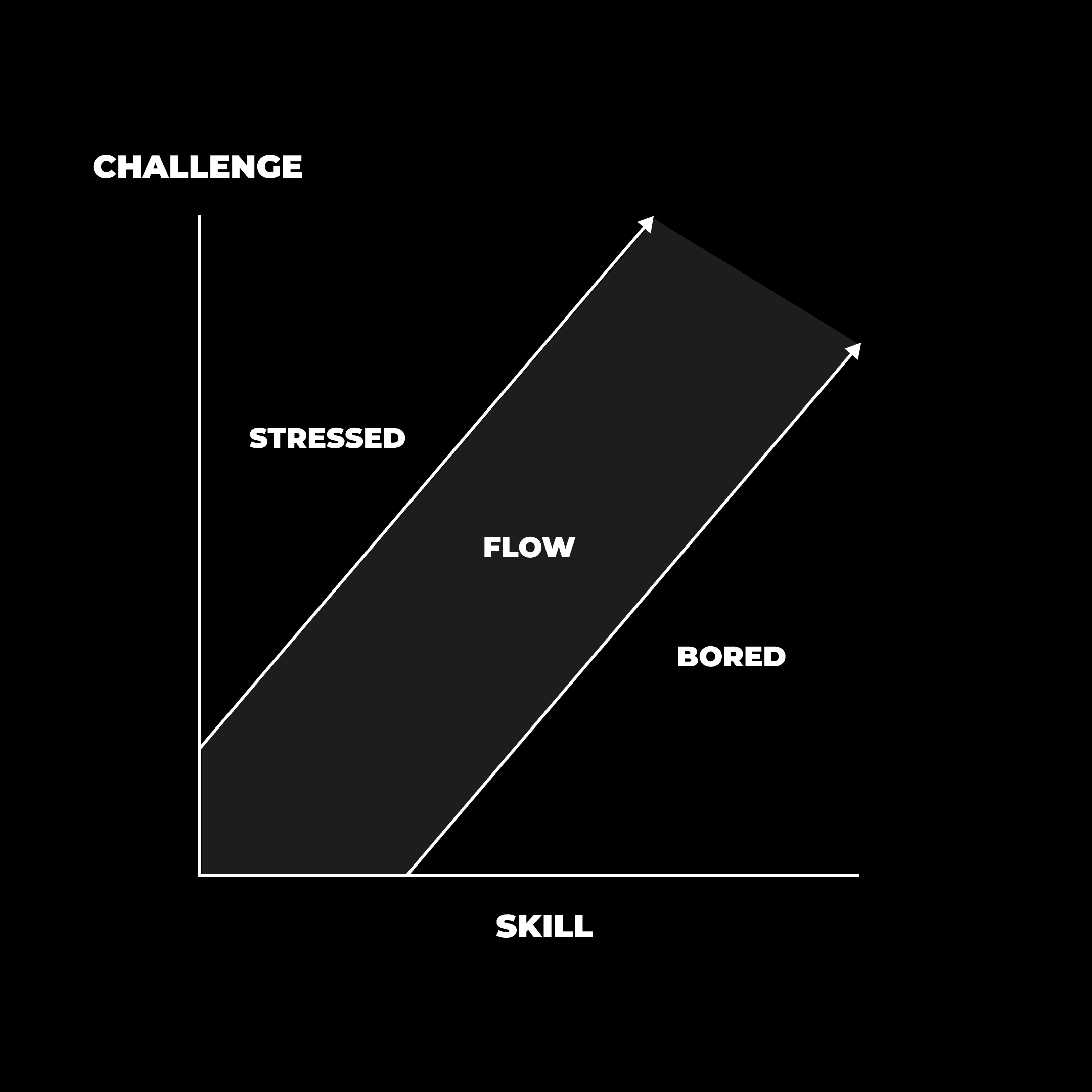
Flow is a mental state where work feels effortless.
You’re fully focused on one task and you become extremely productive.
It takes some struggle and (activation) energy to get into flow. That’s why it’s so important to have clear, small action steps you can take. When you complete it, it builds momentum and this helps to motivate you and to get you into flow state.
Just don’t switch between tasks because this will usually knock you out of flow state.
3. Limit your dopamine consumption
Almost all of the positive emotion that you will experience in your life will not be from attaining things but from seeing that things are working as you proceed towards a goal you value.
– Jordan Peterson
Dopamine isn’t the molecule of reward, pleasure or achievement.
Is the molecule of motivation, craving, and pursuit.
When we see ourselves move closer toward a goal we value, dopamine gets released. The bigger and more meaningful the goal, the more positive emotion we experience when we move toward it.
It’s a fantastic system.
But the problem is that modern society abuses this system.
There are all kinds of Dopamine Traps that will give you cheap dopamine.
Porn
Drugs
Alcohol
Gaming
Smoking
Gambling
Scrolling
Gaming
Junk food
It feels nice in the moment. But these traps desensitize your dopamine system by decreasing the number of dopamine receptors in your brain.
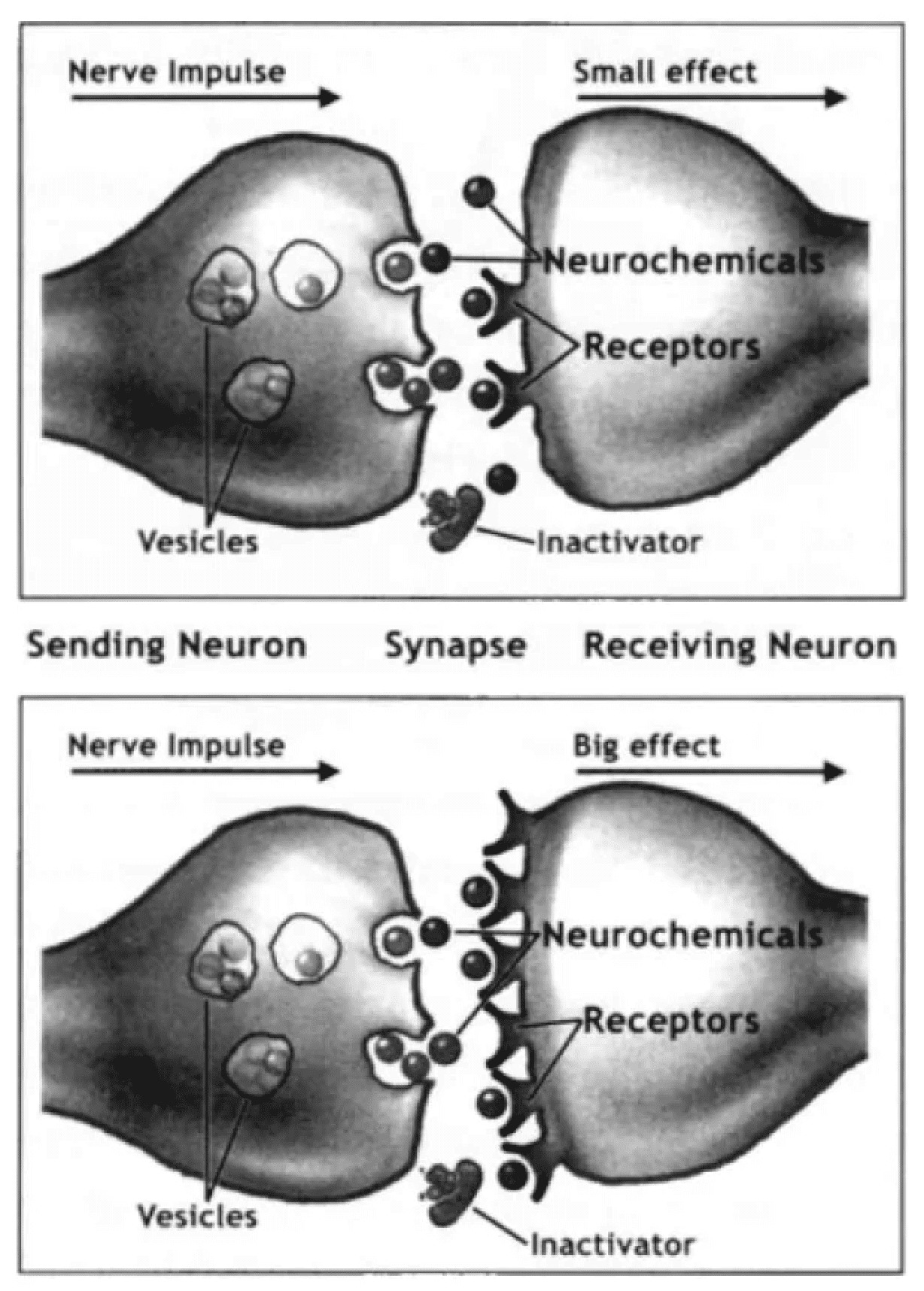
This basically means that they make you less sensitive to dopamine.
In other words, you need more stimulation to get the same effect.
And the problem is that stuff like working on your goals, going to the gym, and reading books isn’t as stimulating as the Dopamine Traps above.
So if you constantly overstimulate your dopamine system, you won’t feel motivated to do the work. And that’s why you might think that you have ‘bad focus’.
You don’t have bad focus. You just have an desensitized dopamine system.
I can’t help you to fix in 1 day because it takes time (1-3 months) to fully resensitize your dopamine system.
The graph from the YouTuber AfterSkool illustrates this idea well:
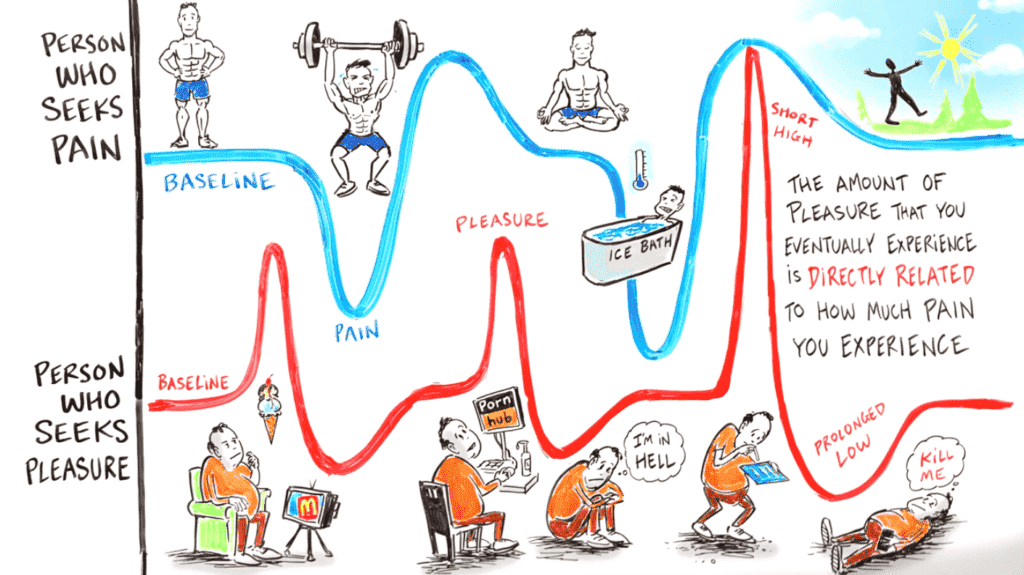
Yes, it’s oversimplified. But that doesn’t mean that the core idea isn’t true. Too much dopamine lowers your baseline. But when you do a dopamine detox, your baseline increases. And as a result, your focus improves.
So limit your cheap dopamine consumption to improve your focus.
That brings us to the third Focus Pillar: Self-control.
Pillar III - Self-Control
Between stimulus and response there is a space. In that space is our power to choose.
– Viktor Frankl
Self-control is about:
Deciding what you want to do
Designing your environment accordingly
Being mindful while you work so you don’t get distracted
You need to make it easy to do the good behavior and hard to do the bad behavior.
That’s all it is. And there are 3 important things you can do for this.
1. Focus Design
Environment is the invisible hand that shapes human behavior.
– James Clear
Focus Design is about designing your work environment for maximum focus.
It comes down to two rules:
Remove everything that distracts you
Add everything that helps you focus
This differs for everyone, but here’s what works for me:
Plan tomorrow today
Turn off all notifications
Isolate during the morning
Hide bookmarks and minimize tabs
Use a standing desk to switch posture
Exercise daily, sleep 8 hours, eat clean
Don’t multitask or switch between tasks
Focus on one big action step per work block
No phone, email, or social media before noon
Stay fasted and caffeinated during deep work
Use earplugs or noise-cancelling headphones
Keep your desk empty (just your PC and water/coffee)
Work in 90 minute blocks (then recover for 10 minutes)
Batch-produce shallow tasks into one time block later in the day
Do your most important work when your energy peaks (usually morning)
Reduce decision fatigue by eating mostly the same meals, wearing simple clothes, and automating small decisions
The more of these you apply, the easier it becomes to focus.
It works well for me so I can highly recommend trying it out.
2. Practical Mindfulness
What you are aware of you are in control of; what you are not aware of controls you.
– Anthony de Mello
Mindfulness may sound woo-woo to you.
And this is probably because you heard some spiritual guru talk about it in a way that didn’t appeal to you. I used to ignore it because of this as well. But in the recent years I realized that it’s actually very practical.
Mindfulness is just the skill of staying present so you can control what you focus on.
That’s all.
I like to think about it as a mental muscle.
You can train it with a simple game to become more focused:
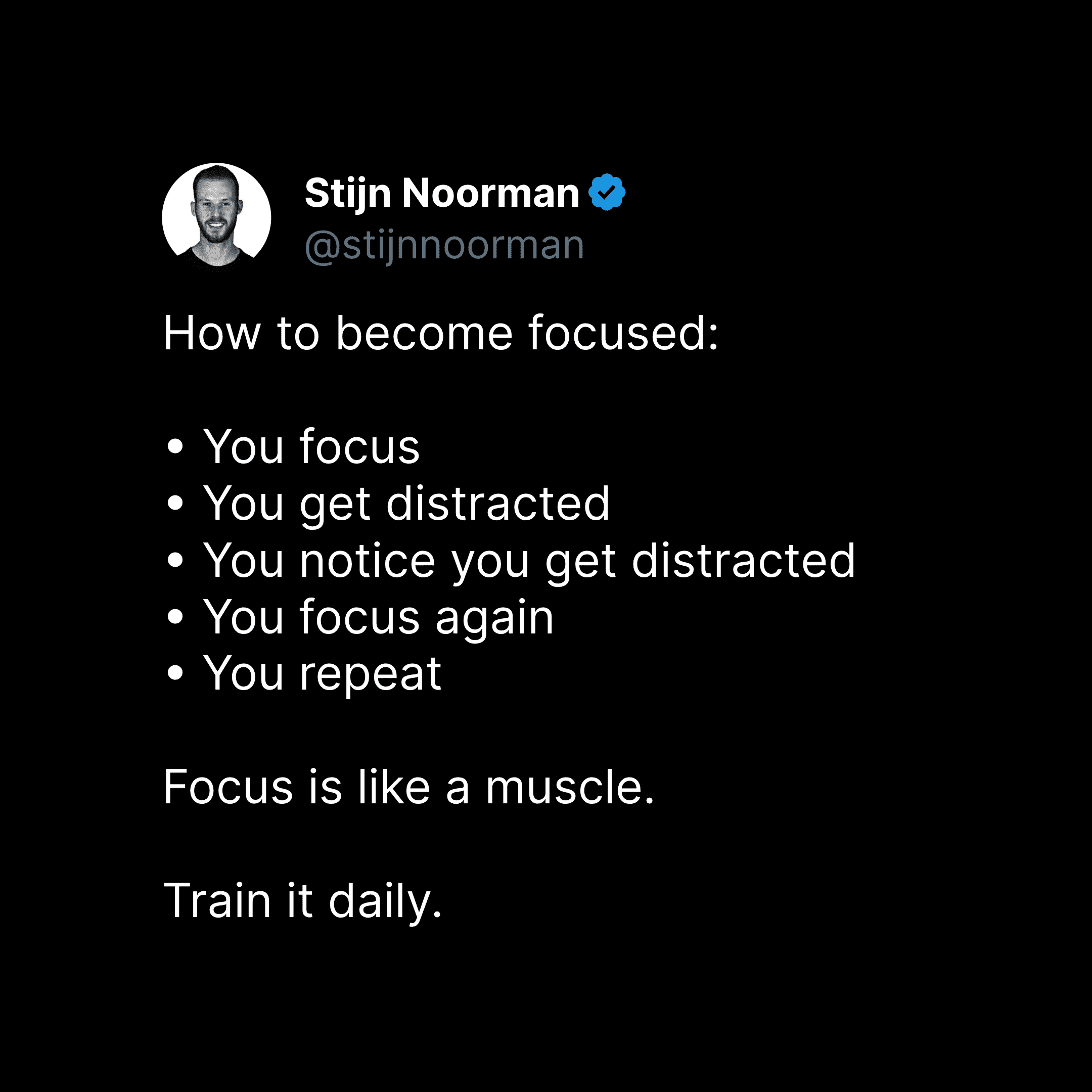
You can just replace ‘focused’ with ‘mindful’ in this tweet.
The best way to train this is with mindfulness meditations.
You just close your eyes. Then you try to stay present. Then a thought comes up that distracts you. Then you notice this. And then you return to the present moment.
That’s all it is.
Focus (and mindfulness) is like a muscle.
Every time you get distracted, and return to the present moment, you make this muscle a little bit stronger. That’s why there are no bad meditations. Just meditations where you do fewer reps. The more you do this, the better you can control your focus.
But there’s still one other key concept you need to understand.
3. Tactical Friction
Anticipate the difficult by managing the easy.
– Lao Tzu
Self-control is about not doing what you know you shouldn’t do. So a simple way to make this easier is to make it harder to do these things.
I call this adding Tactical Friction.
Our brains usually get distracted because it’s an easy, low effort way to get a dopamine kick. But if we make it harder to get this, by adding friction, then we’re less likely to get distracted.
A simple example is checking your phone.
If you have your phone in your pocket, you can check social media within a few seconds. But if you log out of your social media accounts, turn off you phone, and lay it in a different room, then there’s much more friction to checking social media. And as a result, you’re much less likely to check it.
So to control yourself, add Tactical Friction. Make it hard to do what you don’t want to do and make it easy to do what you want to do. Add friction to make bad habits harder. Remove friction to make good habits easier.
That’s it for the 3 pillars of focus.
So let’s end with a quick practical 8 step plan to fix your focus.
8 Steps To Fix Your Focus
Give me six hours to chop down a tree and I will spend the first four sharpening the axe.
― Abraham Lincoln
We talked about example how focus works and how you can get more focused.
So let’s make it practical now with a 8 clear action steps you can take to fix your focus.
1. Get clear on your goal.
Give your brain something to focus on.
When you do, you leverage your brains reward system.
It’ll be clear what you need to focus on.
2. Break it down into actions.
Your goal is what you want to achieve.
Your actions are what you need to do to achieve it.
Reverse engineer the process so you know exactly what you need to do.
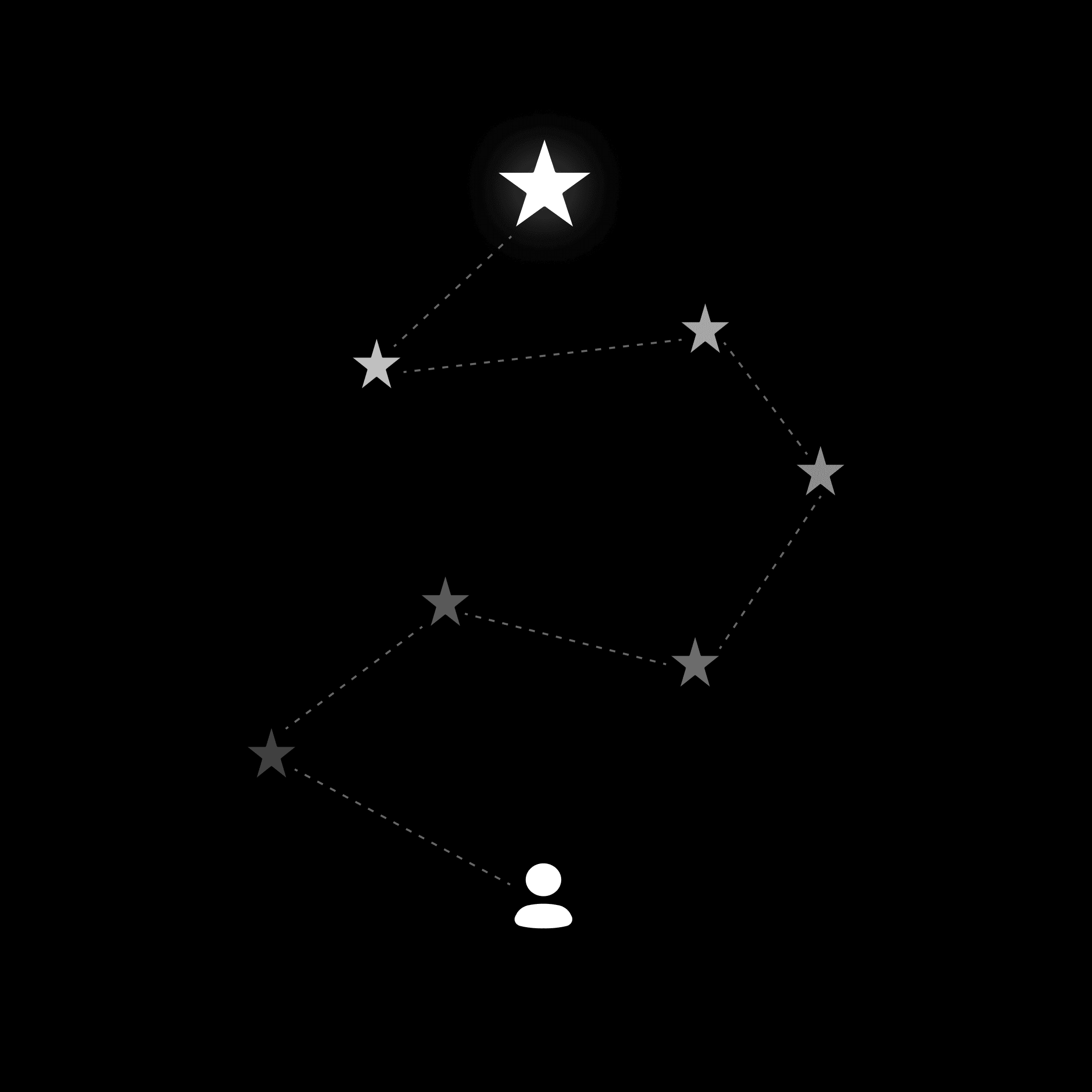
3. Track your energy levels for a week
Get clear on when you’re at your best.
When you know this, you know when to do your focused work.
4. Design your environment
Remove the distractions from your work space.
Make it hard to do bad behavior and make it easy to do good behavior.
Use Tactical Friction for this.
5. Plan (the day) before you work
Planning and executing use different parts of the brain.
So plan tomorrow today.
Then you instantly know what to focus on when you wake up.
6. Optimize your habits
You can’t focus if you are not doing well.
So optimize your most important habits.
Sleep 8 hours
Eat healthy food
Exercise almost daily
Limit cheap dopamine
Meditate 10min per day
Take daily walks as breaks
This will make it much easier to focus.
7. Schedule 2-3 deep work blocks of 1-2h per day.
No multi tasking. No task switching.
Just you doing the most important tasks.
This is how you blow past the competition.
8. Rest & recover (passive & active recovery)
Most people work like cows. They ‘graze’ all day. They’re always half-working and half-resting. High performers work like lions. They plan, hunt, and rest. They switch between 0% and 100% intensity. This is how they achieve more in less time.
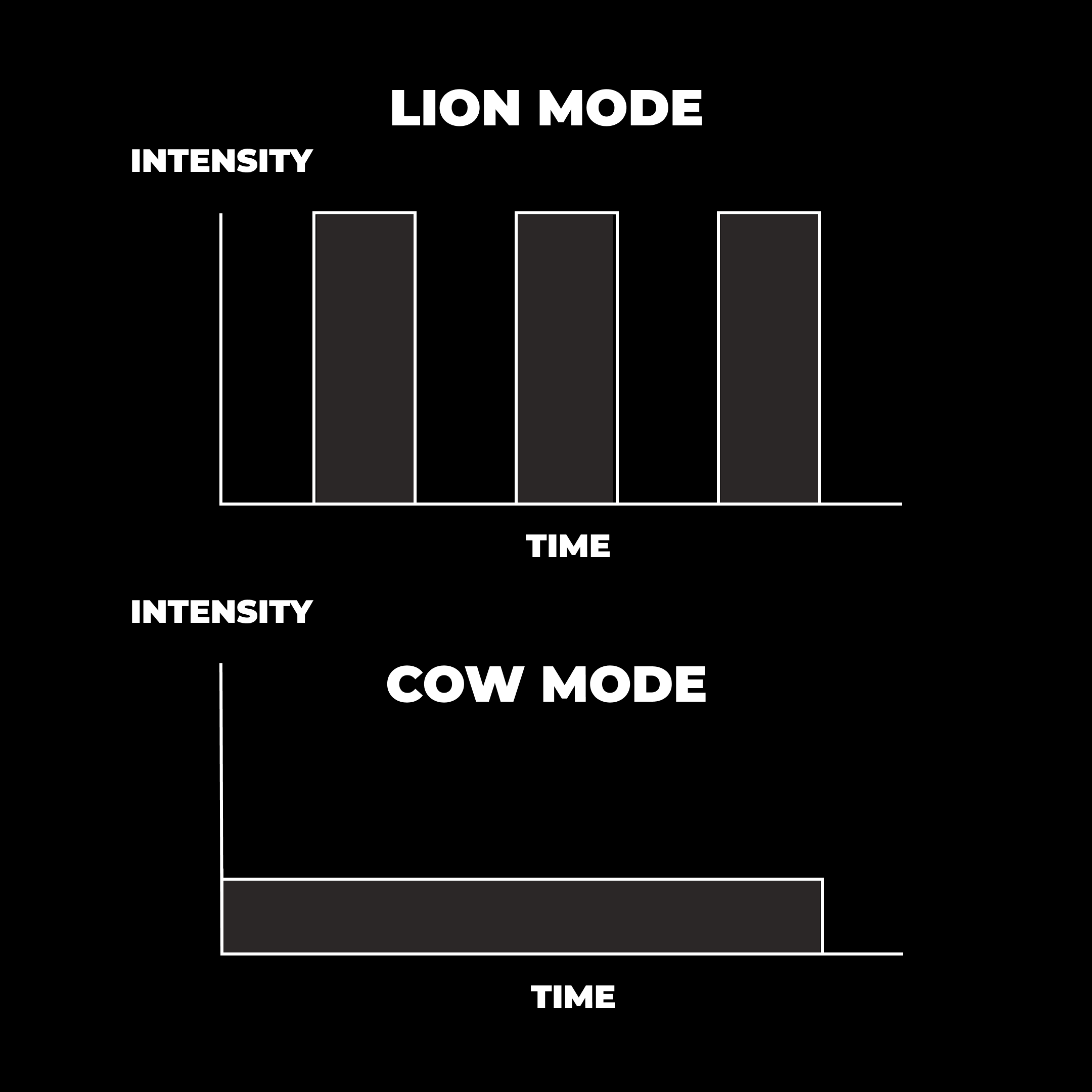
You can’t always be on.
To be focused, you need time off. But most people think this just means relaxing. It doesn’t. You also need to recover.
Relaxing = passive rest. So doing enjoyable stuff that doesn’t take energy.
Recovering = active rest. So doing stuff that helps you to restore your energy.
Passive rest can be laying on the bank. Active rest can be sitting in the sauna.
Combine both to recover optimally. Because what you do when you don’t work influences how well you can focus when you do work.
So in short:
Define your main goal
Break it into clear action steps
Track your energy and work when it’s highest
Remove distractions and design your environment
Plan your next work day the night before
Optimize sleep, food, exercise, and other habits
Work in 1–2 deep blocks without switching tasks
Relax and recover properly so you can repeat tomorrow
That’s how you fix your focus.
Talk soon my friend.
– Stijn
PS: don’t forget to grab the X Brand Booster. It will help you to start gaining 1,000+ X followers and 1M followers per month. Click here to get it. (if the page says ‘offer expired, you’re too late).
Newsflash, you don’t need more time.
You need more focus.
Focus is the multiplier.
Deep focus and deep block.
Even hyperfocus will help but 100% concentration on things you do.