

You cannot change your entire life in one day.
That may seem like a weird first sentence for an article called ‘how to change your entire life in 1 day’. But it’s the truth. You cannot build a successful business, transform your body, become financially free, repair all your relationships, and become a completely different person before you go to bed tonight.
However, you can change the direction of your life in one day.
You can change your goals. You can change your actions. You can change your internal dialogue. You can change what you focus on. You can change who you hang out with. You can change your interpretations. And all of this will change your life.
This article will help you to do that. It’s pretty dense and it contains a lot of practical action steps so I can recommend that you bookmark it so you can come back to it later.
By the end, you will have:
A clear vision and anti-vision
A practical plan to get there
A redesigned environment for success
A list of the actions, habits, and skills you need
A clear guide on how to start changing your life today
I made a Purpose Planner to help you to implement everything we discuss here. It’s free and you can get it by signing up here. When you sign up, you also get my Writer In a Week course for free to learn how to write content and grow a profitable audience.
I’ve divided this article into 3 core sections. Let’s start.
1) The Hidden Force That Holds You Back
“The mind is everything. What you think, you become.”
– Buddha
We all know the term limiting belief. It’s a belief that holds you back. If you change it, new things suddenly become possible for you.
I want to talk about a related concept. I call it a Limiting Identity.
It’s similar to a limiting belief in the sense that it holds you back. But a belief is usually something you believe about something else; your identity is something you believe about yourself. It’s the type of person you view yourself as.
We can call it your ego, although that’s a word that means different things to different people. I simply mean that it’s who you think you are. You see yourself as a particular person, and that’s why you will behave in a way that’s in accordance with that identity.
If you’re a vegan, you won’t eat meat. If you’re a professional bodybuilder, you won’t drink alcohol. If you’re a writer, you will write. You will perform the actions of the type of person you see yourself as. Because ‘that’s who you are’.
You might be. But are you sure?
If your life is working for you and if you’re genuinely happy, then you probably are. But if you feel an inner frustration or tension, then you probably aren’t.
If the latter is the case, it’s a Limiting Identity. It’s something that you think you are that’s holding you back. When you change this identity, you change your behavior.
Let me give you a quick example from my own life to make it clearer.
When I was young, I didn’t talk a lot. I still don’t. But because of this, I got labeled as ‘shy’ by people around me. Since I was a child, I didn’t think anything of it and I accepted it as true. I never questioned it. As a result, I started to identify as a shy person. And as I got older, this made it harder for me to socialize. I believed that I wasn’t able to do certain things ‘because I was shy’. Even though that’s just a label.
The facts were that I didn’t talk a lot (behavior) but the story I told myself about it was that I was shy (identity).
As a result, I didn’t do certain things because I thought I was shy.
This is a Limiting Identity. It prevented me from doing certain social activities. Not because I couldn’t do them, but because I thought I couldn’t do them.
I was physically able to do the things that I thought I couldn’t do, but my Limiting Identity prevented me from doing so.
The solution was to change how I thought about this. When I changed how I thought about this, I was able to change my identity. When I changed my identity, I was able to change my actions. I stopped seeing myself as a shy person (identity) and I started seeing myself as someone who didn’t like socializing a lot (preference) and who hadn’t practiced a lot with socializing (behavior).
This made me realize that I could change if I changed my behavior. But I wouldn’t have been able to change if I hadn’t changed my identity first. I stopped seeing myself as a shy person who couldn’t socialize and I started seeing myself as an introvert who could learn to socialize if I changed my actions.
If I hadn’t changed how I perceived myself first, I wouldn’t have been able to change.
That’s why you need to change your identity before you can change your life. You don’t rise to the level of your goals. You fall to the level of your identity. Change your identity to change your actions. Change your actions to change your life.
So how do we make this practical?
I want you to get clear on the person you want to become. Not the person you think you are or have to be. But the person you would genuinely want to be. Don’t let your Limiting Identity trick you into thinking you can’t do it. You can. You just need to start behaving like the person that you want to become. That’s all there is to it.
Answer these questions:
What kind of person do you want to become? Why?
What character traits do you want to develop?
Which people do you look up to the most? Why?
What do you want to stand for?
How do you want people to describe you?
Add all the answers to The Purpose Planner.
There are also a few additional questions in there so make sure you answer those too. When you do this, you’ll have clarity on who you want to become.
2) How to Reverse-Engineer Your Ideal Life
“If a man knows not to which port he sails, no wind is favorable.”
– Seneca
If you want to change your life fast, you need clarity on two things:
1) Something to move toward (vision)
2) Something to move away from (anti-vision)
This leverages the 2 human motivators (moving toward pleasure and away from pain).
I call this your Heaven and Hell.
Your Heaven = what you want to achieve
Your Hell = what you want to avoid
Both need to be somewhat realistic. I don’t mean small, but they won’t motivate you if they seem almost impossible to achieve.
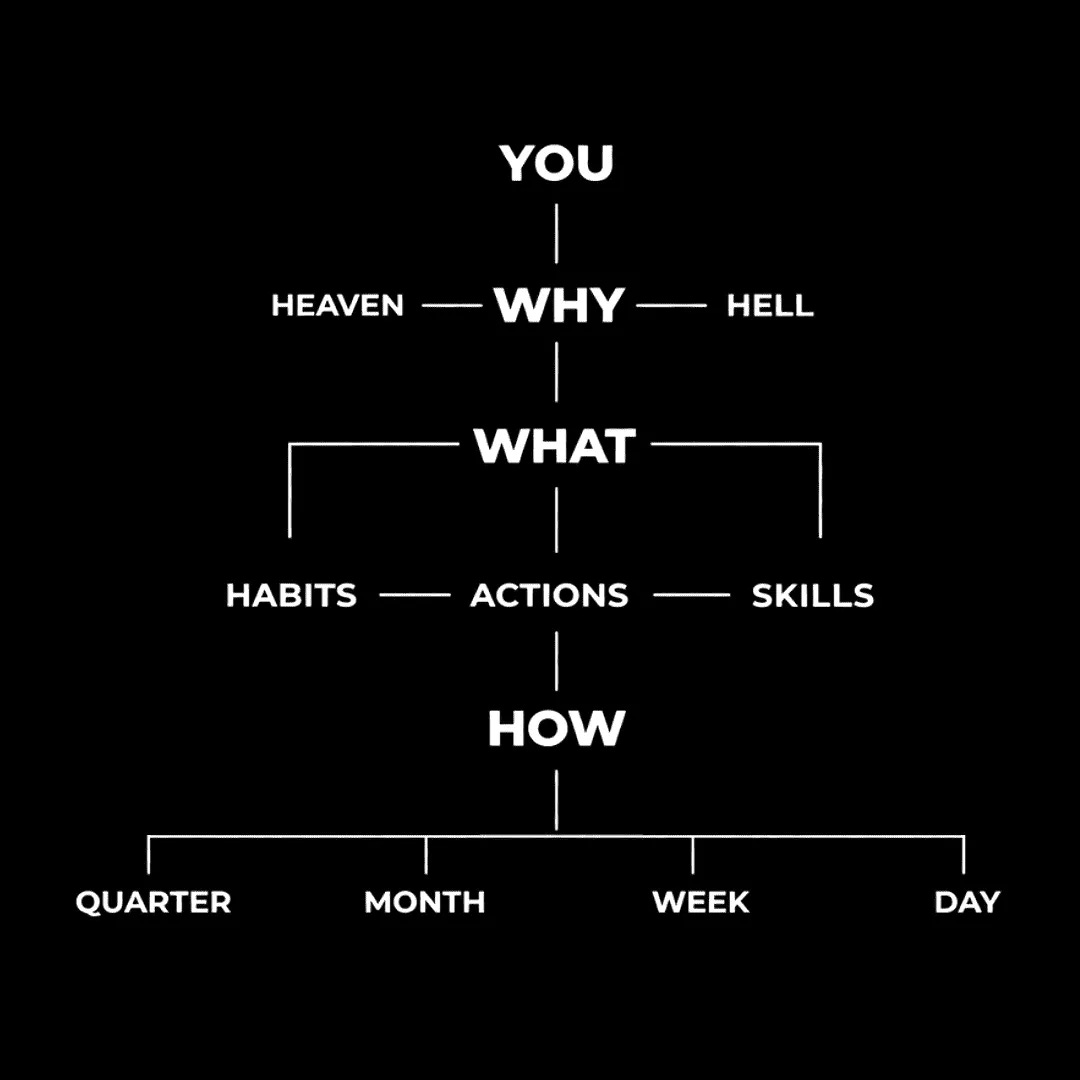
Here’s an example of my Heaven and Hell:
My Hell isn’t some extreme scenario where I lose my limbs and become homeless.
It’s slipping back into my bad habits, burning out, getting depressed, isolating myself, failing in business, and ending up in a factory job I hate again.
I’ve experienced parts of that before and I never want to experience it again.
That’s what makes it powerful.
This gives you something to move away from.
Your Heaven gives you something to move toward.
It wouldn’t be realistic if my vision was to become a professional basketball player because I’m 28, I have zero experience, and I’m only 6 ft tall (average male height in my country). So even if I start working out like Kobe, that’s not happening.
Your Heaven should be something that could happen if you commit long-term.
For me, that’s becoming a bestselling author, financially free, and one of the best educational creators in the world. Those are massive and difficult goals, but they’re achievable with years or even decades of focused work.
So define both:
What you’re moving toward
What you’re moving away from
Make it specific.
What do your days look like?
What skills do you need to learn?
What habits do you build and avoid?
The more specific you make it, the more motivating it becomes.
There are questions about this in The Purpose Planner, so make sure you fill it in. It doesn’t need to be a perfect plan. It just needs to be as good as you can make it right now. You will improve it later. But you can only improve something that exists.
As Jordan Peterson puts it, you aim at the highest possible good you can conceive of right now. He calls it ‘aiming at a star’. Then you move toward it and adjust as you go.
Each goal (star) gives you more clarity on the next one. You keep improving and eventually, you discover your true north star (your purpose).
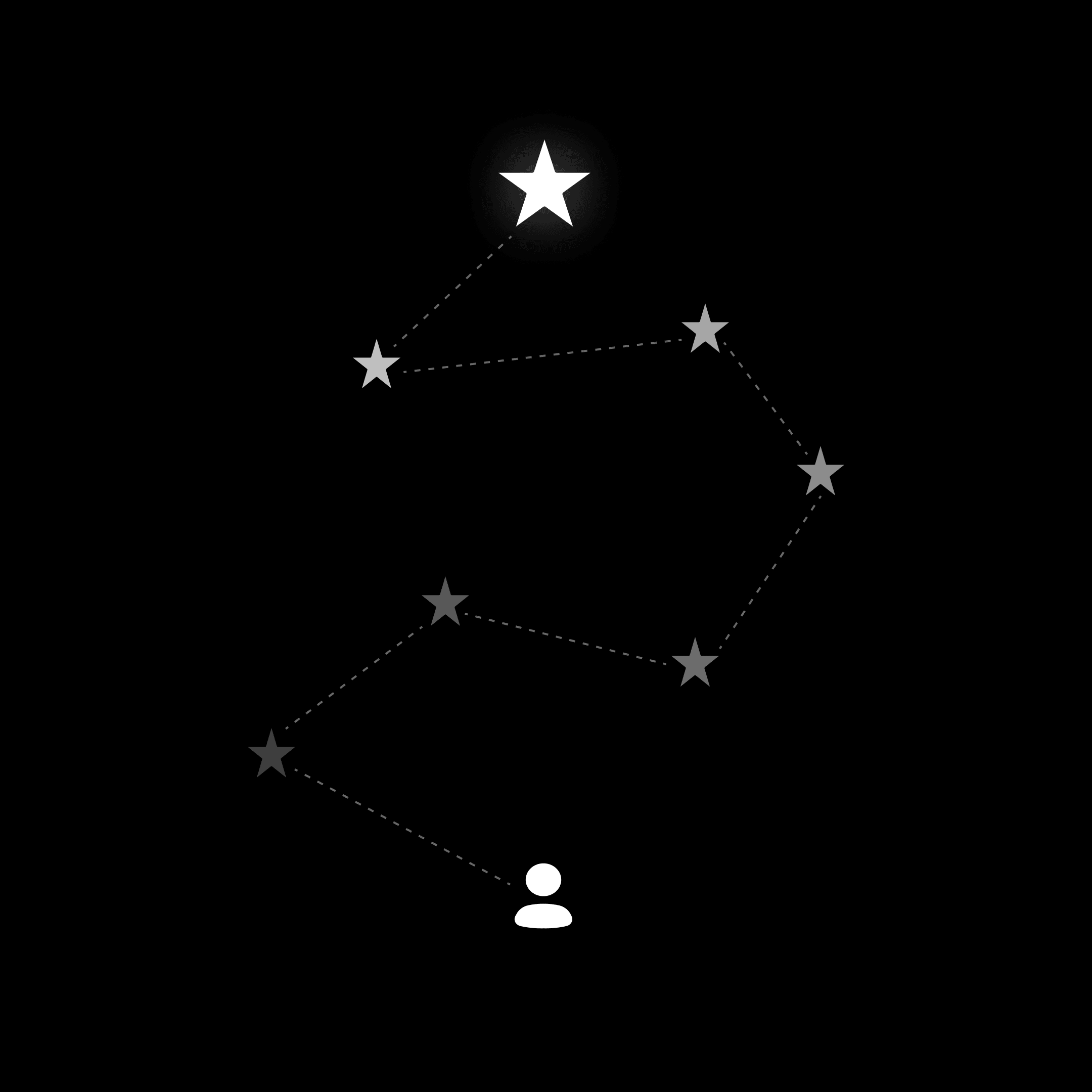
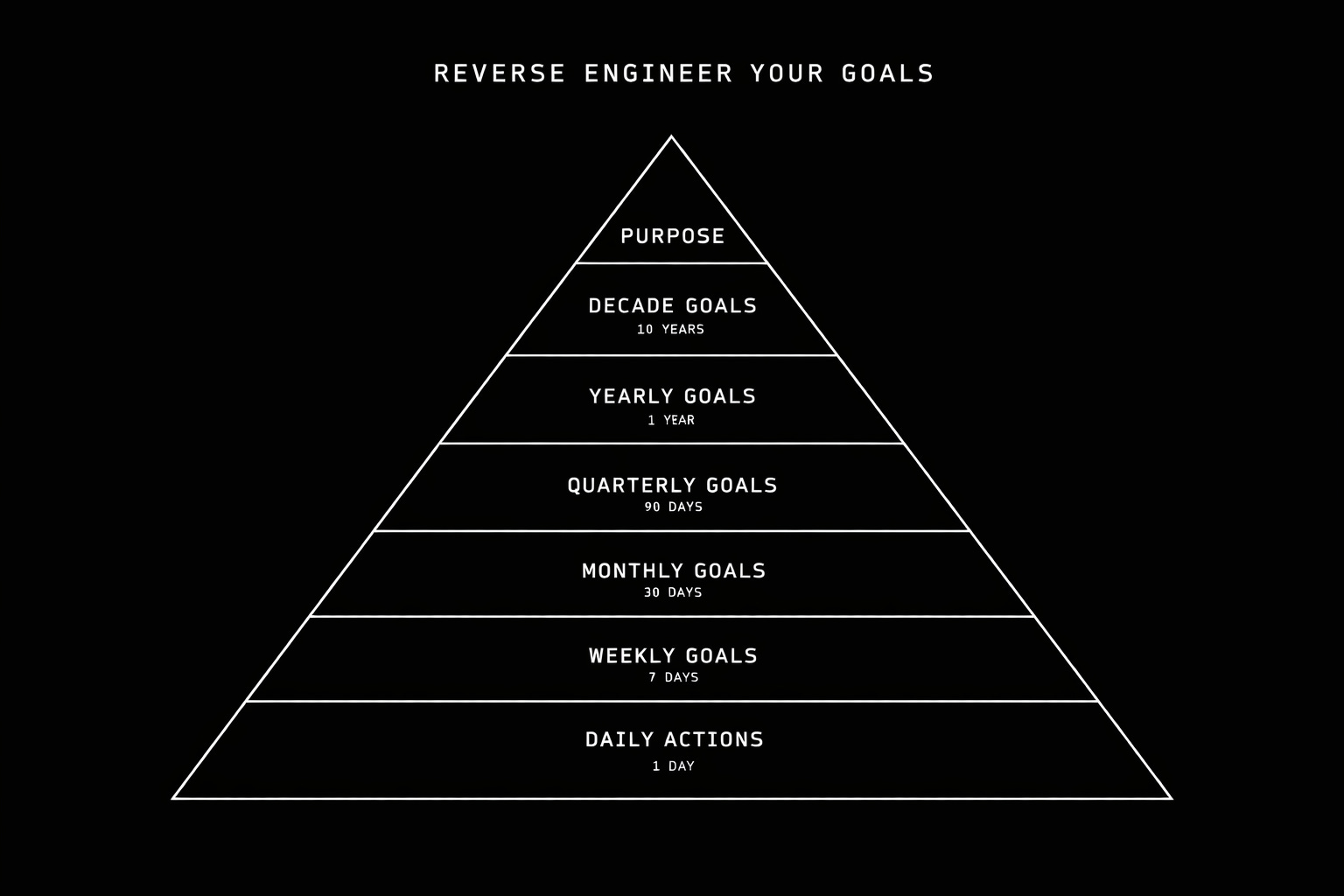
After you’ve written this down, you need to reverse engineer your ideal end goal.
When an engineer wants to recreate something, he takes it apart to understand how it works. This is called reverse-engineering, and it’s extremely effective for goal-setting.
Here’s how you can use it:
Aim at the highest possible good you can imagine
Turn this into a practical long-term goal (10 years)
Break it down into smaller goals (3y, 1y, 1q, 1m, 1w, 1d)
Define clear daily, weekly, monthly, and quarterly actions
Execute three key actions every single day
This aligns your daily actions with your long-term goal.
And because that goal represents the highest good you can imagine, it aligns your actions with what you value most.
This gives you the strongest motivation and dopamine while you pursue it.
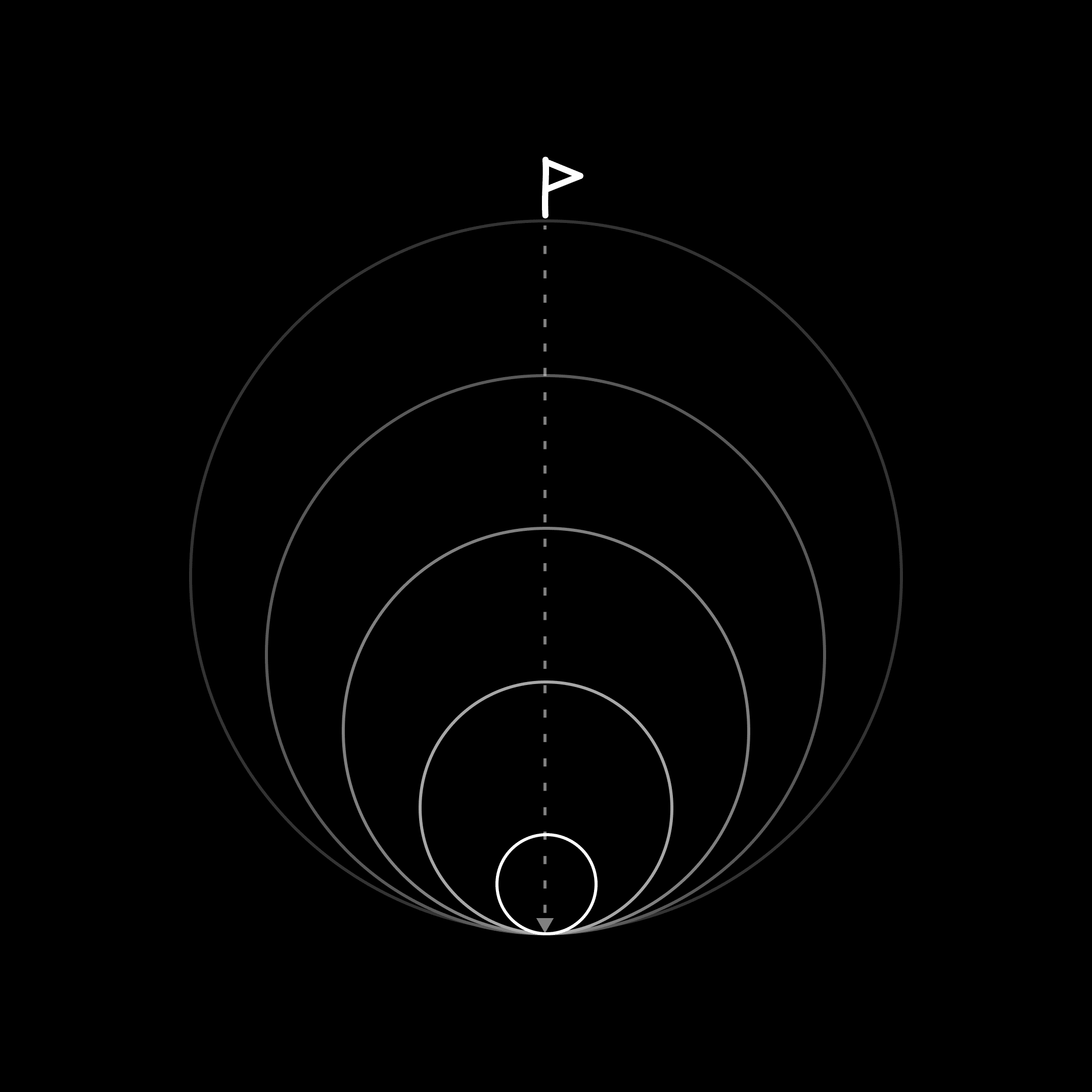
Again, I’ve included questions about this in The Purpose Planner.
In short:
Start with the end goal.
Break it down into smaller goals:
Life purpose → decade → year → quarter → month → week → day.
Then define a few daily actions that move you forward.
You now know who you want to become and where you want to go.
3) How to Make the Right Actions Automatic
“Environment is the invisible hand that shapes human behavior.”
– James Clear
Most people try to change their lives through willpower.
They tell themselves that they will work harder, stop procrastinating, eat healthier, and finally become disciplined. This might work for a few days, but if their environment stays the same, they usually fall back into their old behavior.
If your phone is next to you, you’ll check it. If there’s junk food in your kitchen, you’ll eat it. If you open social media as soon as you wake up, you’ll keep starting your days reactively. And if everyone around you wastes their weekends drinking, it becomes much harder not to do the same.
Your environment is constantly pulling you toward certain actions.
So instead of only trying to become more disciplined, you need to design your environment in a way that makes discipline easier.
This comes down to two things:
1) Make it easy to do what you should do
2) Make it hard to do what you shouldn’t do
If you want to read more, put a book next to your bed. If you want to work out in the morning, prepare your clothes the night before. If you want to eat healthier, prepare healthy food in advance.
Remove as many steps as possible between you and the actions you want to take.
The easier it is, the more likely you are to do it.
You can use the opposite approach for the actions you want to avoid.
I call this Tactical Friction: making bad habits harder and good habits easier.
Most bad habits are attractive because they’re easy. If your phone is in your pocket, you can open social media within a few seconds and get an instant dopamine hit. There is almost no friction between the impulse and the action.
But imagine that you log out of your accounts, delete the apps, turn off your phone, and leave it in another room. You can still check social media, but it now takes much more effort. That extra friction gives you time to realize that you don’t actually want to do it.
You can apply this to almost every bad habit.
Don’t keep junk food in your house
Block distracting websites while you work
Unplug your game console when you’re done (or sell it)
Add friction to bad habits. Remove friction from good habits.
That’s how the right actions become almost effortless.
It’s also very useful to create routines. A routine is simply a group of actions you perform in roughly the same order every day. It reduces the number of decisions you need to make and makes your most important actions more automatic.
Start by designing your morning routine, evening routine, and typical day.
Your morning routine determines how you enter the day. You don’t need to meditate for an hour, take an ice bath, journal for 30 minutes, and perform a complicated ten-step ritual. You could simply drink some water, move your body, review your goals, and start working on your most important task.
Your evening routine should help you to recover and prepare for tomorrow. You could review your day, plan your most important actions, prepare your workspace, put your phone away, and read before sleeping. This makes it easier to start the next day well because you’ve already decided what you need to do.
Then design your typical day. Decide when you’ll work, exercise, recover, socialize, and perform the habits that move you toward your goals. You don’t need to plan every minute and you also don’t need to do the same exact things every day, but you should have a basic structure that makes your most important actions more likely to happen.
This makes it more likely that you actually do the work.
You should also design your days around focus and recovery.
When you work, remove distractions and focus on one important task at a time. Turn off notifications, keep your phone away, avoid multitasking, and do your most important work when your energy is highest. A few focused hours will usually get you further than an entire day of constantly switching between tasks.
But focused work costs mental energy, so you also need to recover properly. Cheap entertainment can feel relaxing in the moment, but it often leaves you more tired and overstimulated afterward. Prioritize sleep, exercise, walking, social interaction, time in nature, and anything else that makes you feel better afterward. You don’t need a perfect optimization bro routine. You just need a lifestyle that gives you enough energy to keep moving toward your goals.
Finally, think about your lifestyle as a whole. Your goal isn’t to create the perfect work routine while building a life that you hate. Think about where you want to live, who you want to spend time with, what work you want to do, how much you want to work, which hobbies you want to pursue, and how often you want to travel.
Ask yourself questions like:
What does your ideal day look like?
What about your ideal week?
Which activities give you energy, and which ones drain you?
How much freedom do you want, and what would you use that freedom for?
Your lifestyle is also part of your environment, so design it deliberately.
Now write down:
Your morning routine
Your evening routine
Your ideal typical day
The habits you need to build
The habits you need to remove
How you will work, focus, and recover
The changes you need to make to your environment
Add everything to The Purpose Planner. It doesn’t need to be perfect. Create the best version you can right now, test it in real life, and improve it as you go.
Your identity determines who you want to become. Your goals determine where you want to go. Your habits and environment determine what you repeatedly do.
Align all three, and you will change the direction of your life.
This is how you can change the inputs that will change your life in 1 day.
Don’t forget to get the Purpose Planner to fill everything in:
You also get the Writer In a Week course for free when you sign up.
If you got value from this, hit the like and restack buttons. This helps me to create more free newsletters and resources like the Purpose Planner and Writer in a Week course. Thanks for your support!
– Stijn
PS: The X Money System shows you how I turn my knowledge into smaller written offers and sell them through written content and email.
It’s the exact system I used to make more than $150,000+ without ads, cold outreach, or sales calls. It’s made for 𝕏 but the same principles also apply to LinkedIn, Threads, Substack & other writing platforms.
Click here to get it (gone after tomorrow).
How I Can Help You
1. X Growth System. How I grew from 0 to 64,000 𝕏 followers, 100,000+ followers across social media, +100M 𝕏 views in a year, and 6-figures. It’s made for 𝕏 but the same principles also apply to LinkedIn, Threads, Substack & other writing platforms.
2. Free Content. I backlog my best newsletters and articles on my website. I also turn them into video podcasts. Click here to subscribe so you don’t miss them. I also post simple self-improvement videos on my other channel. Click here to subscribe. You can also follow me on LinkedIn, 𝕏/Twitter, Instagram, and Threads for short lessons.
You've got a lot of really great and actionable ideas in here. I recently broke a binge eating cycle like the flip of a switch through environment design, and it's been soooo eye opening. Now I'm going to go through all your questions so I can hopefully figure out how to make such a shift possible in my money making endeavors 😅
“You don’t rise to the level of your goals. You fall to the level of your identity.”
That distinction between identity and behaviour is what stayed with me. Change the story you tell yourself, and your actions begin to change naturally from there.
Practical. Thought-provoking. Motivating. I'M SUBSCRIBING!
I write at The Reflective State, where one of my ongoing series is Mountain Mysteries—atmospheric tales of mystery, folklore and the unexplained set in the mountains of India.
If curiosity ever brings you my way, I'd genuinely love to know what you think.