

Creativity is one of the most important skills you can have as a creator.
We all kind of understand what it means.
But here’s what I couldn’t answer:
How do you actually become more creative?
I had no real answer.
So I started to do some research because I wanted to become more creative.
I read 5 books about creativity, I read 20+ articles, I watched 10+ podcasts and interviews with the most creative people alive (artists, writers, creators, and more).
I took notes the whole time.
What I found surprised me.
Unlike what most of us think, creativity isn’t a mystical gift. It’s not something you’re born with or without. It’s easier for some than for others, but there is a set of principles that anyone can learn. And the most creative people in history — from Picasso to Rick Rubin to Steve Jobs — all followed versions of the same principles.
In this article, I’m going to give you the best lessons I learned about creativity after studying it for 100+ hours. I call these lessons The 20 Laws Of Creativity. Think of this article as a written mini-course on creativity. By the end, you’ll have 20 practical principles you can use to become more creative.
Let’s begin.
Before we dive in:
I made a short course called Content Alchemy. It helps you to turn 1 good post into 100 good posts. It’s only $5 today and it closes tomorrow. Click here to learn more.
Also don’t forget to like & subscribe if you’re reading this in your browser.
1. Constraints Make You More Creative
The more a person limits himself, the more resourceful he becomes.
– Søren Kierkegaard
This one is counterintuitive.
Most people think creativity needs freedom.
No rules. No boundaries. No restrictions.
It sounds good at first. But a blank canvas is actually paralyzing.
When you have infinite options, you spend a lot of time on decisions and it’s harder to pick the right one. When you only have 3 options, it’s easier to pick the best one.
This allows you to move faster.
Self-imposed constraints also force you to solve problems in a different way. They close off the obvious paths so you have to find the hidden ones.
A great example of someone who does this well is Jack Butcher. He’s my favorite designer and he built a brand (Visualize Value) around a clear constraint: a black background with white shapes or basic icons (and sometimes some text).

That’s it. No color. No images. No fancy design.
It may seem like this makes it harder to be creative. But this constraint actually made him more creative. Every piece of Visualize Value works because he took away every tool except one: the idea itself.
The fewer tools you can use, the better you’ll get at using each one.
I fear not the man who has practiced 10,000 kicks once, but I fear the man who had practiced one kick 10,000 times.
– Bruce Lee
The same principle applies to writing. If you limit yourself to 280 characters, you’re forced to make your writing clearer and conciser. This increases the value per word.
If you feel stuck, set a constraint. Constraints fuel creativity.
2. Creativity Can’t Be Forced
Creativity is the opposite of productivity.
Productivity is about output. Getting more done in less time.
Creativity doesn’t work like that. You can’t optimize your way into a creative idea.
You can only sit down and try to be creative. But creativity can’t be forced. You can’t schedule a breakthrough on a Tuesday morning (believe me, I tried).
The best ideas arrive when you’re not chasing them. In the shower. On a walk. At 3 AM when you can’t sleep. They come when your mind has space to wander, not when you’re trying to force it.
This doesn’t mean you should be lazy or that you shouldn’t set deadlines. But it means you should protect space in your day where nothing is scheduled.
No inputs. No tasks. No distractions. Just time for your brain to connect things.
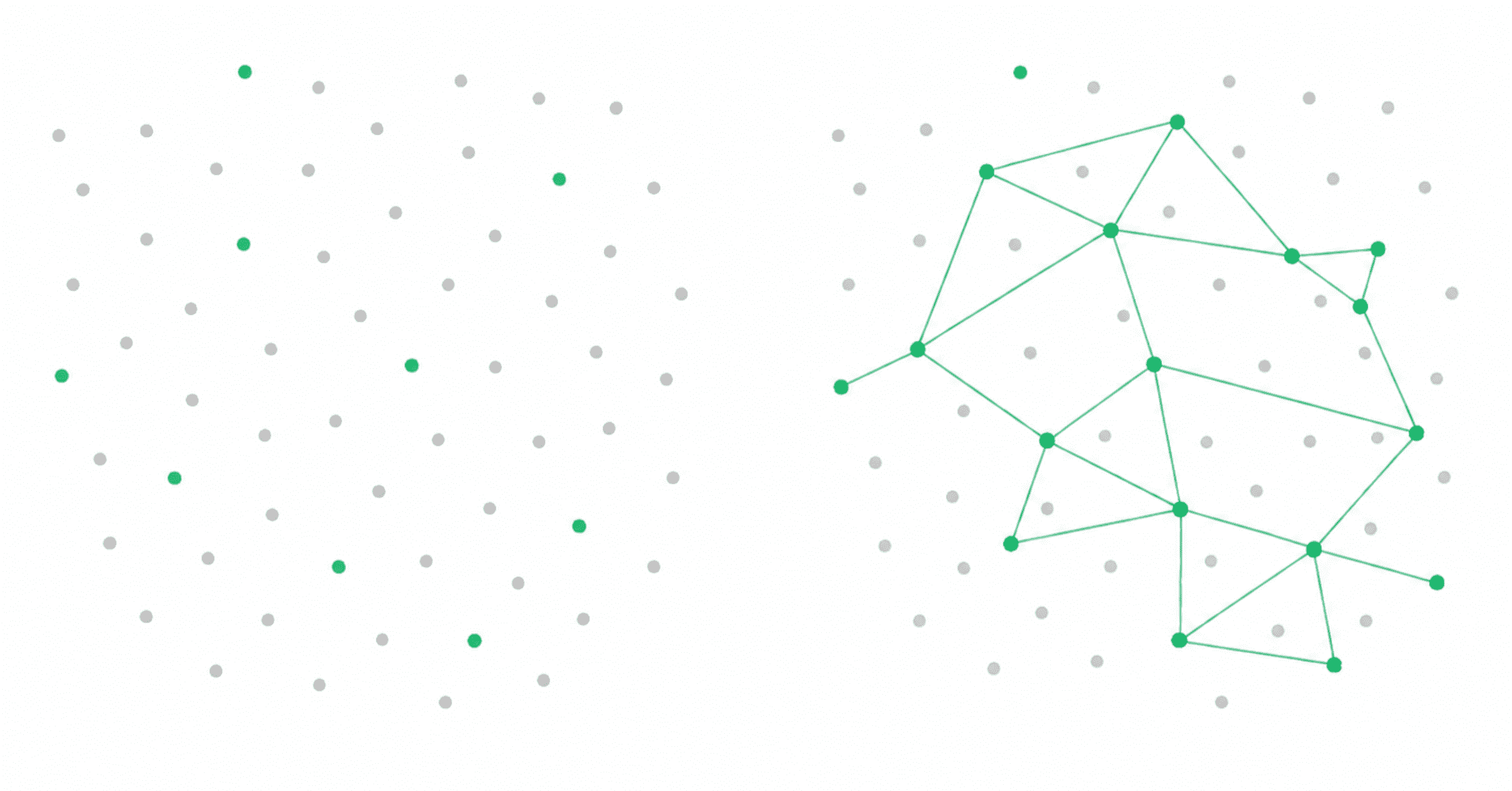
Use your conscious mind to collect dots.
Use your subconscious mind to connect dots.
3. Learn From Seemingly Unrelated Fields
The most creative people are almost never specialists in one narrow domain.
They pull from everywhere.
A great example is Biomimicry. The practice of learning from and mimicking strategies found in nature to solve human problems.
We didn’t invent airplanes from scratch. We learned from birds.
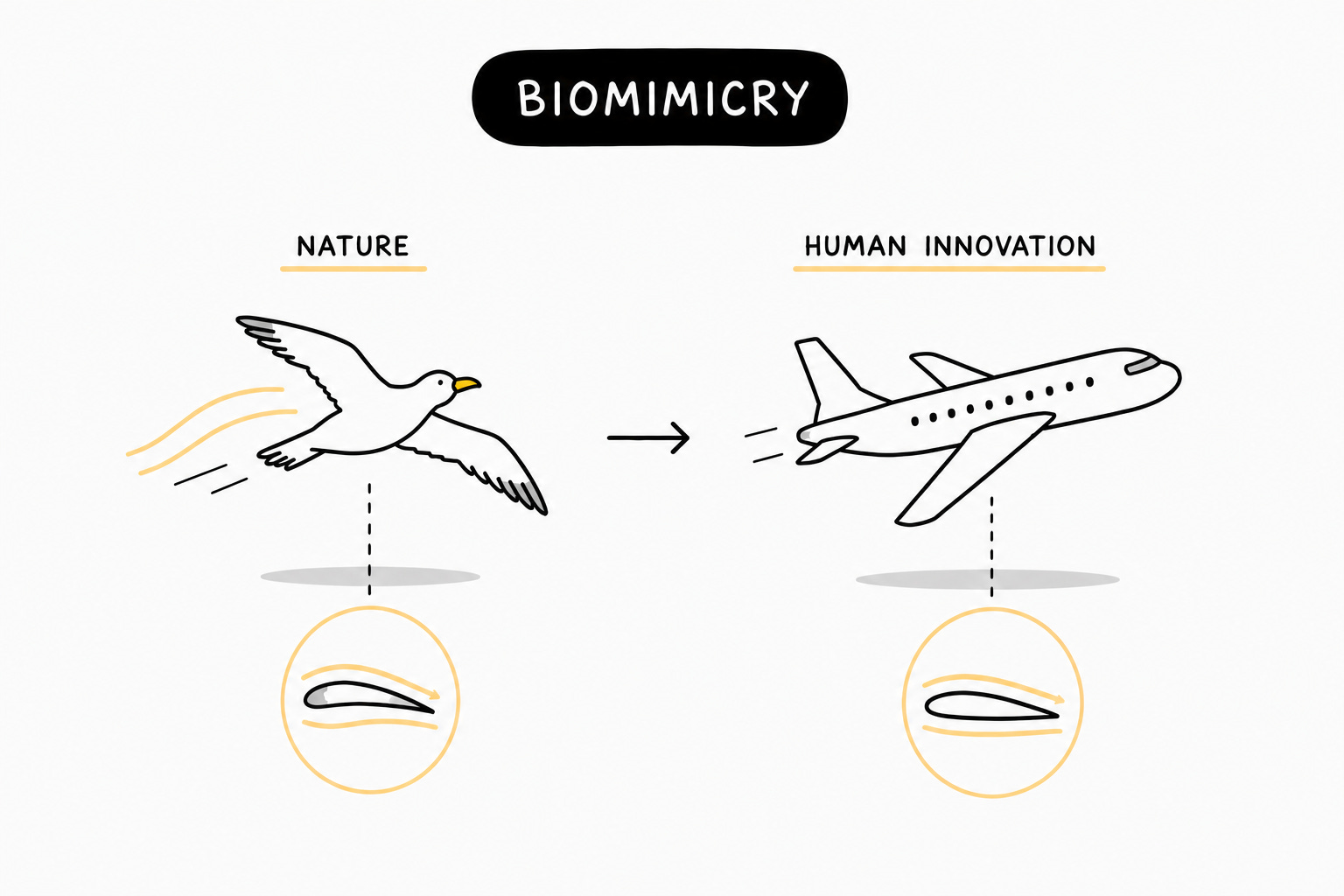
Learning from other fields is a great way to become more creative.
Steve Jobs famously credited a calligraphy class for the typography that made the Mac beautiful. He wasn’t studying design. He was just curious about something seemingly unrelated, and years later, it became a defining feature of Apple’s products.
Your best ideas don’t have to come from your field. You can learn from other fields.
Read outside your niche
Learn about topics you don’t know
Chase a curiosity that doesn’t seem “useful”
It may become a future breakthrough.
4. Master The Plateau
Every skill has a honeymoon phase.
You start something new
You love the process
You improve fast
Every day feels like progress. And then you hit the plateau.
The plateau is where most people quit.
It’s the period where you’re putting in the work but nothing seems to be getting better. The progress slows down. The excitement fades. The work feels harder than before. You may even wonder if you should continue.
The book Mastery by George Leonard explains that the plateau isn’t a sign of failure. It’s a necessary stage of growth.
Beginners hate the plateau. Masters embrace it. They find satisfaction in the daily practice itself, not just the results. That’s how they keep getting results.
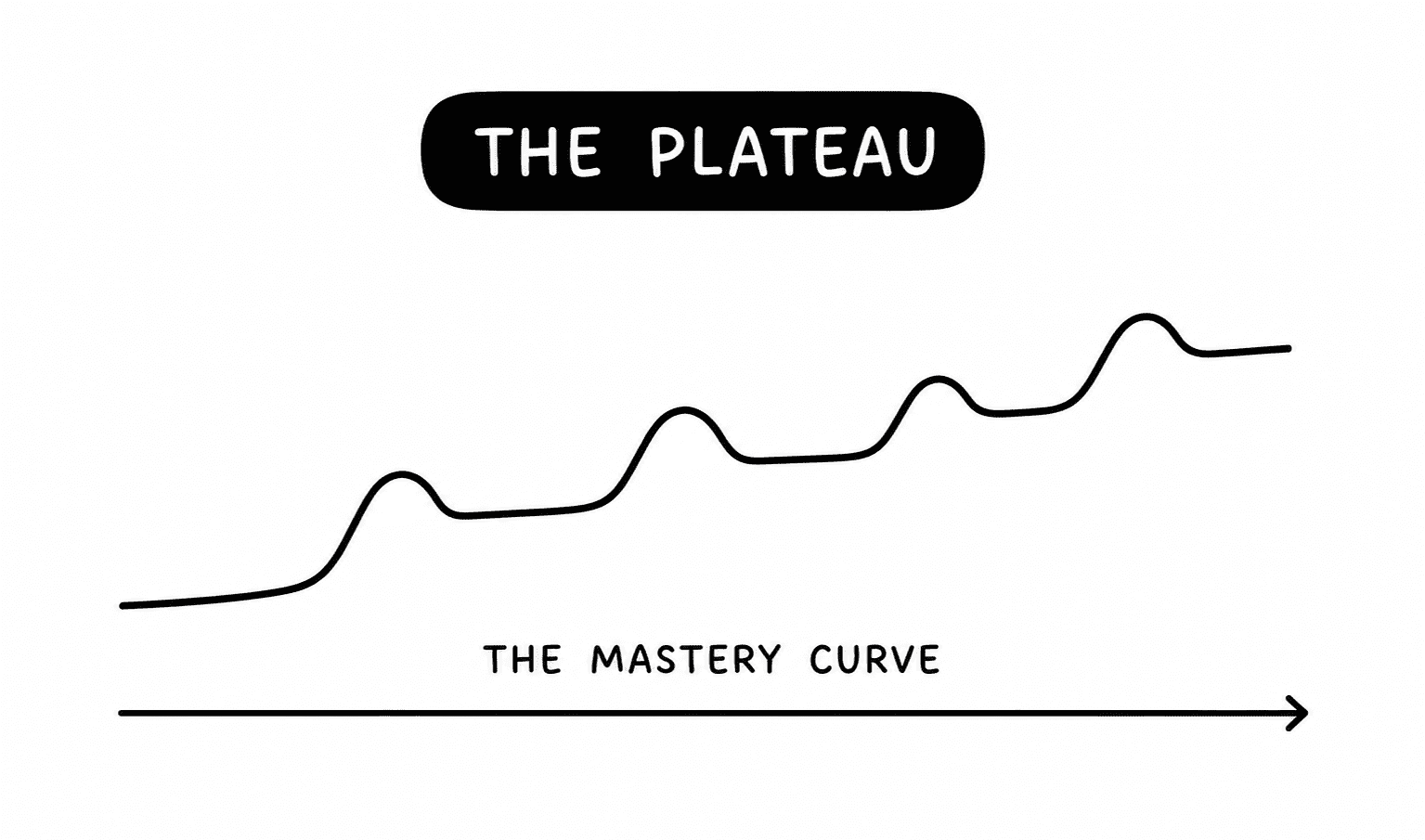
Creativity works the same way. You don’t get one breakthrough after another. You get long periods of ordinary work. If you want to create something great, you need to embrace the boring work. Boring work leads to breakthroughs.
The people who make it are the ones who don’t need every day to be a breakthrough.
They are the ones who commit to the mastery process by showing up every day.
5. Fail More To Improve Your Creations
If I am worth anything later, I am worth something now. For wheat is wheat, even if people think it is a grass in the beginning.
– Vincent van Gogh
Van Gogh sold almost nothing during his lifetime.
He was dismissed, ignored, and considered a failure. But he painted anyway, because he knew, or at least hoped, that what he was making mattered, even if nobody else could see it yet. He wasn’t afraid to fail. He knew failure was necessary to succeed.
True creative breakthroughs come from the willingness to experiment and fail.
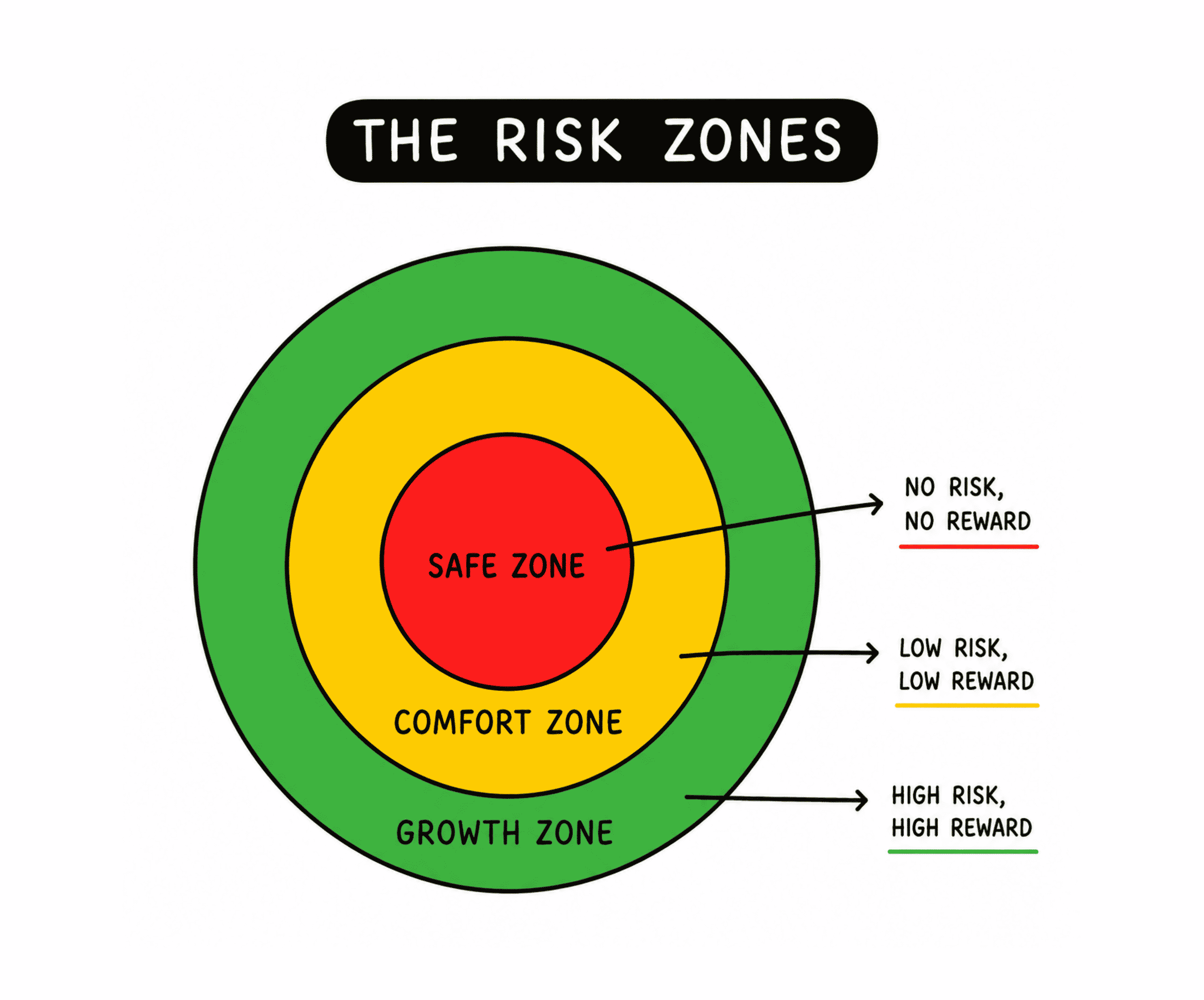
Most people are terrified of this. They stay in the safe zone where they know the work will be “good enough.” They never make something truly original because originality requires risking a miss. But to get a breakthrough, you need to take a risk.
Scientists understand this better than anyone else. When an experiment fails, a scientist doesn’t think “I’m a failure.” They think “that’s interesting.”
Finding out that something doesn’t work is still a discovery.
Edison famously said he found 10,000 ways that didn’t work before he found the lightbulb. He wasn’t joking. He genuinely saw every dead end as progress.
Don’t label failure as good or bad. Label it as interesting.
6. Compare A With B to Improve
We can only assess an object or principle if we have something to compare and contrast it to. If you place two options side by side and make a direct comparison, our preferences become clear.
– Rick Rubin
Rick Rubin has a simple method for making creative decisions.
Don’t ask “how much do I like this?” or “how will this perform on social media?”
Instead, ask: “Do I like A or B better?”
That’s it.
Comparing two options side by side reveals what your gut actually thinks. You might not know if the title of your article is good. But when you write two versions, you instinctively feel which one is better.
This works because it bypasses overthinking. You’re not analyzing. You’re just looking at two things and noticing which one feels right.
When you’re stuck on a creative decision, don’t try to solve it in your head.
Make two versions. Put them next to each other. Trust your reaction.
7. Create What Only You Can Create
The most value comes from doing something no one else can do, or no one else has thought of, in a way that is hard for other people to copy. If you try to be just like everyone else, and do just what they’re doing, you will maybe do ok but certainly not great.
– Sam Altman
Regardless of whether you like Sam, he is spot on here.
This is how you get a true competitive advantage.
Anyone can copy a format
Anyone can follow a template
Anyone can repeat what works
So you gain an advantage if you create something remarkable that people can’t copy.
You don’t need to build the next ChatGPT. But you can create something that only you can create.
The only way to do this is to double down on your authentic strengths. Nobody else has lived your life. Nobody else has your combination of interests, experiences, taste, and perspective. So nobody can compete with you at being you.
When you make something that only you could have made, you become impossible to compete with. People can copy the surface (the format, the style, the structure). But they can’t copy the substance, because the substance is you. You are 1 of 1.
Ask yourself: what can I make that nobody else can?
That’s the work worth doing.
8. Starving Artists vs Thriving Artists
Learn to sell. Learn to build. If you can do both, you will be unstoppable.
– Naval
The difference between starving artists and thriving artists usually isn’t their art.
It’s their ability to sell it to an audience.
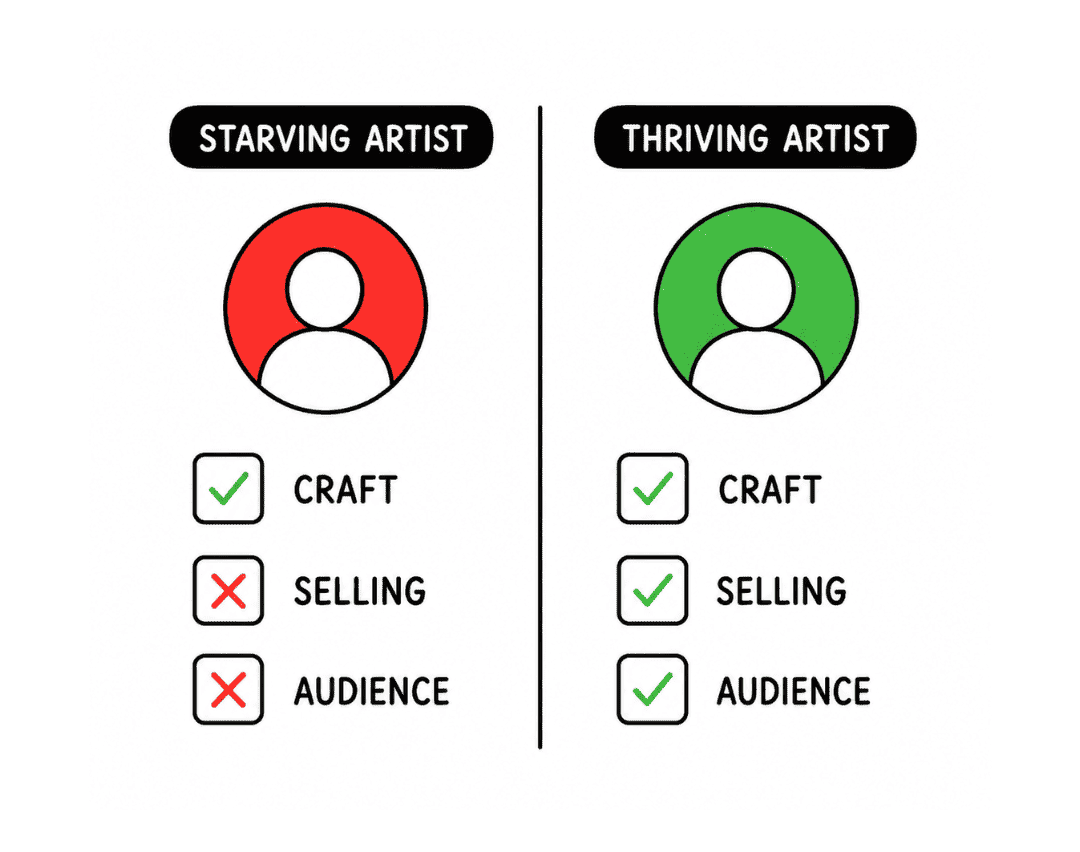
You need to learn to build and sell.
I know this is not popular to say. But the term “starving artist” exists for a reason.
If you don’t know how to sell and build an audience, you will struggle as a creative.
Some creatives take pride in this. They see selling as beneath them. They think the purity of the work should speak for itself.
In an ideal world, it would. But I think this attitude is foolish.
Selling your creations is a part of the process.
Artists sell their music. Authors sell their books. Filmmakers sell their films. Photographers sell their photos. Entrepreneurs sell their products.
There is nothing wrong with selling if you do it in a non-sleazy way.
Selling ≠ selling out.
If you think selling is inherently bad, you probably have some limiting beliefs around money that are worth examining. Finding a way to monetize your creations isn’t selling out. It’s making it sustainable. When your work pays the bills, you can make more of it. You can invest in it. You can get better at your craft. You can reach more people. You can have a bigger impact.
So learn to build and sell. It’ll make you a thriving artist instead of a starving one.
9. Never Wait For Inspiration
Inspiration exists, but it has to find you working.
– Picasso
Most people imagine creativity as a lightbulb moment.
You’re sitting there, doing nothing, and suddenly a brilliant idea appears.
That’s not how it works.
Inspiration doesn’t strike lazy people. It strikes people who are already in motion.
You sit down and you do the work regardless of whether you feel inspired.
Sometimes the best idea doesn’t come while you’re working. It can come later, during a walk, a shower, or while you’re lying in bed. But it only comes if you showed up first.
You don’t need to feel inspired to do the work.
You need to do the work to feel inspired.
10. Let Your Intuition Guide You
My aim is to put down on paper what I see and what I feel in the best and simplest way.
– Hemingway
Intuition is the compressed wisdom of everything you've learned and experienced. It communicates with you through a feeling we call our gut feeling. Your gut knows things that your conscious mind hasn’t processed yet.
The most creative people trust that signal.
They don’t ignore data or feedback. But they also don’t let analysis override the internal compass that says “this is right” or “this isn’t working yet.”
It’s your nervous system telling you what to do in the form of a feeling.
In sales there’s a saying:
“People buy on emotion and justify with logic.”
The gut works similarly:
“People decide with their gut and justify with logic.”
The gut decides, the mind rationalizes.
Start listening to your internal signal. It will tell you what to do.
11. Think From First Principles
Most people reason by analogy.
They look at what worked before and tweak it slightly.
First principles thinking is the opposite.
You strip away all assumptions and rebuild from the ground up.
Elon Musk used this with rockets. His mission is to bring humans to Mars. For this, he needs a lot of rockets. But rockets turned out to be extremely expensive.
So instead of buying rockets, he looked at what they were made of. It turned out that the raw materials were much cheaper. So he built them himself instead.
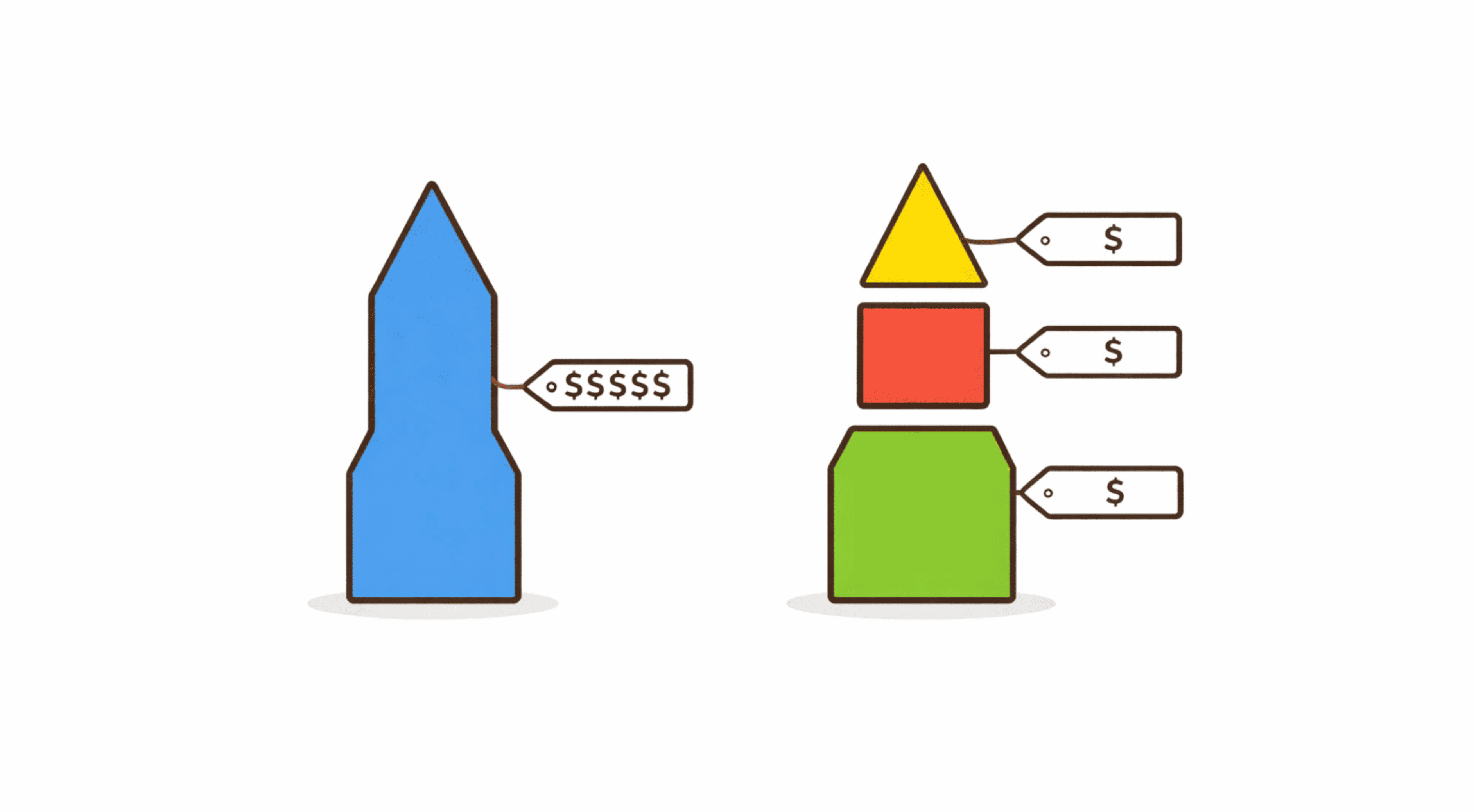
He was only able to do this because he questioned the assumptions that most people took for granted. This is harder and it takes more energy. But it’s also where genuine innovation comes from.
To be more creative, learn to think from first principles.
12. Steal Like An Artist
If I have seen further, it is by standing on the shoulders of giants.
– Isaac Newton
A new idea is almost never completely new.
It’s usually a combination of existing ideas, presented in a new way.
The ingredients are old. The recipe is new.
The iPhone wasn’t the first phone, the first music player, or the first internet device.
It was the first device that combined all three into something that felt inevitable.
You don’t need to start from zero. Study what came before you. Understand it deeply. Then rearrange it through your own lens. Austin Kleon wrote an entire book about this idea called ‘Steal Like an Artist’.
The core idea is that there is almost no truly original creation. Everything builds on what came before. The difference between copying and stealing is transformation.
Bad artists copy. Good artists steal.
– Picasso
If you steal from 1 person, it’s called plagiarism. If you steal from 100 people, it’s called research. The difference is that you take what you like, discard what you don’t like, and add what is uniquely yours. You are basically creating a remix of your favorite ideas, combined with your own personality, stories, and perspective.
That’s how you steal like an artist ethically.
There are countless smart people who lived before you. Learn from them.
13. Create What You Wish Existed
It was always in the service of: “I love this thing. I want something like this. No one else is making one. I have to make one.”
– Rick Rubin
This is the purest creative fuel.
Not what will sell. Not what will go viral. Not “what does the audience want?”
Just: “I wish this existed. Since it doesn’t, I’ll make it.”
When you create from genuine desire and curiosity, you love what you create and the audience will feel this.
Most people separate work and play.
Work is what you have to do. Play is what you get to do.
The best creators blur that line.
They create things they genuinely want to exist. The act of creating becomes rewarding in itself, not just a means to an end.
The work becomes the reward.
Never permit a dichotomy to rule your life, a dichotomy in which you hate what you do so you can have pleasure in your spare time. Look for a situation in which your work will give you as much happiness as your spare time.
– Picasso
That doesn't mean every moment feels effortless. Even work you love has hard days. But there's a difference between hard and draining.
Hard challenges energize you. Draining work depletes you.
Find the challenging thing that gives you energy. That’s how work becomes play.
14. Create First, Edit Later
Don’t try to create and edit at the same time.
It’s keeping you from being creative and effective.
Creating and editing require different ways of thinking.
Creating is about generating ideas. Editing is about improving them.
When you try to do both at the same time, you constantly interrupt your own thinking.
A better approach is to separate the two.
Create freely first. It can be bad because you will still edit it later.
Then come back later and edit with fresh eyes.
This is especially useful with writing. The fastest way to overcome writer’s block is to allow yourself to write a terrible first draft. This removes all the pressure.
After that, remove the mistakes, cut the unnecessary parts, and add what’s missing.
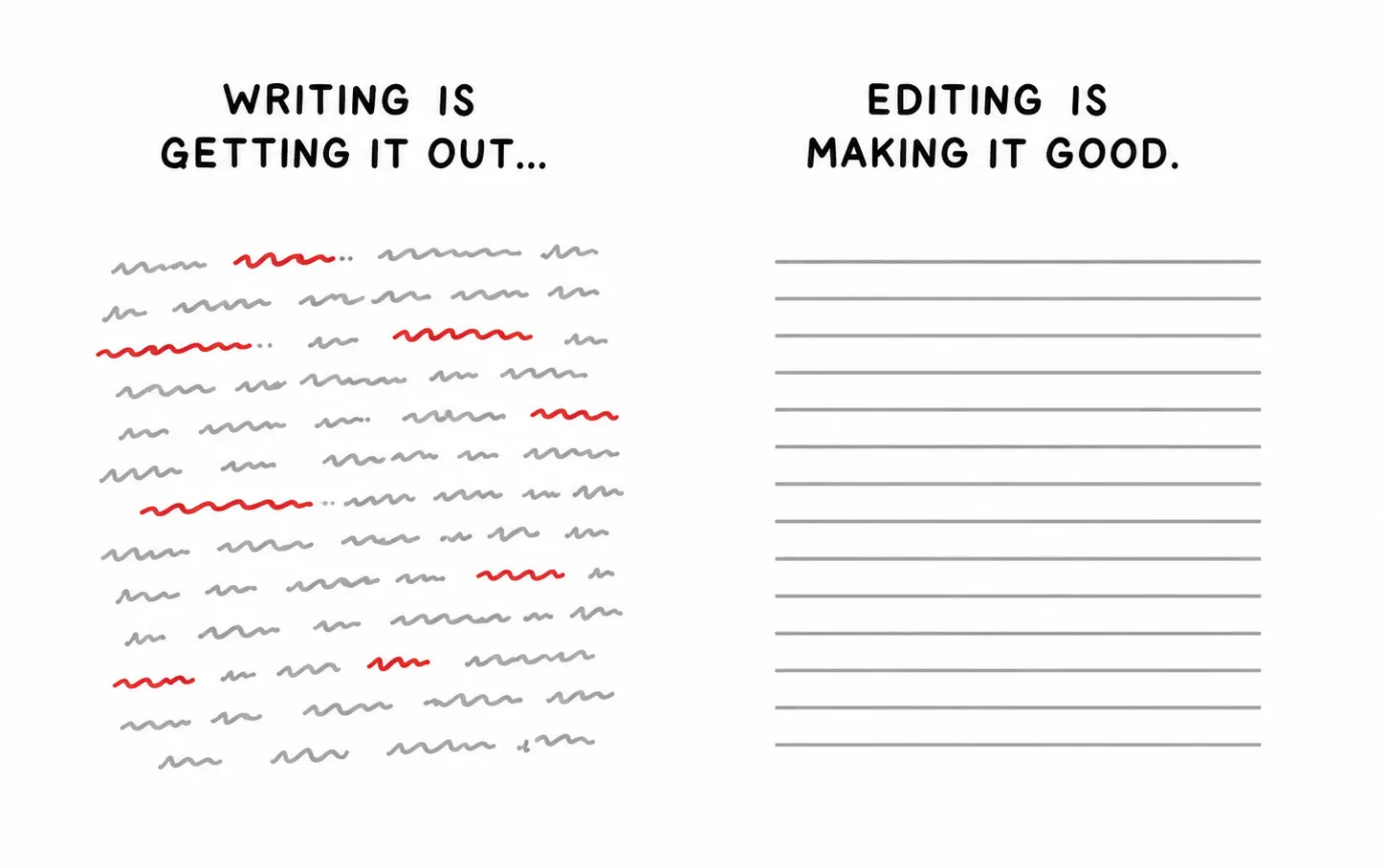
You can’t improve what doesn’t exist. So allow yourself to create something bad first.
Create first, edit later.
15. Art Is Subtraction, Not Addition
Art is the elimination of the unnecessary.
– Picasso
Art isn’t about adding more. It’s about deciding what to remove.
Imagine if we added much more to the image of Visualize Value in law 1.
You might think that adding more would make the visual better and clearer, but the opposite is true. It would just make it busier, not better. More noise, less signal.
Jack knows this and that’s why he removed everything that wasn’t necessary.
What remains after elimination is what actually matters.
You’re not finished when there’s nothing left to add.
You’re finished when there’s nothing left to remove.
You can apply this beyond art:
Writing: Remove words until only meaning remains.
Business: Remove features until value is obvious.
Work: Remove noise until focus returns.
Most people improve by adding stuff. Masters improve by removing stuff.
I saw the angel in the marble and carved until I set him free.
– Michelangelo
Subtract until you can’t subtract anymore. That’s when you’re done.
16. Obsession Creates Mastery
Everybody has the same energy potential. The average person wastes his in a dozen little ways. I bring mine to bear on one thing only: my paintings, and everything else is sacrificed to it... myself included.
– Picasso
The best artists, creators, athletes, and entrepreneurs have one thing in common:
They were obsessed with their craft.
Isaac Newton was obsessed with science
Nikola Tesla was obsessed with inventing
Kobe Bryant was obsessed with basketball
Cristiano Ronaldo is obsessed with football
Picasso was obsessed with creating paintings
Beethoven was obsessed with composing music
Elon Musk is obsessed with building companies
MrBeast is obsessed with making YouTube videos
Steve Jobs was obsessed with building great products
This is no coincidence. Great creative work requires obsession.
Not balance. Not moderation. Not sort of wanting to do it.
The people who change things don’t treat their work as one priority among many. They pour everything into it. They think about it constantly. They sacrifice for it.
This isn’t healthy advice for all of life. But creatively, it works. When you’re deeply obsessed with something, you see connections others miss. You work harder without feeling like you’re working. You push past the point where reasonable people stop.
Obsession is the ultimate unfair advantage.
17. Keep Things Simple
An intellectual says a simple thing in a hard way. An artist says a hard thing in a simple way.
– Charles Bukowski
One of the clearest signs of mastery is simplicity.
When people don’t fully understand something, they often make it more complicated than it needs to be. They use jargon, long explanations, and elaborate frameworks because complexity creates the illusion of expertise.
Masters do the opposite. They strip away everything that isn’t essential until only the core idea remains. Simple doesn’t mean basic. It means easy to understand.
That’s why the best teachers explain difficult concepts in simple language.
The best products are intuitive
The best books are effortless to read
The best videos are effortless to watch
Simplicity isn’t the absence of depth. It’s the result of it.
If it feels simple, someone worked very hard to make it that way.
18. Let Your Subconscious Work For You
Big ideas come from the unconscious. This is true in art, in science, and in advertising. But your unconscious has to be well informed, or your idea will be irrelevant. Stuff your conscious mind with information, then unhook your rational thought process.
– David Ogilvy
Great ideas often appear when you’re not trying to think of them.
One of the greatest advertisers ever, David Ogilvy, would immerse himself in a problem until he understood it from every angle. Then he would stop thinking about it entirely. He would go for a walk, take a bath, or simply work on something else.
While his conscious mind was resting, his subconscious kept working.
This happens to all of us. A solution appears in the shower. On a walk. Right before you fall asleep. Your brain continues connecting ideas long after you've stopped thinking about them.
But this only works if you've done the first part.
You have to give your subconscious something to work with.
Immerse yourself in the problem. Then step away.
You can’t force an insight. You can only create the conditions for one.
Feed your mind, then give it space to think.
19. Process Over Outcome
Pursue excellence, ignore success. Success is a by-product of excellence.
— Deepak Chopra
When you focus on the outcome, you’re focused on something you can’t fully control.
The process is different.
You can control whether you show up. Whether you practice. Whether you experiment. Whether you keep improving.
Rick Rubin argues that attachment to a specific outcome also limits creativity. When you try to force the work in a particular direction, you stop listening to what it wants to become. Instead of discovering the work, you begin controlling it.
Trust the process instead. Immerse yourself in the work. Stay curious. Follow what feels true. Let the project evolve naturally. Stay detached from the outcome.
The best creators don’t measure success by today’s results. They measure success by whether they did the work. The outcome is a byproduct of the process.
Fall in love with the process. The outcome will take care of itself.
20. The Creative Process (4 stages)
This one isn’t really a law but it’s a great summary of the Creative Process.
Rick Rubin breaks The Creative Process into four stages.
Stage 1: Gathering. You collect ideas that will feed into your work. You’re not judging anything yet. You’re just accumulating. Research widely and save things that spark something in you. Build a library of raw material to take inspiration from.
Stage 2: Experimentation. Start to experiment with the ideas you’ve gathered. Test ideas and don’t worry about the results. This phase is supposed to be messy. Let it be.
Stage 3: Crafting. You shift toward refinement. You take the rough concepts from experimentation and you try to turn them into something coherent. Be willing to remove anything that isn’t good enough. Only keep the best parts.
Stage 4: Completing. Finish the work when you’re satisfied and let it go. Resist the urge to keep tweaking every little detail. Perfection doesn't exist. At some point, you have to ship it and move on to the next project.
In short: Gather. Experiment. Craft. Complete. Repeat.
Those are the 20 Laws Of Creativity.
You don’t need to apply all of them at once. Start with the ones that resonated with you the most. Creativity isn't something you're born with or without. It's a practice. And the more you practice, the more creative you become.
Now go create something.
– Stijn
PS: This post took a week to put together. If it resonated with you, please like and share it. The more creative builders we get, the better the world becomes.
PPS: Don’t forget to check out Content Alchemy. It helps you to turn 1 good post into 100 good posts. It’s only $5 today and it closes tomorrow. Click here to learn more.
How I Can Help You
1. X Growth System. How I grew from 0 to 64,000 𝕏 followers, 100,000+ followers across social media, +100M 𝕏 views in a year, and 6-figures. It’s made for 𝕏 but the same principles also apply to LinkedIn, Threads, Substack & other writing platforms.
2. Free Content. I backlog my best newsletters and articles on my website. I also turn them into video podcasts. Click here to subscribe so you don’t miss them. I also post simple self-improvement videos on my other channel. Click here to subscribe. You can also follow me on LinkedIn, 𝕏/Twitter, Instagram, and Threads for short lessons.
Be born with the creative gene ;)
Thank you for sharing this fantastic, resourceful article! It thoroughly describes diverse approaches to becoming more creative. Everyone can remarkedly be creative in a certain area, whether you realize or not. “Let Your Intuition Guide You” can help, so can simplicity help discover it. I also cherish learning from unrelated fields or just being curious, which can boost our creativity, at least, open our mind and anchor different perspectives.