

If you prefer watching/listening, I made a video version of this newsletter:
Almost 2 years ago, I hit my first $5K month online.
From the outside, it looked like I got there fast (after about 6 months of writing on Twitter).
But the truth is that I had already been ‘failing’ in the creator economy 2 years before that. I made hundreds of YouTube videos and only earned a few grand (after spending 4+ hours per day on it for 2 years).
In the 4 years or so that I’ve been in the creator economy, I’ve learned a lot. I’ve spent over $30K on courses and coaching from some of the best creators in the world.
Sadly, most of their advice didn’t work for me. It always felt like something was missing. But after lots of mistakes and sleepless nights, I finally started to get it.
And honestly? Most creator advice massively overcomplicates things.
It’s not about doing more, it’s about doing less - but doing it better.
Because the truth is that you only need to do a few things well if you want to make +$5k/mo online.
And that’s what we’re going to talk about in this newsletter. I’ll share how I would make $5k/mo asap in just 2h/day if I had to start from scratch. Without outreach, sales calls, dms, ads, or sleazy sales tactics.
It’s by no means ‘the only way’ or ‘the best way’, but it worked for me and my clients so hopefully it helps you do the same so you can take control of your work, income, and time.
Step 1: The Rule of One
As I said, there are only a few things that actually matter.
The first one is the Rule of One. Understanding this concept will already put you ahead of 80% of creators.
The Rule of One helps you to stay focused on what matters:
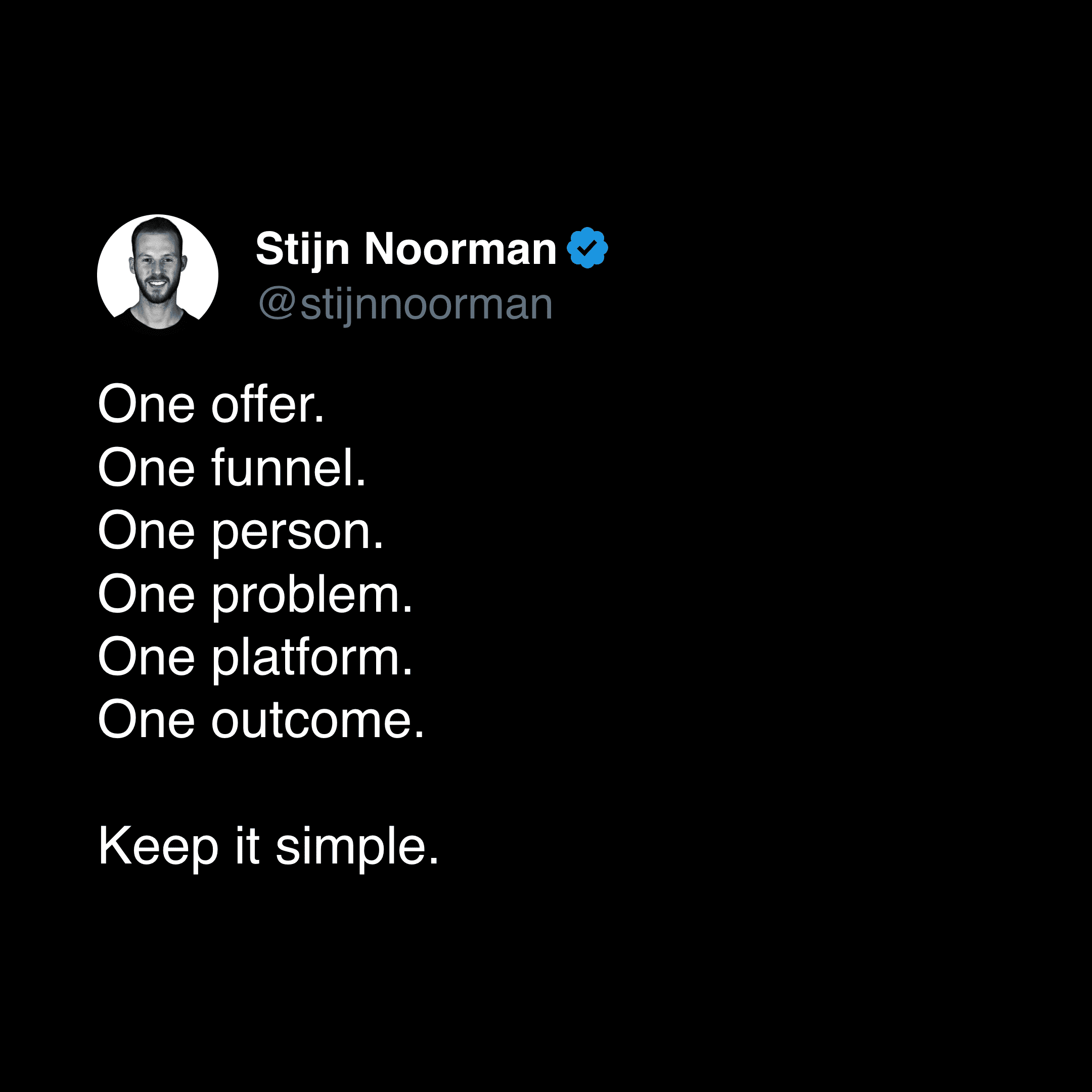
That’s all you need to make a full-time living online.
You need to help one person solve one big problem so they can achieve their one desirable outcome.
You have one simple funnel (social media → email → offer) that sells one offer.
You grow your newsletter by posting valuable content on one platform (at first, you can expand later) and plugging your lead magnet or newsletter below it.
You use social media to get people on your email list.
You use your newsletter to give more value and sell your offers.
I recommend starting with Twitter (for growth and short-form writing) and Substack (for long-form writing). If you have extra time, add YouTube and repurpose your Twitter and Substack content to other platforms (this is literally all I do for LinkedIn, Threads, and Instagram). But I’ll share more on this in the second step of the process.
Let’s make this more practical first. Let’s take this newsletter as an example. Take a look at this visual:
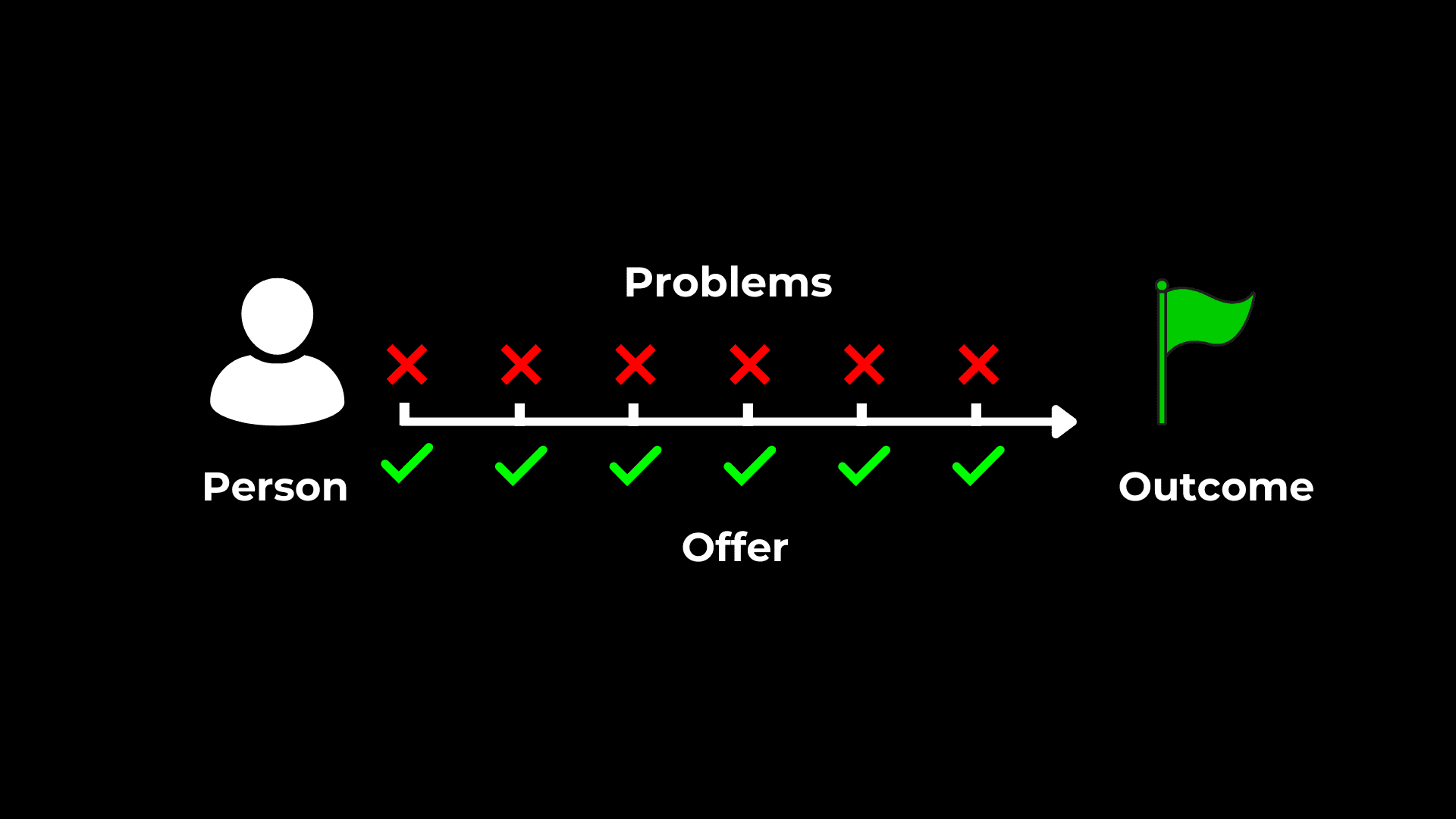
It illustrates the Customer Journey. This is the path your customer needs to take to get to their desired outcome.
To make money, you need to help a person solve their problems so they can achieve their desired outcome. You do this selling them your offer and then giving them your product or service.
Your product is what you sell, your offer is how you sell it. For example, if you help men to get a sixpack, then your offer could be “get a sixpack in 90 days”, and the product would be the training and diet program that helps them to do this. This difference is important because people don’t care about your product, they care about what it can do for them. And this is exactly what the offer shows them.
People don’t buy products, they buy transformations. So sell them what they want, and then give them what they actually need to get what they want.
That’s the simplified version of it.
Your product helps them solve their problems.
Your offer shows them how you can help them.
Your content makes them aware of your solution.
So for example, if you’re reading this, your goal might be making $5K/month.
That’s the outcome you want. But the reason you haven’t achieved it yet is that there are certain things standing in your way (problems). If you learned what you needed to do, you would develop the skills to solve these problems and achieve the outcome.
Because the right actions lead to the right outcomes.
So in your case, here’s what you would need to learn:
Creating offers
Building products
Writing newsletters
Growing an audience
Optimizing your profile
Writing short-form content
Selling your offers to the right people
If you learn to do this, you get the skills necessary to solve the problems that are preventing you from achieving your desired outcome.
So my offer could be to show you how I can help you solve these problems so that you can get to $5K/month (which I explain in the X Growth System business tier).
If my offer clearly shows how I can help you to solve these problems, and if you find me credible enough, you might be interested in buying it.
That’s how it works. You help people get from A to B. You do this by giving them a product that solves their problems. You can do it for them, with them, or you can give them the relevant information so they can do it themselves. But we’ll talk about offers and selling later in this newsletter.
First, let’s talk about the funnel we’ll use to attract followers and customers.
Step 2: The X-Mail Funnel
The funnel we’ll use is something I call the X-Mail funnel.
X because we use 𝕏 (Twitter) to grow our audience and newsletter.
Mail because that’s what we drive the traffic towards and where we sell.
You can use different platforms if you want, but in my opinion 𝕏 is the best one to start (combined with email, f.e. Substack).
Here are the main reasons:
Fast feedback loops
It’s great to get clients
You learn to write concisely
Best platform for networking
You only need writing to grow
It’s great to grow your newsletter with plugs
People are business-oriented so willing to invest
It’s one of the platforms with the most growth left
People care about your ideas, not lifestyle (unlike Instagram)
It’s informal, people care about competence (unlike LinkedIn)
It’s like a community and you’re surrounded by like-minded people
You can leave comments which gives you control over your growth
There’s less competition compared to Instagram, TikTok, and YouTube.
It takes only a few hours per week to write content with the right system
You can post multiple times per day without the algorithm punishing you
You can get ad revenue from just writing tweets (after 5M views in 90 days)
Elon wants to make it ‘The Everything Platform’ (hate him or love him, but don’t bet against him)
It’s the fastest platform to test ideas before turning them into emails, videos, books, or products.
Your content is mostly text, so you don’t need a camera, editing skills, or high production or fancy gear to get started.
Once you have tweets and threads that work, it’s easy to repurpose them to grow on LinkedIn, Substack Notes, Threads, and Instagram.
There are more reasons, but these are the main ones. You can also start on a different platform if you want because the same principles apply, but I did it on Twitter first so that’s what I’ll use as the example.
So again, we use the X-Mail Funnel:
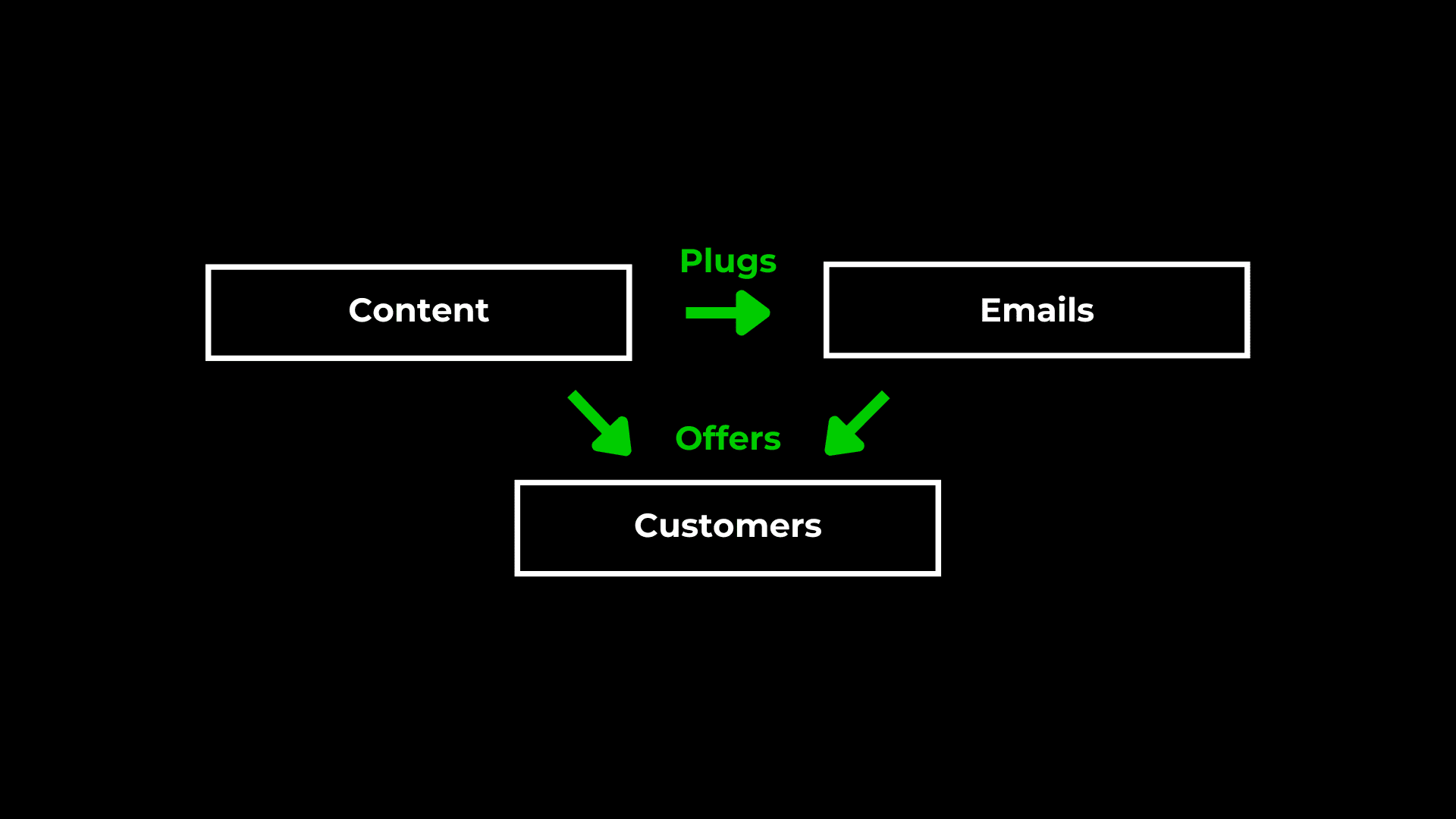
I’m by no means the richest creator, but this simple funnel made me $105K last year without ads, outreach, or sales calls. All while writing about what I love (the X Growth System business tier explains my entire system).
The idea of this funnel is simple:
We use content to grow our audience.
We use auto plugs to grow our email list.
We use emails and offers to monetize our list.
So for this, we need to know a few things:
What content to post
How to turn views into email subs
How to write emails that educate and sell
Let’s start with content.
You only need 2 types of content for this:
Growth content to grow your audience.
Authority content to monetize your audience.
A third (optional) one is Personality content to connect with your audience. But if your writing is good enough, you automatically do connect with your audience so you don’t really need this (to improve your digital writing skills, check out Aesthetic Writing).
There are lots of different posts you can use, but let me give you 3 of the best examples of both. We’ll start with growth content.
Growth Content
Growth content helps to grow your audience. The goal is to gain a lot of views and followers.
You want to attract the right people, but you also want to keep it broad. So write about popular topics in an interesting way with frameworks that are proven to work.
Keep your content broad. Niche down on your paid offers.
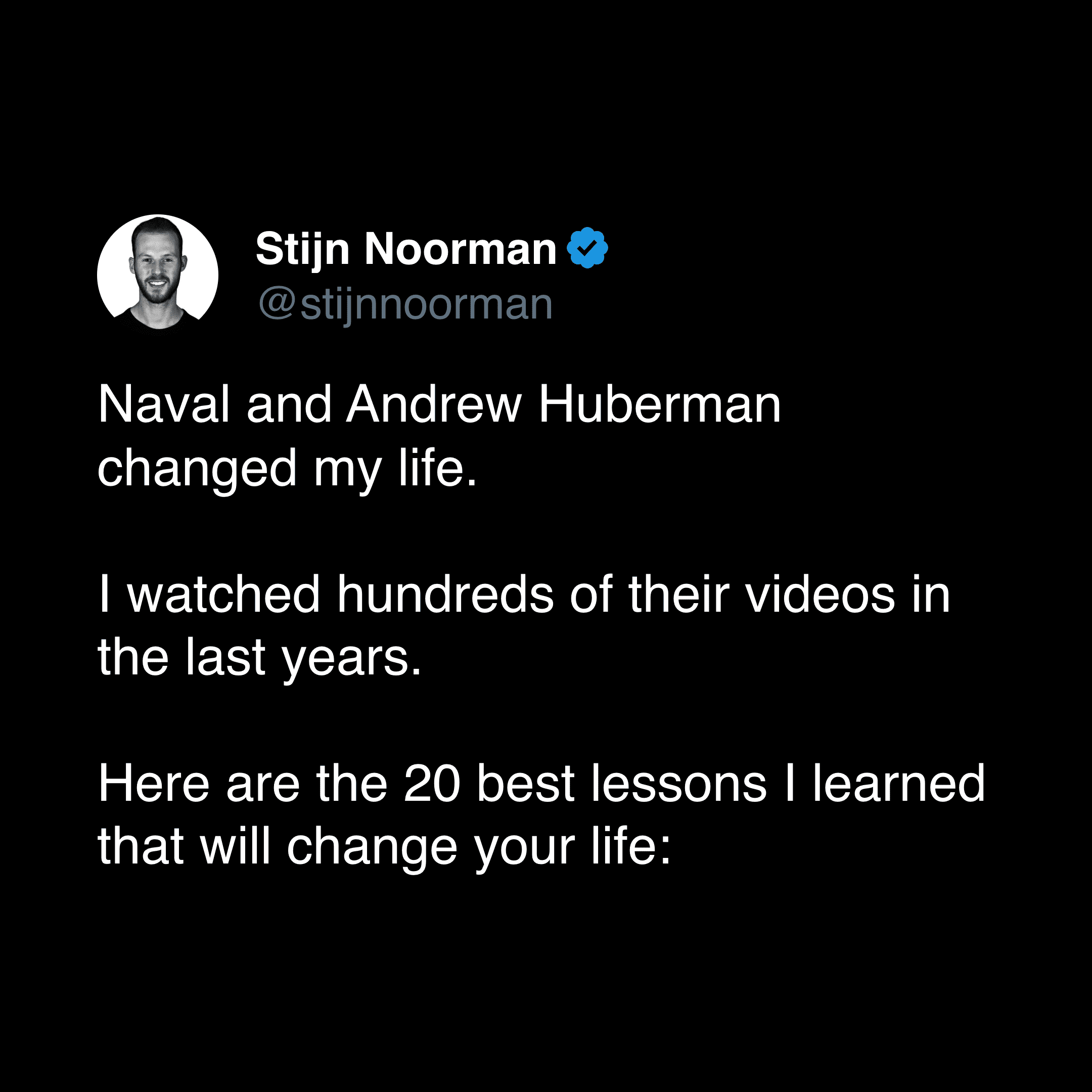
Here are 3 types of growth content that always perform well for me and my clients:
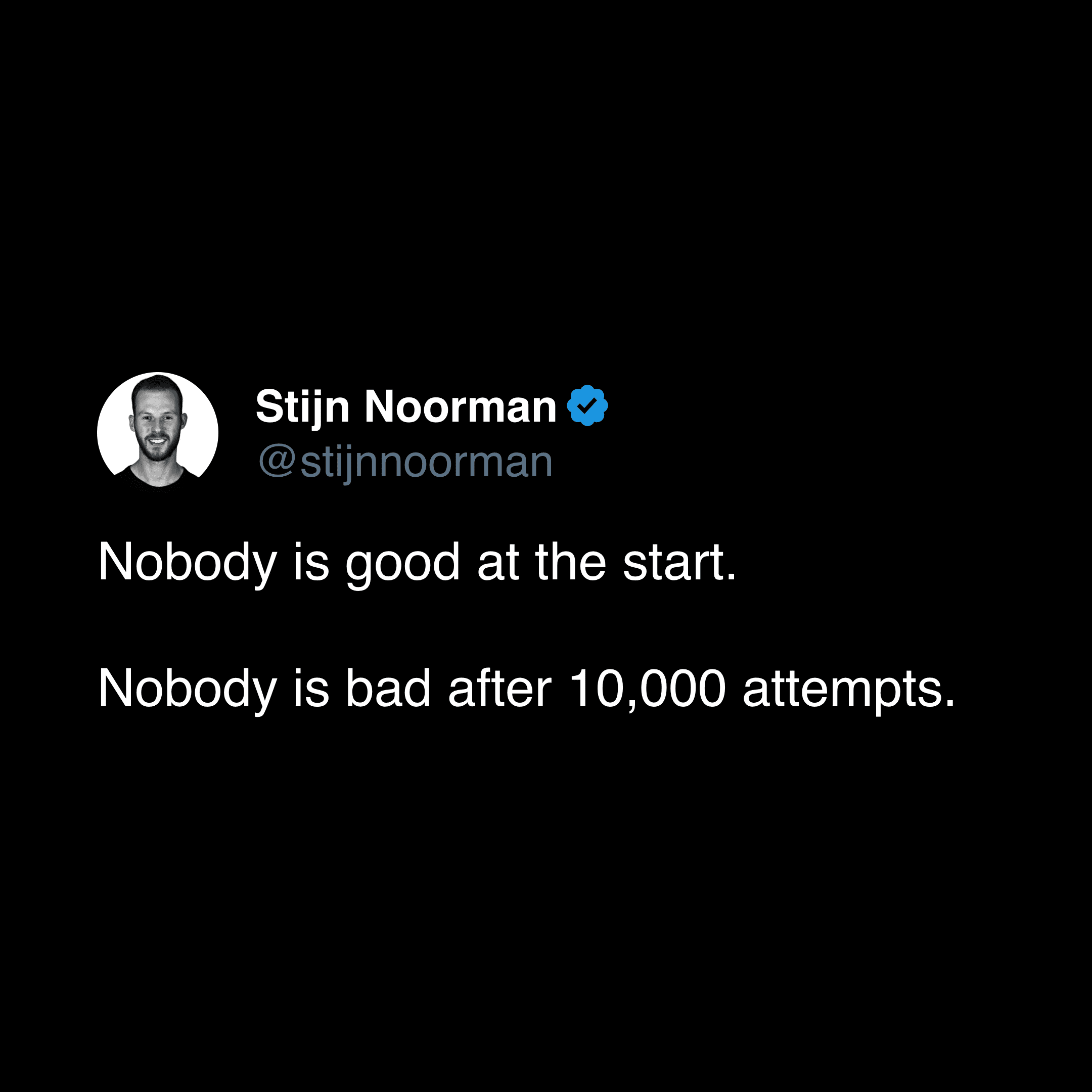
1. Contrast Posts
Contrast posts are simple two-liners. You create a contrast to make your point.
They can show the wrong vs. right focus, what works vs. what doesn’t, or any other clear comparison. I love writing these and they can be very effective for growth once you get good at them.
2. Motivational Posts
People come to social media to be entertained, educated, or inspired.
Motivational posts inspire people to keep going.
You can do this by reminding them of their goal or by empathizing with their struggles.

3. Social Hacking Posts
When you start, people don’t care about you yet. But there are certain people in your niche that they do care about.
I call these Power People. They’re popular people in your niche with good ideas.
You can borrow their authority by writing about their best ideas.
The cool part about this is that people don’t have to care about you for this to work.
They only need to care about the person you’re writing about.
This it’s one of the best growth tactics early on.
And if your post is good, the Power Person might even repost it if they see it. This happened to me multiple times and it helped me grow much faster.
Highly recommend this (especially in the beginning).
Authority Content
Authority content makes you look credible and it makes it monetization easier.
You simply show expertise and proof that you can deliver the outcome your offer promises.
Here are 3 types of authority content that consistently perform well for me and my clients:
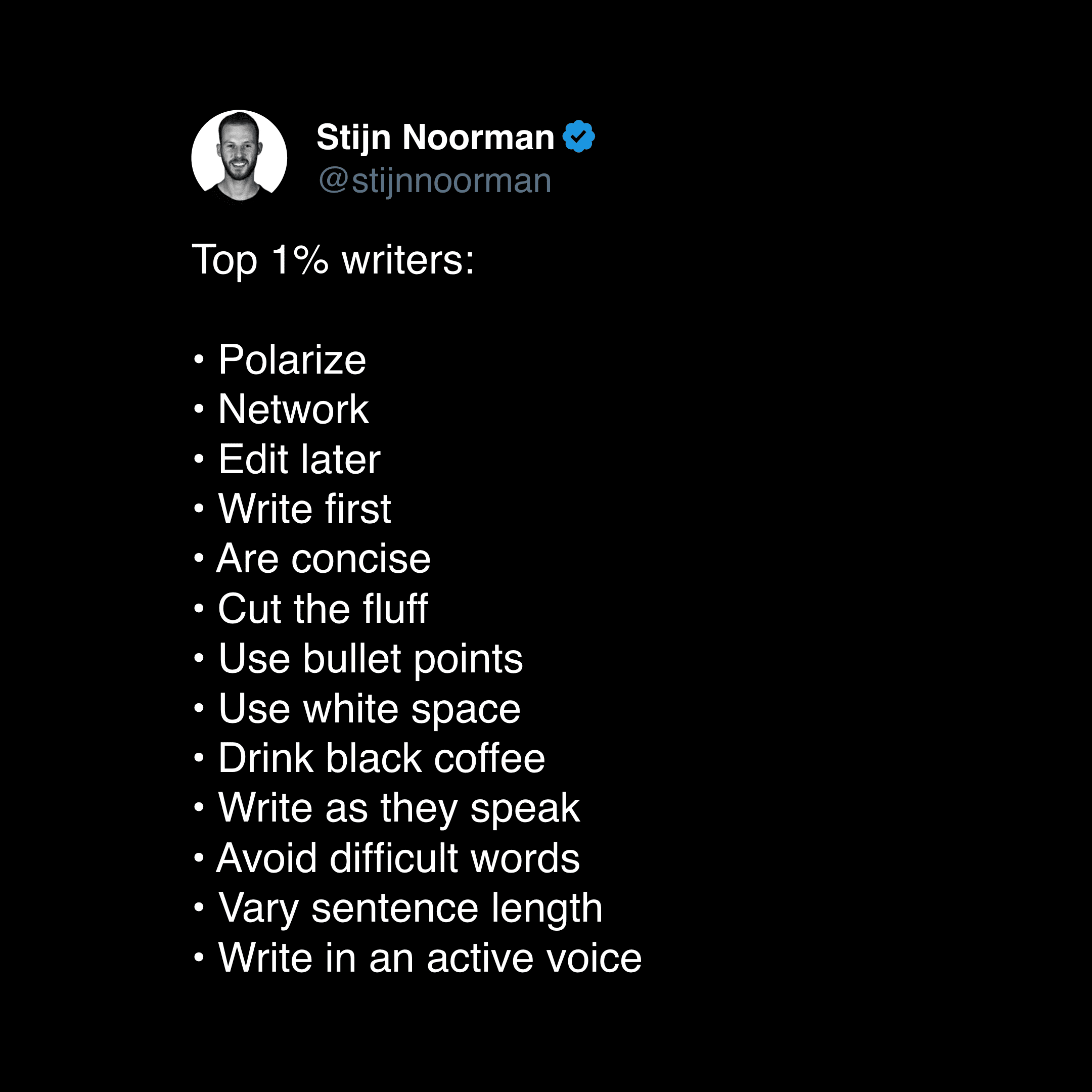
1. Educational lists
Educational lists teach people something useful.
They help your audience solve small problems that are standing in the way of them achieving their goals.
In my case, people need to learn how to write great content (which I teach in Aesthetic Writing), so a list with writing tips can do well.
Lists are great because they work well in any niche.
Fitness → list with dieting or training tips
Finance → list with saving or spending tips
Dating → list with confidence or relationship tips
The possibilities are endless.
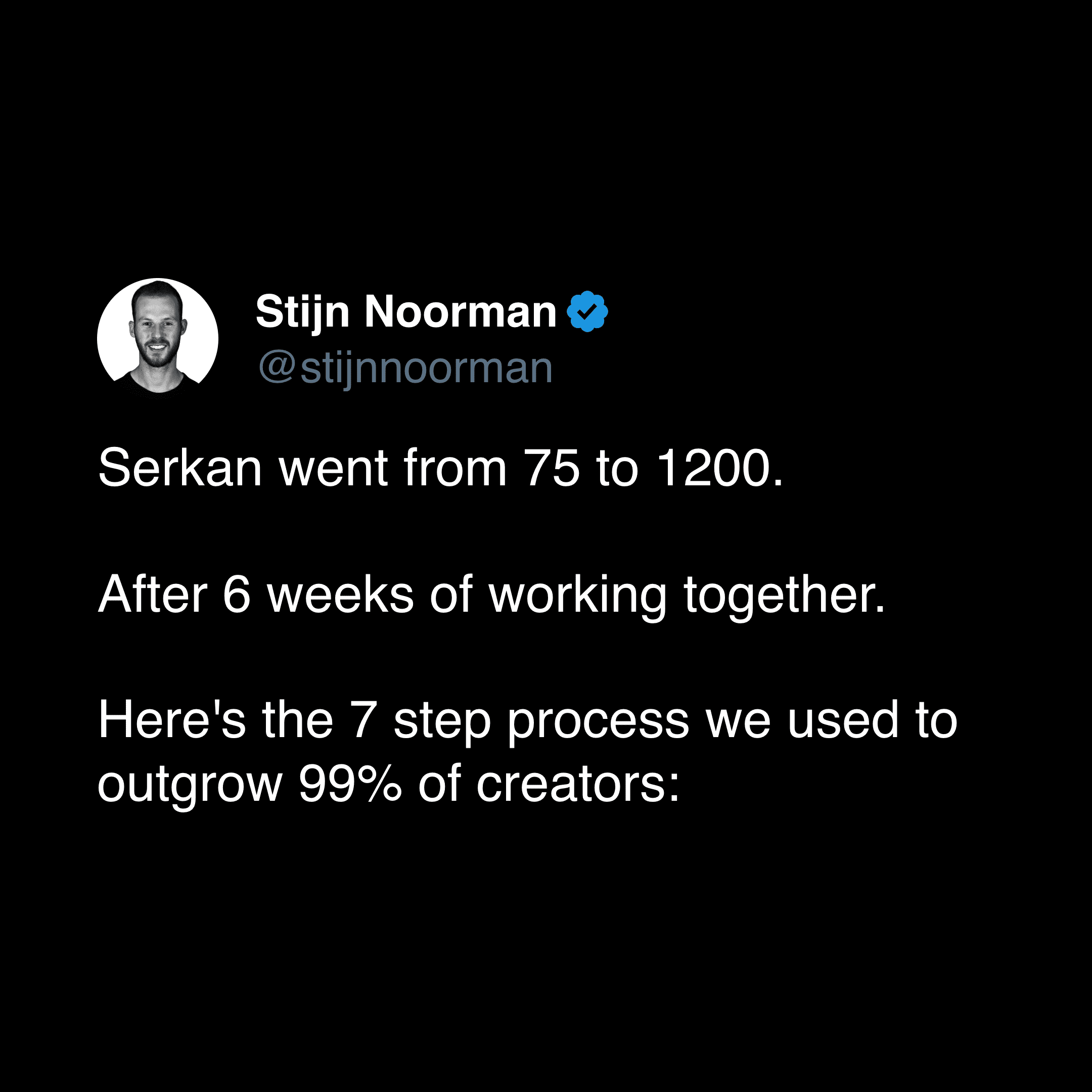
2. Case Studies
Case studies show proof that you’ve helped someone else get results.
This builds up your credibility and increases trust.
It also lets you share a simple overview of how you did it.
This educates your audience and increases the chance they become a customer if they want the same outcome.
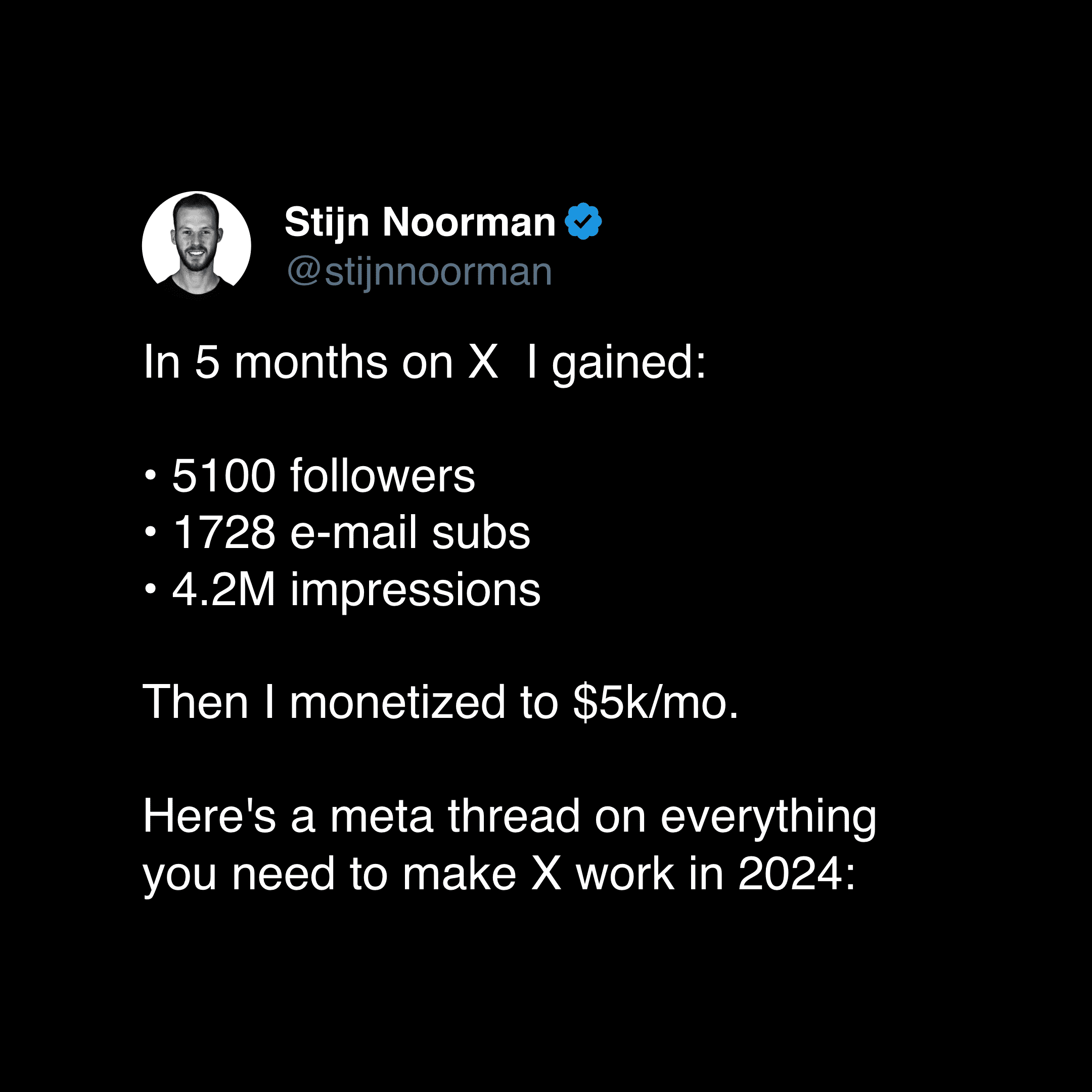
3. Personal Results
Personal results show that you achieved the outcome your audience wants.
This builds trust quickly.
If you hire a personal trainer, you don’t want them to be obese.
It’s the same in your niche.
When you show proof of your own results, your credibility goes up.
That’s it for the content. If you post these, you’ll grow your audience fast and build authority. Now let’s talk about turning those views into email subscribers.
Growing Your Newsletter
To turn views into subscribers, you use auto plugs.
An auto plug is a tweet with your newsletter or lead magnet link in it.
You post it under a relevant tweet to turn some of the traffic into subscribers.
In this example, I got 16 link clicks from one auto plug:
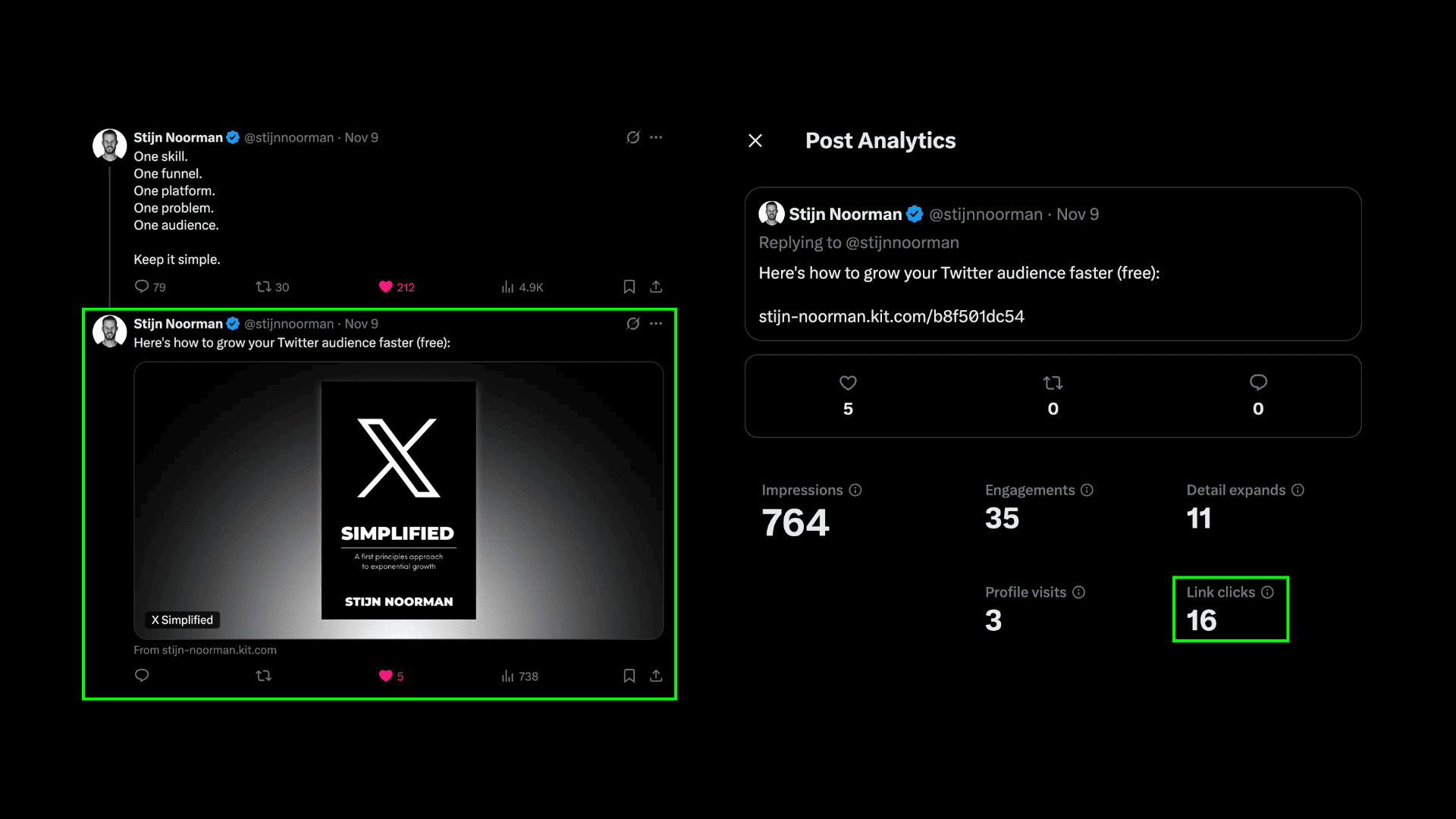
My landing page converts about 50%, so that’s 8 new subscribers from a single tweet. As your views increase, this becomes extremely powerful.
You can post plugs manually, but it’s time-consuming. I use Hypefury (aff. link) to automate the process. This saves me hours every week so I highly recommend it.
Setting it up is simple:
Write the tweet
Click on ‘autoplug’
Write your autoplug
Choose the like trigger
Turn it into a template to reuse
Test multiple versions and iterate
Here’s what it looks like:
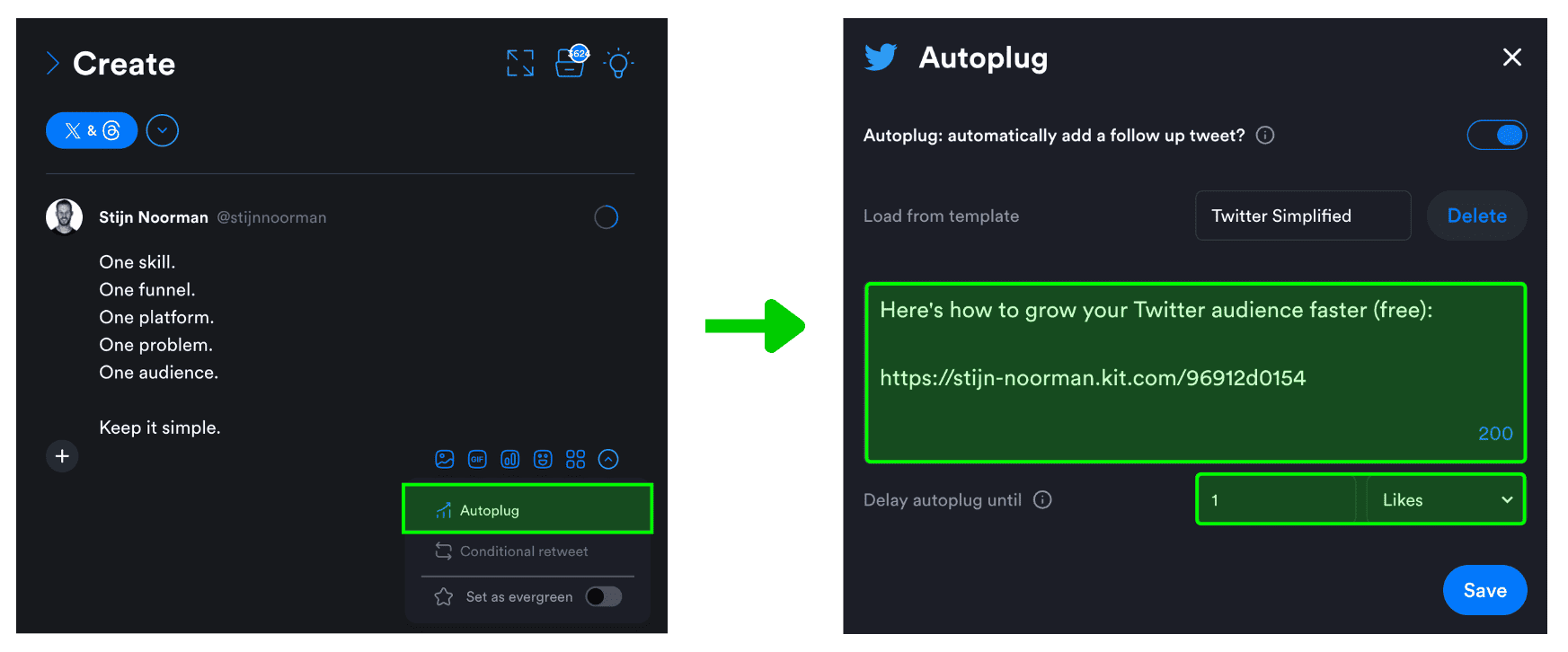
That’s how you grow your email list. Now let’s simplify how to write great emails.
The Email Reader Journey
You need to understand something I call the Email Reader Journey.
It’s the process your reader goes through when they open their inbox.
Here’s the path:
They see your subject line → so give a reason to click.
They read your intro (hook + lead) → so give a reason to read.
They decide whether to read or not → so set clear expectations.
They read the email body (value or insight) → so give valuable insights.
They see the CTA and PS and decide to buy or not → so make a clear offer.
That’s the journey. Here’s a visual to simplify it:
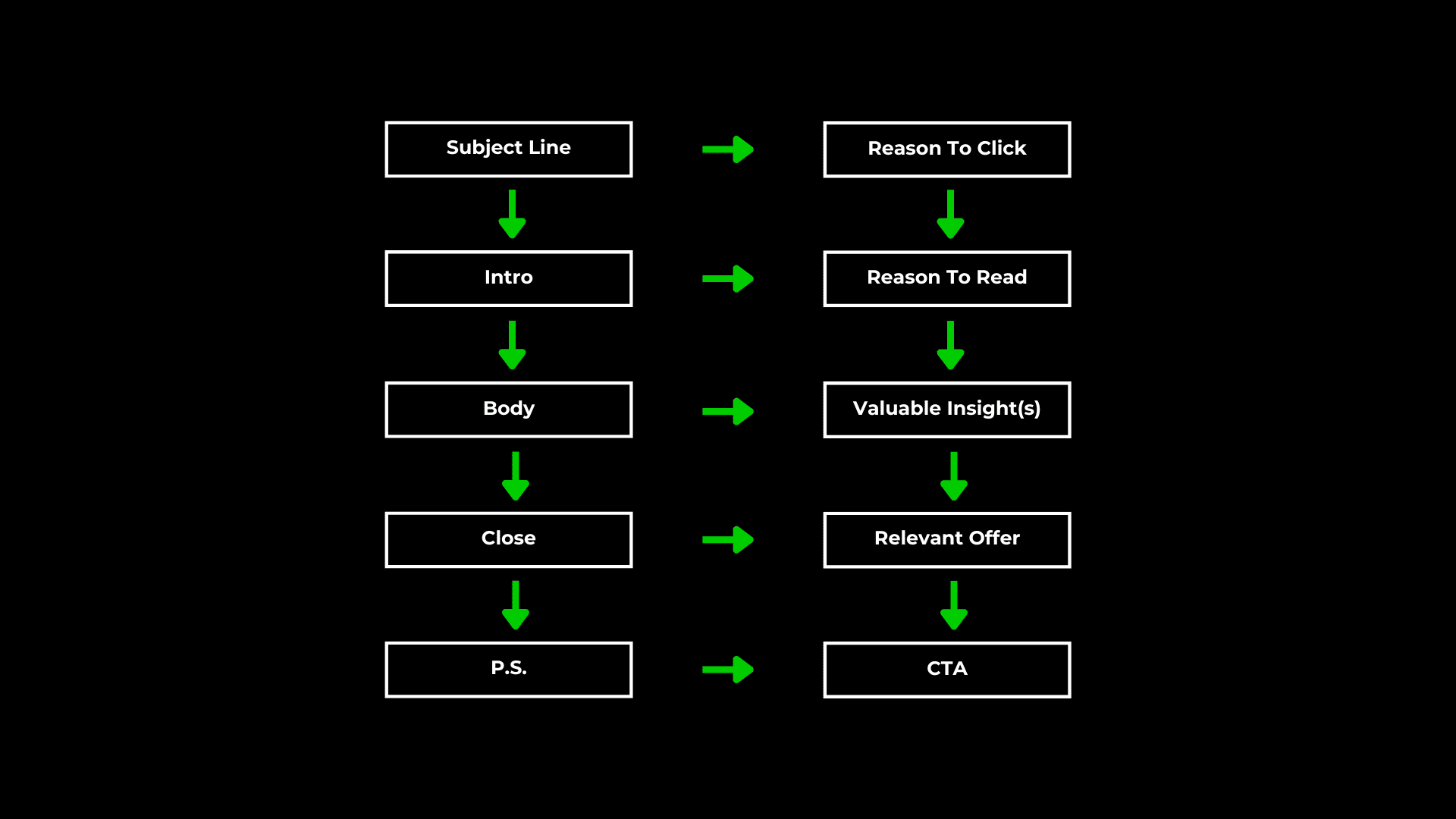
Of course there’s more to email writing (I break down the 10 best email types and much more inside the X Growth System), but this is the core.
If you optimize these steps, you’ll write emails that help people and convert.
So now you know:
How to write content that grows your audience and builds authority.
How to use auto plugs to grow your email list on autopilot.
How to write emails that grab and convert attention.
Now that you understand this, let’s talk about offers and selling.
Step 3: Strategic Selling
At the start, we talked about helping people solve problems so they can reach their desired outcome. You can do this in different ways.
Your offer can solve one problem, multiple problems, or the entire problem.
And you can deliver it in 3 ways:
Done-For-You Offers (DFY) → you do the work for them
Done-With-You Offers (DWY) → you help them to do it
Do-It-Yourself Offers (DIY) → you give the info so they can do it themselves
All three work, they just have different trade-offs:
DFY Offer → highest prices, most time-intensive
DWY Offer → high prices, scalable, less time-intensive
DIY Offer → lowest prices, infinitely scalable, requires a larger audience
Let’s simplify it with a short example. Imagine that someone wants a sales page.
You could sell them 3 types of offers:
DFY: a service where you write the entire page for them
DWY: consulting calls where you help them write it
DIY: a course that teaches them how to write it
All help them get the same outcome. The difference is the effort on their side.
The less effort and time they need to put in, the more you can charge.
I recommend that you start with the offer type that seems the most fun to you. That’s how you stay consistent long enough to make it work.
Inside my Asset Creator Model, we mainly use DWY and DFY offers. The main focus is building valuable Digital Assets that solve problems (and a bit of consulting until we have enough leverage to focus fully on just content and assets).
Why? Because these offers scale best and they fit my 100% introvert personality type:
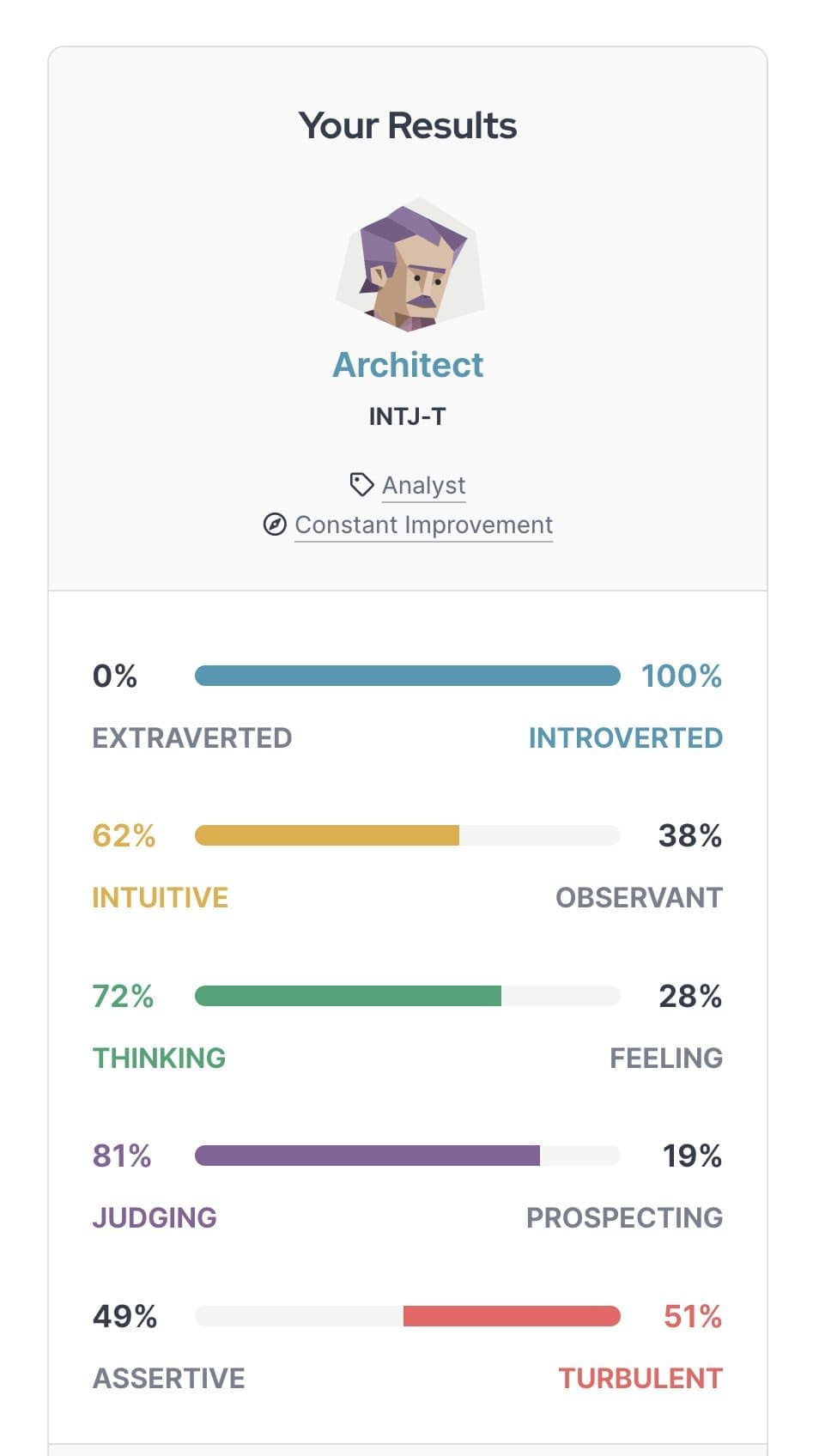
There are 3 types of offers that me and the Asset Creators use to make +$5k/mo in 2h/day without sales calls, ads, or outreach (DM me “AC” if you want more info on this 1-1 program).
We use these 3 offers:
High-Ticket Offer (HTO) → 1:1 or group consulting
Mid-Ticket Offer (MTO) → courses or cohorts
Low-Ticket Offer (LTO) → workshops or digital assets (ebooks, mini-courses)
I illustrate this with the Offer Pyramid:
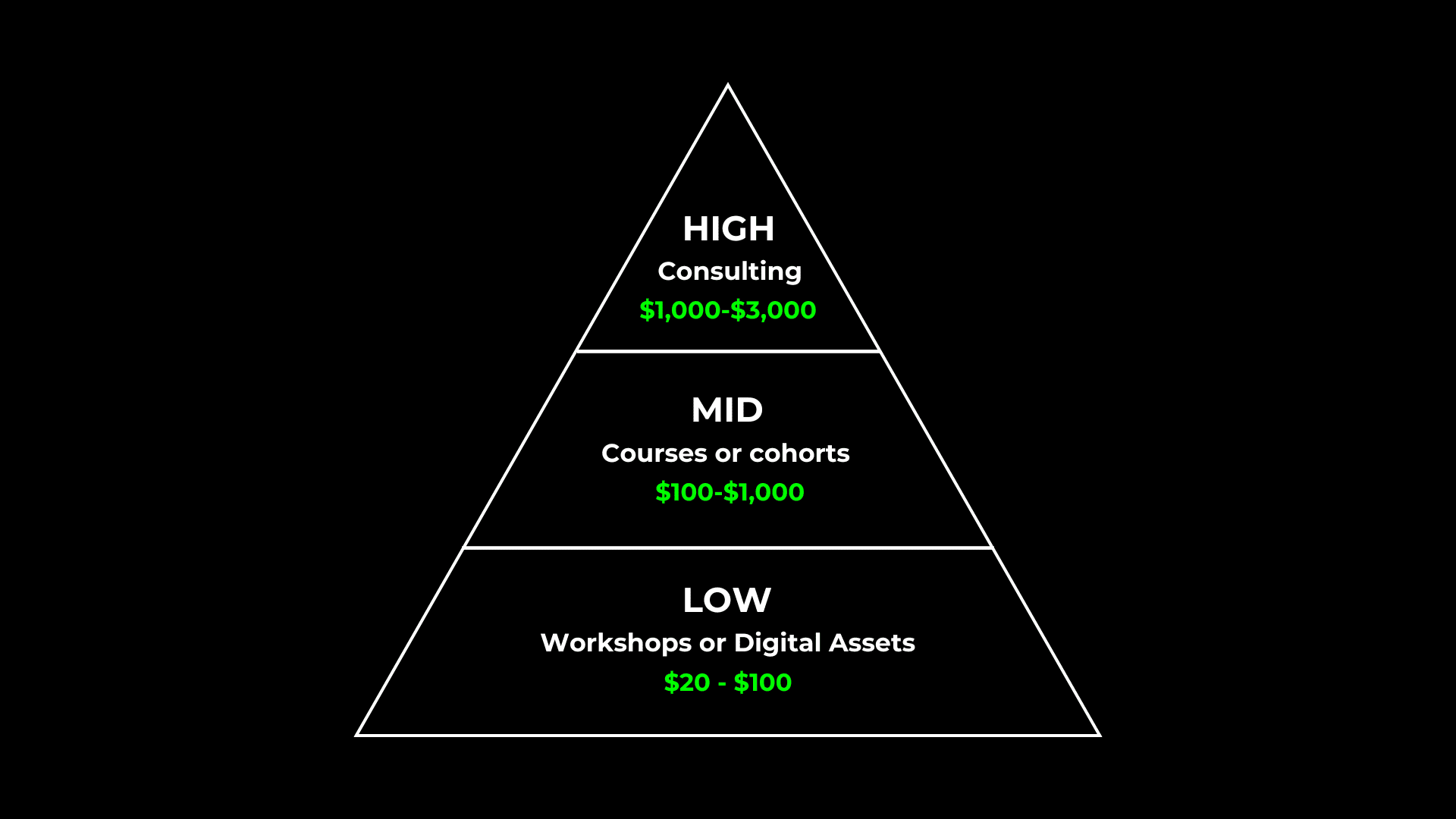
The idea is to guide them up the Offer Pyramid.
You start by selling them something small, then you massively overdeliver, and then you offer the logical next step.
You can either:
Start with one main offer that delivers the full transformation and break it into smaller offers (courses, cohorts, digital assets)
Start small and get paid to build your main program over time.
I call this the Strategic Selling System.
It gives you something to sell every week without constantly creating new products.
You simply break off a part of your program, show how it solves a problem, and sell it.
Or you create a new asset, sell it, and add it to your main program to improve it.
You get paid for what you’ve already created or you get paid to improve your program.
Win-win.
Email Selling Schedule
Here’s what your email schedule can look like:
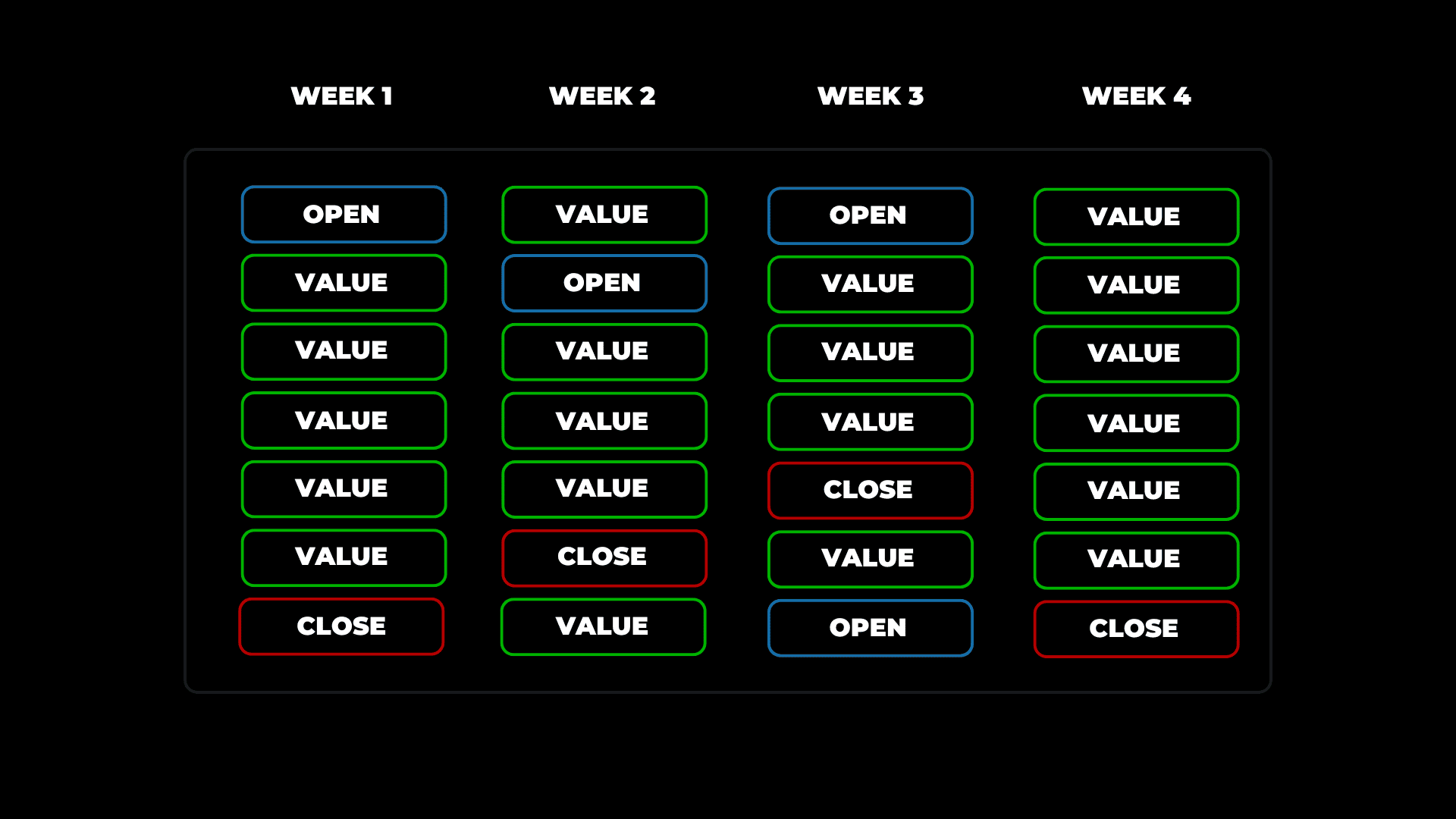
You send a valuable email almost every day. Make each email genuinely useful for your ideal customer (based on their goals and problems).
Don’t give everything away, just give one part of your system and tell them where to get the rest (like I did with the X Growth System plugs in this newsletter).
Once per week, open and close an offer. We do this because it adds urgency (and scarcity if you limit your spots). If you’re “always open,” people procrastinate.
I personally still have a few courses that are always open, but the other offers I sell always come with a deadline. There are no strict rules, do what fits you.
You also don’t need to do daily emails if you don’t want to. But if you want to get to $5k/mo asap, daily emails are highly recommended (especially since we don’t send dms and don’t do sales calls as Asset Creators).
$5k/mo Simplified
To hit $5K/month, you only need:
3 clients: 3 × $1,000 = $3,000
1 cohort: 5 × $200 = $1,000
10 digital assets: 10 × $100 = $1,000
That’s it.
You only need 15 customers and 3 clients to hit $5K/month with the Asset Creator Model.
It’s extremely simple. But I’m not saying that it’s easy.
It will take months or maybe even a year or more if you’re starting from zero.
But it worked for me and multiple clients. So I know it can work for you too.
You just need to know what to do, and stick to it long enough to see results.
If this model makes sense to you and if you want my help to implement it so you can hit +$5K/mo, DM me AC on Twitter to see if we’re a good fit.
Final Thoughts
You don’t need a complex business.
You need one clear system that works.
One offer
One funnel
One person
One problem
One platform
One outcome
Then:
Use content to grow your audience
Use auto plugs to grow your email list
Use emails to sell your offers
Master this, and you’ll never have to chase clients or algorithms again.
This is how I would get to $5K/mo asap (without sales calls, ads, or outreach).
If you want to see exactly how I use this system to grow and monetize on Twitter — check out The X Growth System (business tier).
It’s the complete system that helped me get 50,000+ Twitter followers, a 6-figure business, and 102M views in the last year.
I hope this was helpful. If it was, please like it, restack it, and subscribe to my free newsletter for more. If you do, I can spend more time on writing newsletters and give you more free value. Win-win :)
Thanks for reading and talk to you soon my friend!
Stijn Noorman
How I Can Help You
1. X Growth System: How I grew from 0 to 55K 𝕏 followers, +100M organic views in a year, and built a 6-fig creator business without sales calls, ads, and cold outreach.
2. Aesthetic Writing: Learn the best writing strategies I used to gain 70M organic impressions and 18,100 followers in only 90 days.
3. All Resources: Click here to see all my workshops, courses, and other resources (discounts ending soon).
4. Work with me 1-1. DM me ‘AC’ (or reply via email) if you want my help to build a 6-fig Asset Creator business with +50K followers and +100M organic views per year. The Asset Creator model only requires 2-4 hours per day and we focus only on content, emails, and digital assets (no cold outreach, sales calls, or sleazy tactics).
5. Free eBooks. Get my Writing and Twitter Simplified eBooks for free by subscribing to my free newsletter (you also get a bonus worksheet that will help you to build a unique personal brand on social media). If you’re already a subscriber and haven’t received these yet, reply ‘ebooks’ to this email and I’ll send them to you:
That was pure value thanks for sharing
Your Emails are usually the best. 100/10 value. I’m obsessed 🔥. Get straight to the point leaves you with an action plan to implement.