

The video version of this newsletter in case you prefer that:
In 2023, I quit Twitter after 3 months of almost no growth.
I posted 3–10 times a day
I gave away my best insights
But nothing worked
I only gained 183 followers.
Meanwhile, people with “worse” content were growing fast.
It didn’t make sense.
I was frustrated and felt like I was wasting my time.
So I quit.
But 6 months later I logged in again.
Those same creators had hit 10K followers and $10K/month.
That’s when I realized the truth:
Twitter wasn’t the problem — I was.
My content and strategy weren’t as good as I thought.
So I put my ego aside and started again.
4 months later, I had 2,000 followers.
2 years later, I had 50,000 followers.
Now I make a full-time income as a creator and have helped 85+ clients and 1,250+ customers to grow their audience faster and make more money from it.
I’ve also gained 7,600+ email subscribers and more than 85,000+ followers across social media (Twitter, LinkedIn, YouTube, Substack, Instagram, and Threads).
I’m by no means the biggest or richest creator, but I’ve obsessed over content creation for the past few years so I’ve definitely learned some useful insights.
So in this newsletter, I’ll share the 8 biggest reasons why people don’t grow on social media and how to fix them, so that you can grow much faster.
I’m often using Twitter as an example (because that’s what I currently know the most about), but in my experience, the same principles apply to all other writing platforms as well. So when I say ‘Twitter’ or ‘tweets’ you can assume that it applies to other writing platforms as well. With that out of the way, let’s get started.
Mistake #1: Not understanding how growth works
When I started out, I thought I growth was simple:
“Just make the best content possible. Everything else will take care of itself.”
— MrBeast
So that’s what I did. But I didn’t grow.
The worst part was that people with ‘bad content’ did.
It made no sense to me — until I joined a social media growth cohort.
That’s when I learned about something that I call the Follower Funnel:
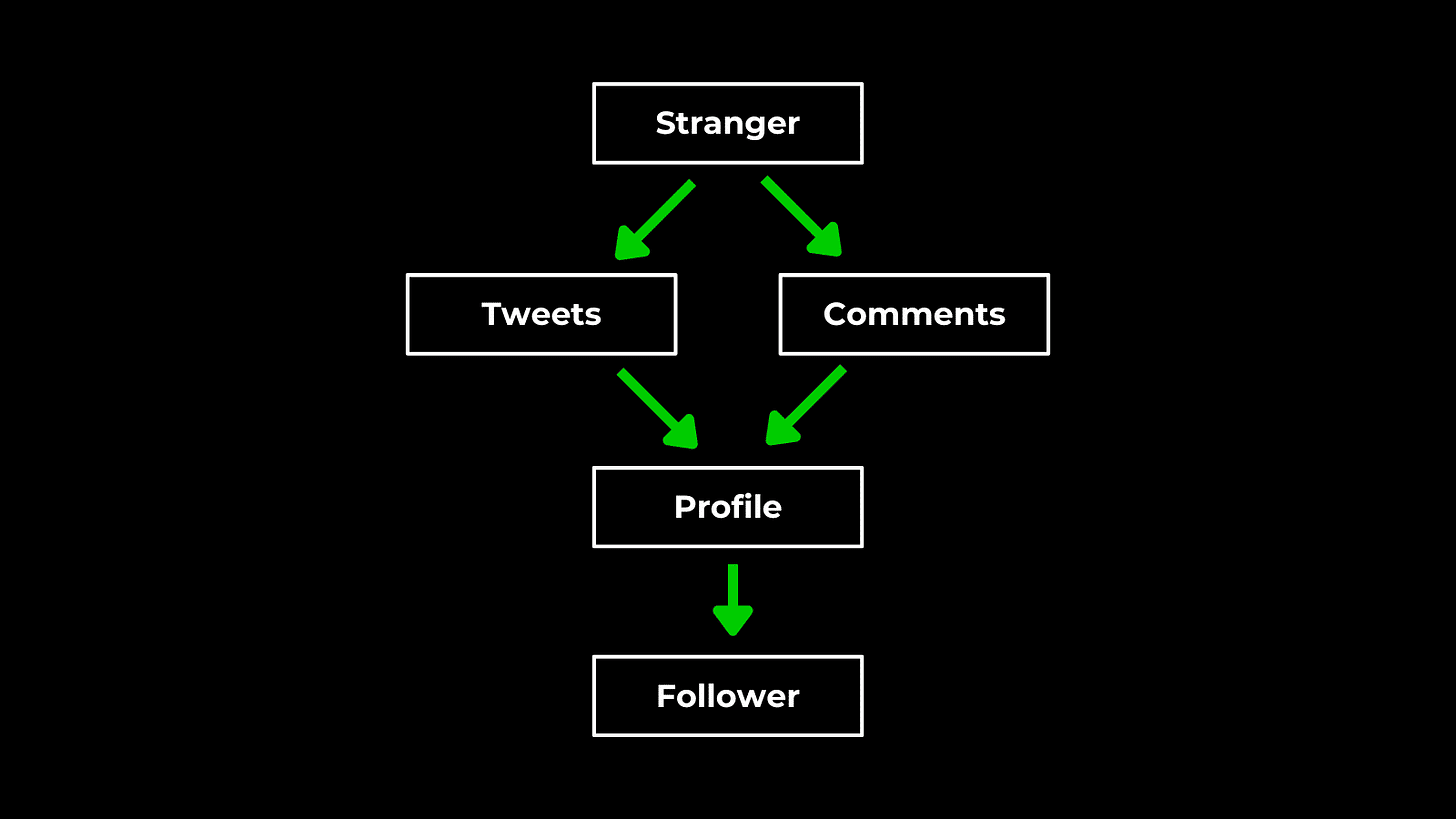
To grow, people must first see you — then click you — then follow you.
But at the start, Twitter, and other social media platforms, barely push your posts. So you can’t just rely on great content. You have to force eyes on your work through:
DMs → profile clicks → followers.
Comments → profile clicks → followers.
Shares → impressions → profile clicks → followers.
You need these things to get the ball rolling. As your audience gets bigger, you gain more impressions and you’ll have to depend less on these tactics. The quote from
So yes, great content matters a lot.
But early on, growth tactics also matter a lot.
You need both if you want to grow fast.
In short:
Content + Comments + DMs→ Profile Clicks → Optimized Profile → Followers.
Optimize these and you’ll finally grow (check out the X Growth System to learn how).
Mistake #2: Not using tools
When I started out, I did everything manually.
Posting multiple times a day.
Reposting and un-reposting all my tweets.
Plugging my newsletter and lead magnet under my posts.
It was exhausting.
I was always thinking about what needed to be done next.
Then I found Hypefury (aff) - a scheduling tool for social media.
Twitter is the main focus, but it also lets you schedule content on LinkedIn, Threads, Instagram, and TikTok.
I know the CEO and when I asked him if he’d be willing to add Substack too, he said that they definitely consider it if the demand is there (which I’m assuming will be soon since Substack is growing rapidly).
I mainly use Hypefury for:
Schedule tweets, threads, and long-forms
Post to LinkedIn, Threads, and Instagram
Plug your newsletter and lead magnets
Auto-repost and auto un-post
Run DM campaigns
Much more
I’m a minimalistic user, but it saves me hours every week so I can highly recommend using it.
Mistake #3: Not making a good first impression
Imagine you’re scrolling on social media and you see two identical posts.
One comes from a faceless account. The other from a clean, verified profile.
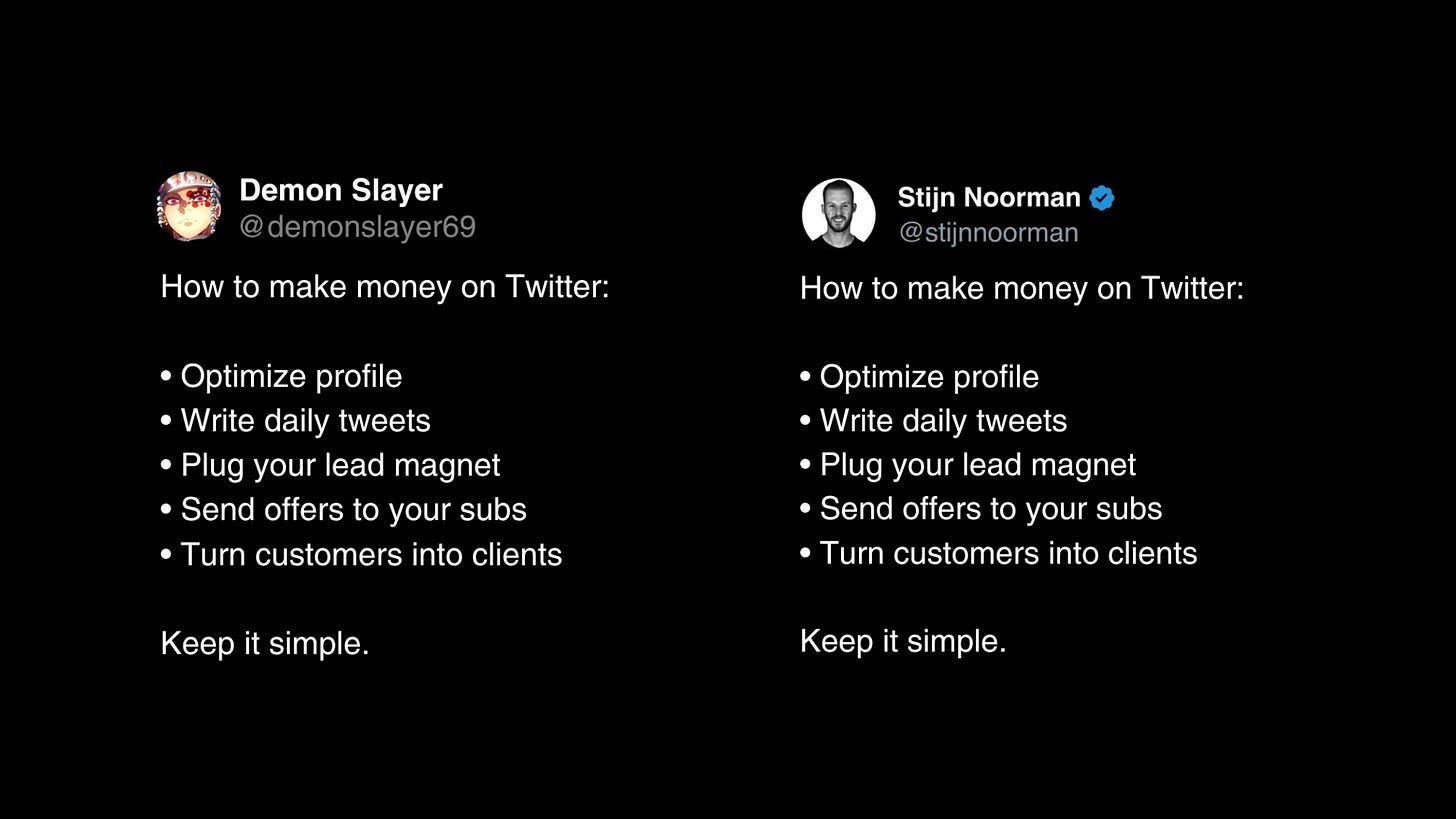
Which one looks more serious?
Exactly.
The post is the same — but the impression isn’t.
And first impressions decide whether people click or scroll.
On social media, you make a good first impression with:
A blue tick
A clear profile picture
A professional name (real or brand)
These are the first things people notice — often before they read your post.
So optimize them.
Get verified
Use a clean headshot
Add your brand colors
The goal is to look like someone with 100,000 followers — even before you have them.
The blue tick isn’t just for show on Twitter. It also gives you:
50% fewer ads
Edit & undo tweets
Access to monetization
Higher ranking in replies
Early access to new features
Longer videos (up to 2 hours)
Longer posts (articles & long-forms)
If you’re serious about growth, it’s worth it.
I’m 2 years in and I make my blue tick investment back with just 2 weeks of ad revenue that I get from writing tweets.
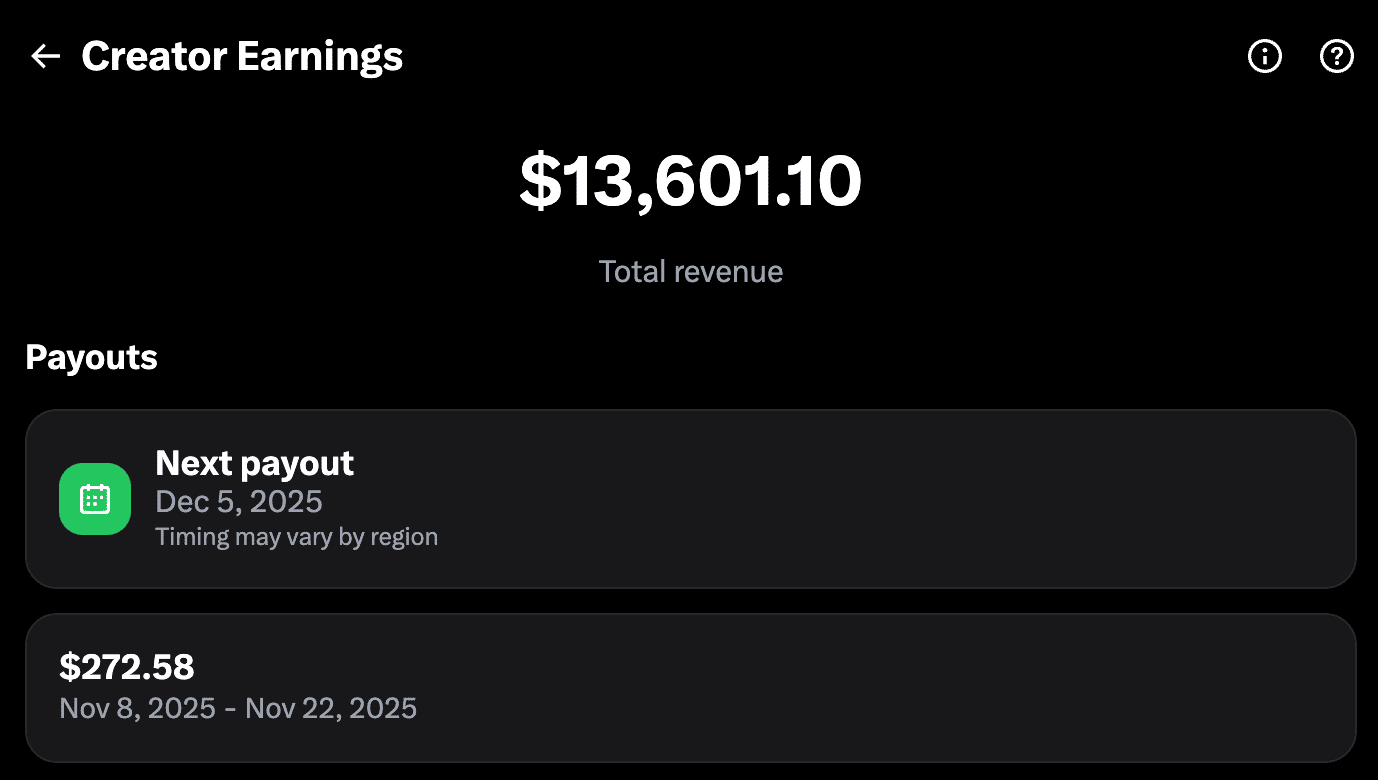
Your CV gets you job opportunities.
Your Creator CV (profile) gets you followers and customers.
So make sure you present yourself well.
Mistake #4: Unclear profile
When I started, I thought my profile looked great:
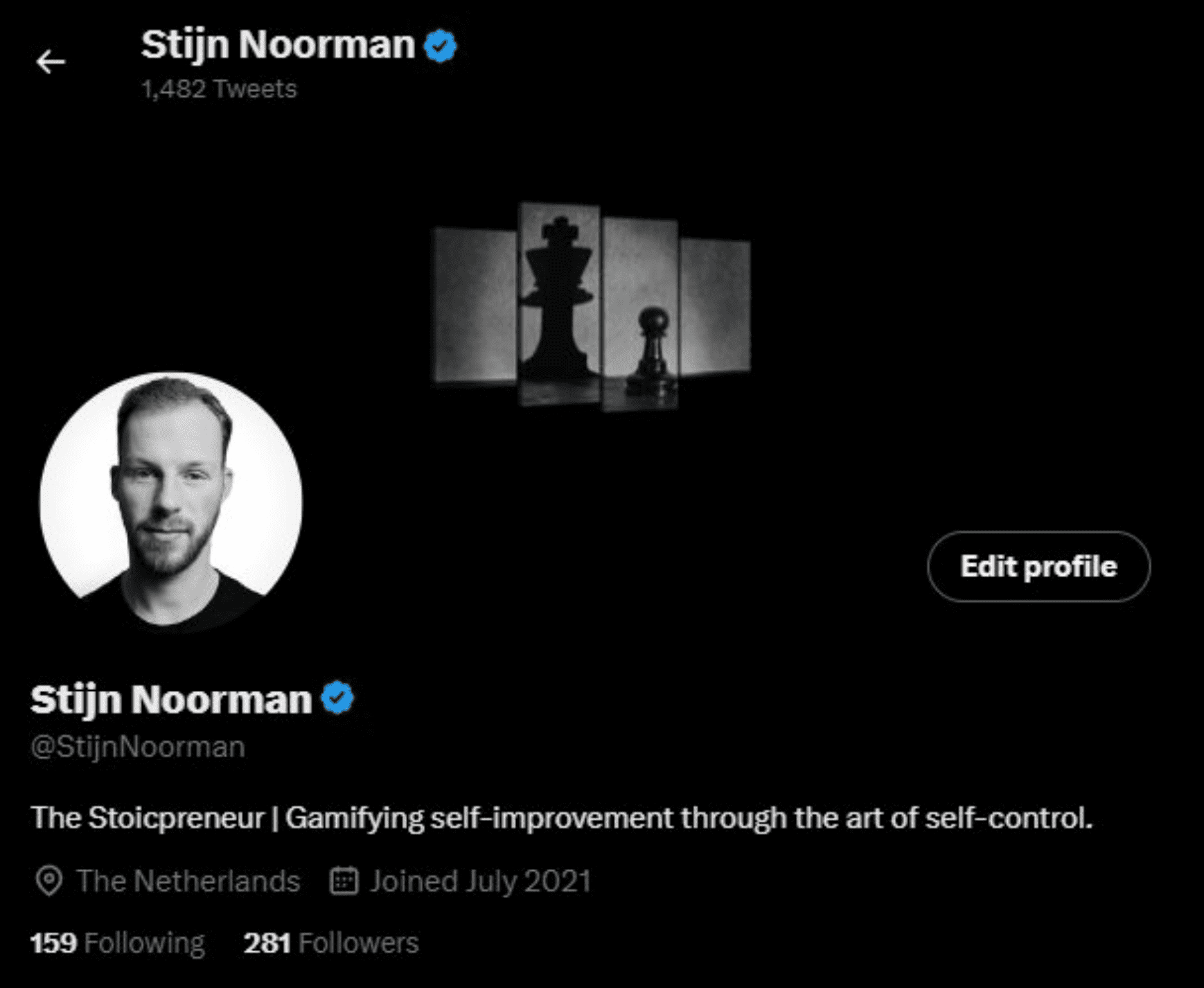
Now I don’t.
It was messy, vague, cringe, and confusing — like most beginner profiles.
And my profile conversion rate showed it: just 5% (10%+ is good.) This means that I only got 5 new followers for every 100 people that clicked on my profile.
The biggest reason?
It wasn’t clear what I actually did.
People only follow if they understand how it benefits them.
So your profile must instantly answer three questions:
What do you do?
Who do you help?
How do you help them?
That’s your value proposition.
Here’s what that can look like:
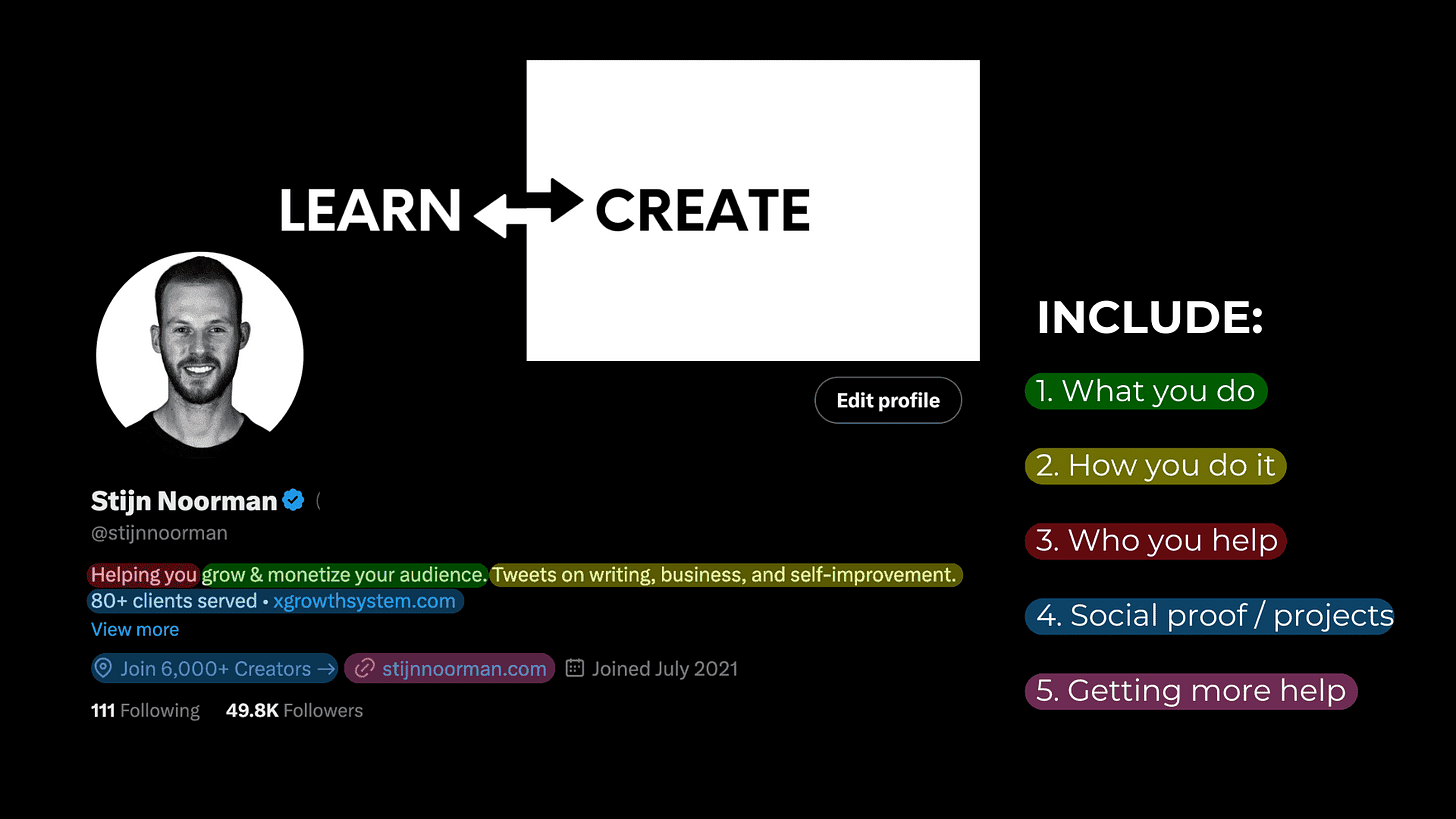
This bio isn’t perfect, and I will change it again in the future, but it’s clear enough.
If you include these 5 elements, people will understand what you do and why it matters to them, so they’ll be more likely to follow you.
Clarity converts.
Mistake #5: Playing in single-player mode
When I started, I had a single-player mindset.
I just wanted to post content and grow.
But this isn’t how it works at the start.
Especially on writing platforms like Twitter, LinkedIn, and Substack.
Unless you already have a network that can share your content, you need to play in multi-player mode first.
That means engaging:
DMs
Replies
Comments
At the start, comments matter most. They’re how you force eyes on your content.
The fastest-growing small creators leave 50–100 comments per day.
Most people will complain that this is a lot of work.
But smart people will understand that it’s great because it actually gives you control over your growth (unlike other platforms).
A single good comment can reach thousands.
One of mine hit 18K impressions and 213 profile visits:
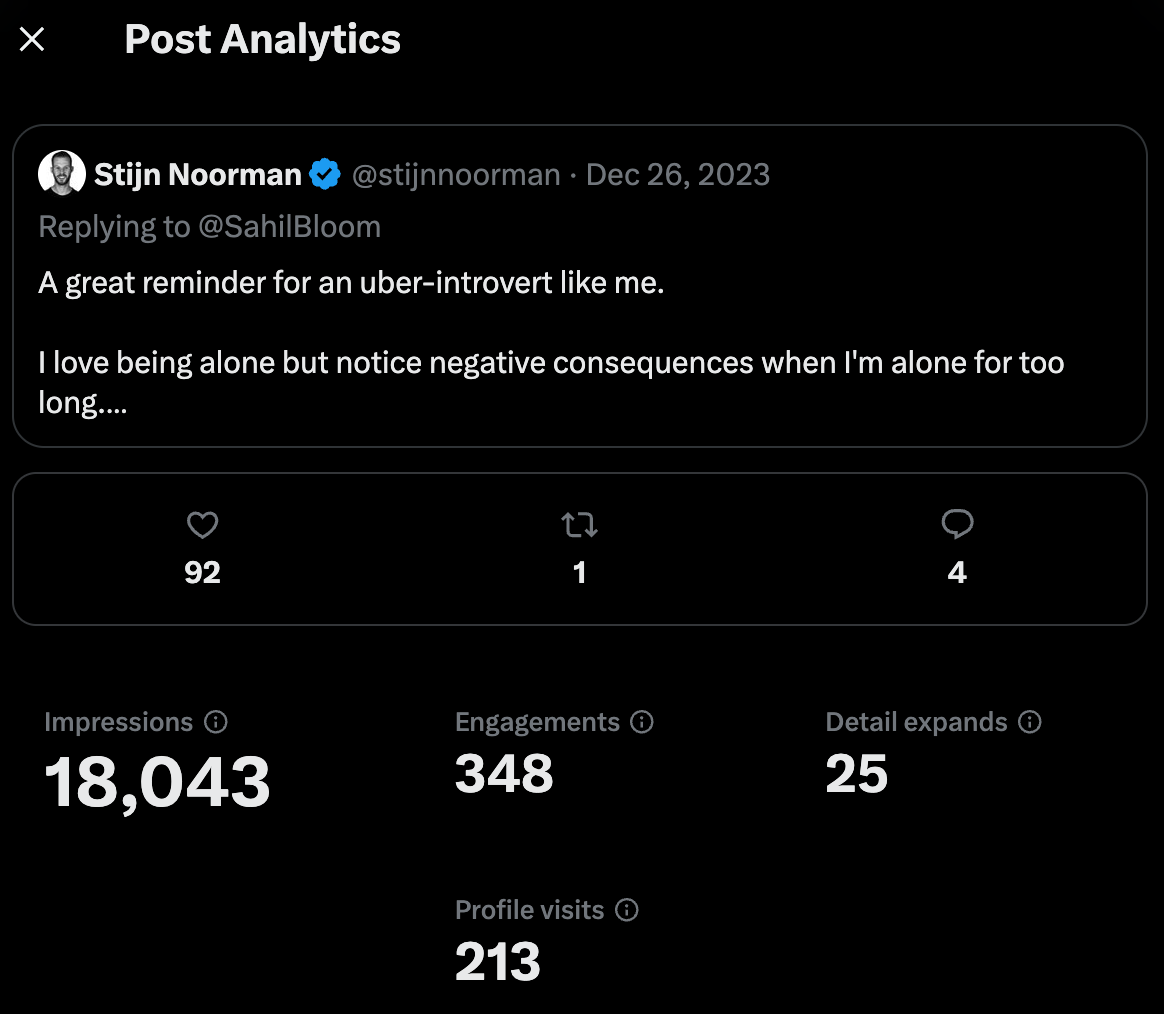
If you optimize your profile, your conversion rate will be 10% or higher.
So that means a comment like this will get you 21 new followers.
You can check your profile conversion rate on Twitter with a tool called BlackMagic:
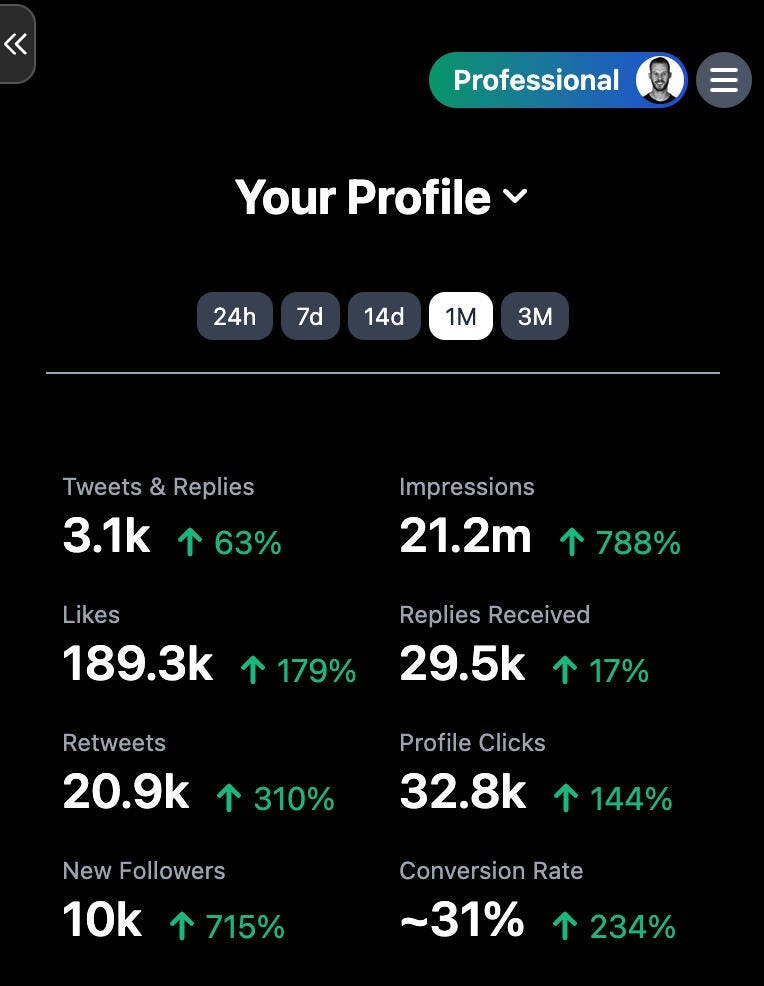
Not all comments will do as well as the one above.
But every comment you leave is like a ‘mini-post’ that can get you new followers.
Aim for 50 thoughtful comments per day if you can.
It’s the fastest way to build momentum early on.
If you want to learn which comments actually drive growth — and leave 50+ comments in 30min per day instead of 2+ hours — check out the X Growth System.
Mistake #6: Trying to sound smart
Most creators make simple ideas sound complex.
Great creators make complex ideas sound simple.
You don’t need complexity. You need simplicity with depth.
“Simplicity is the ultimate sophistication.”
— Leonardo da Vinci
Your job isn’t to sound smart.
It’s to make the reader feel smart.
And you make the reader feel smart by communicating valuable ideas in a simple way.
The simpler your writing, the easier it is to understand, and the faster you grow.
“If you can’t explain it to a six-year-old, you don’t understand it yourself.”
— Albert Einstein
So keep your writing simple and concise:
Simple so people understand it
Concise so people actually read it
You can use Chat GPT or Hemingway for this.
I’m not a fan of letting AI write for you. But I think it’s useful for editing your writing.
Write the draft yourself.
Then paste it into Hemingway or Chat GPT.
Hemingway helps to:
Improve grammar
Replace complex words
Make your sentences more concise
Replace weak words with strong ones
Shows the readability level of your content
I don’t use it a lot but it can be useful.
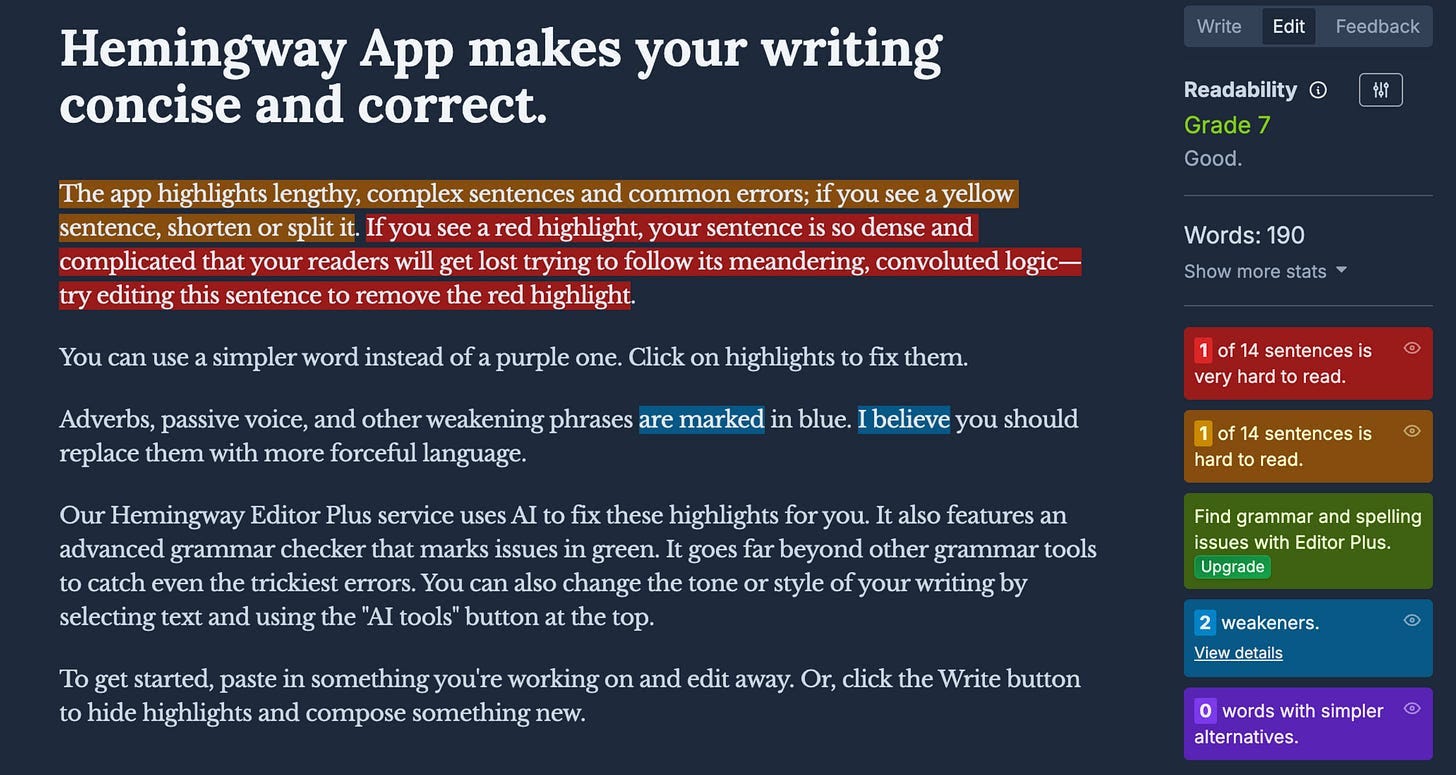
I prefer to use Chat GPT.
I write everything myself but I ask it for specific feedback once I’m done with writing.
For example: “rewrite this sentence in a simple and concise way”.
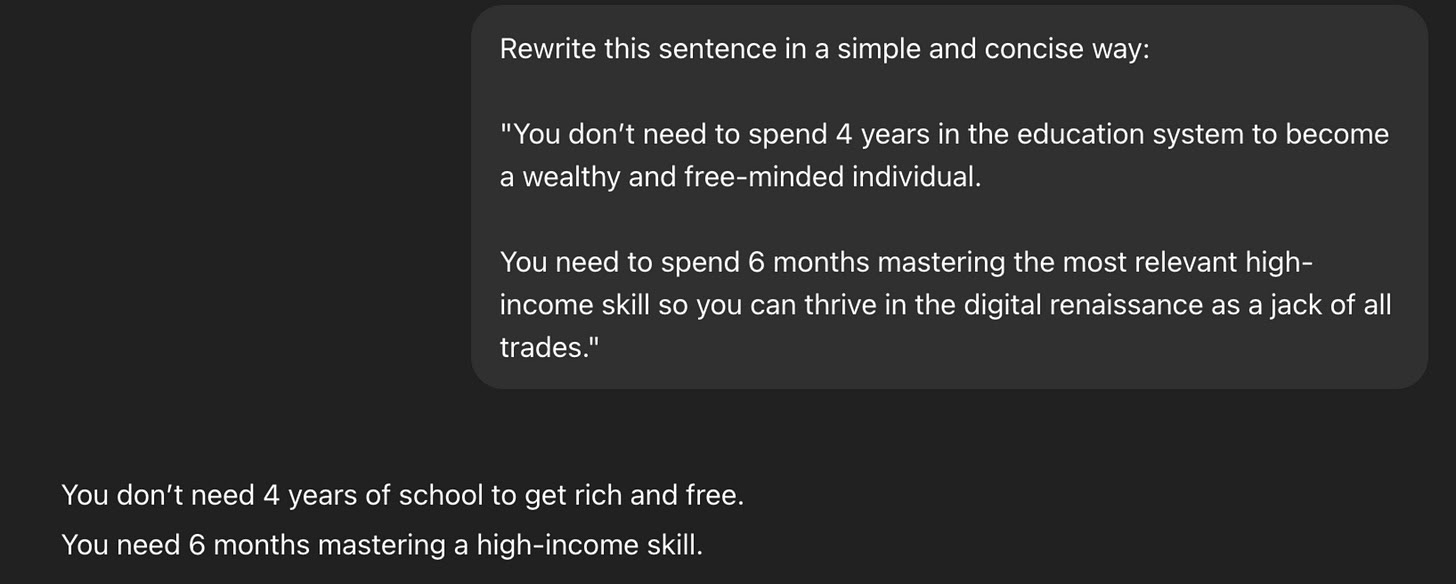
Use their suggestions but never blindly copy them.
AI is an assistant, you are the author.
You decide what stays.
Mistake #7: Ignoring Aesthetic Writing
Writing is like dating — the inside and outside both matter.
In dating, it’s personality and appearance.
In writing, it’s ideas and formatting.
You can have the best ideas in the world but if your writing looks bad, most people will scroll past it before they ever read it.
Big creators can get away with that (just like celebrities can get away with being overweight).
But you can’t. You need good formatting to grab and hold attention.
That’s why you need Aesthetic Writing.
It’s about making your content easy to read and understand.
It’s like a well-edited video, it keeps people engaged.
There’s a lot you can do for this, but here are a few examples:
Repetition for rhythm
Bullet points for clarity
Stairways to improve flow
White space to make it digestible
Write as you speak for readability
Varying your sentence length is also powerful:
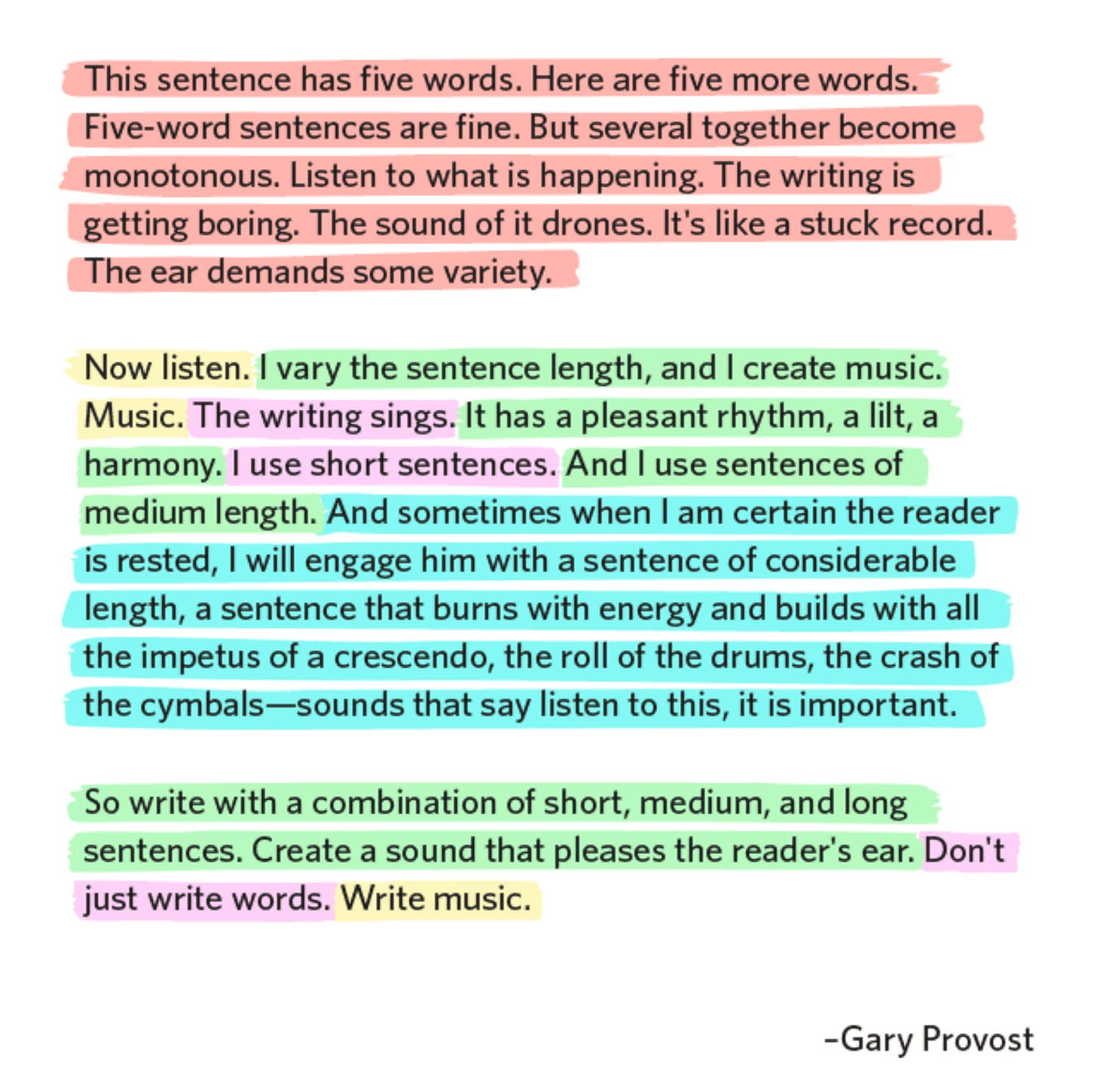
It improves the rhythm, appearance, and flow of your writing.
Great writing isn’t just what you say.
It’s also how it sounds, feels, and looks.
Don’t write like a robot.
Write like a musician.
For more, check out Aesthetic Writing for all my best writing strategies.
Mistake #8: Trying to reinvent the wheel
When I started, I tried to figure everything out myself.
And it cost me months of progress.
Thinking for yourself is good.
But at the start, it’s smarter to look at what works for creators that you like, and make it your own.
Think of it like a buffet.
You don’t take everything.
You only take what fits your taste.
“Adapt what is useful, reject what is useless, and add what is specifically your own.”
— Bruce Lee
You can for example:
Take the brand colors of Creator A
Take the content topics of Creator B
Take the design style of Creator C
Then fuse them with your own ideas, style, stories, and personality.
I call this Artistic Alchemy. You fuse what works with what’s yours to create something that’s proven to work but also original and authentic to you.
“Stealing from one source is plagiarism; stealing from many is research.”
— Wilson Mizner
Don’t copy like a fool.
Steal like an artist.
Then create like an alchemist.
Combine your best ideas with the best that you’ve learned from others.
In Short:
Understand how growth works (comments → content → profile → followers)
Use tools to schedule content (Hypefury)
Make a strong first impression (clear photo, blue tick, real name)
Clarify your profile: who you help, what you help with, and how you help.
Play in multi-player mode (comments, replies, DMs)
Keep your writing simple and concise
Use Aesthetic Writing to grab and hold attention with your writing formatting
Don’t reinvent the wheel — steal like an artist, create like an alchemist
Hope this was helpful.
If you enjoyed it, please like it, share/restack it, and subscribe to this free newsletter for more.
Talk soon my friend,
Stijn Noorman
PS: I turn my newsletters into videos in case you prefer watching/listening over reading. Click here to watch the latest ones (free).
How I Can Help You
1. X Growth System: How I grew from 0 to 55K 𝕏 followers, +100M organic views in a year, and built a 6-fig creator business without sales calls, ads, and cold outreach.
2. Aesthetic Writing: Learn the best writing strategies I used to gain 70M organic impressions and 18,100 followers in only 90 days.
3. All Resources: Click here to see all my workshops, courses, and other resources (discounts ending soon).
4. Work with me 1-1. DM me ‘AC’ (or reply via email) if you want my help to build a 6-fig Asset Creator business with +50K followers and +100M organic views per year. The Asset Creator model only requires 2-4 hours per day and we focus only on content, emails, and digital assets (no cold outreach, sales calls, or sleazy tactics).
5. Free eBooks. Get my Writing and Twitter Simplified eBooks for free by subscribing to my free newsletter (you also get a bonus worksheet that will help you to build a unique personal brand on social media). If you’re already a subscriber and haven’t received these yet, reply ‘ebooks’ to this email and I’ll send them to you:
Well, this was quite interesting and surprisingly even contained some useful tips, which usually articles speaking first three paragraphs about how successful you are usually don´t. So yeah, thanks:)
Thank you for this clear blueprint (the color coding was a nice touch haha). I will taking your advice when I modify my Creator CV.
Would you recommend expanding my brand to Twitter, or Medium, for maximum exposure to my writing? Or building my homepage on here first?